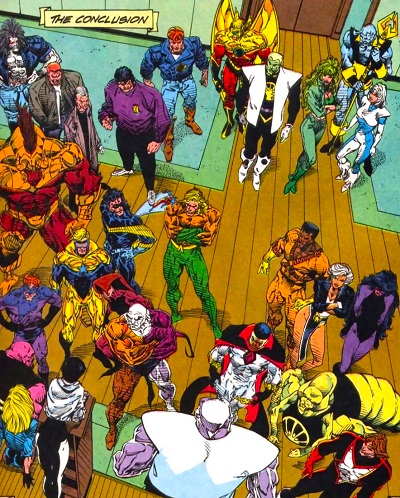
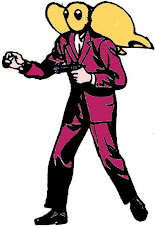
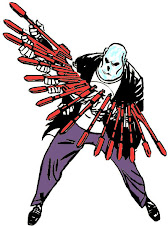
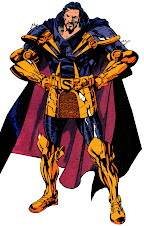
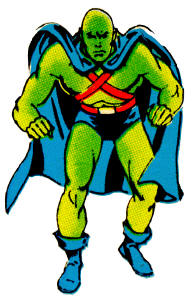
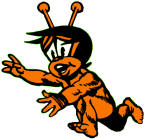
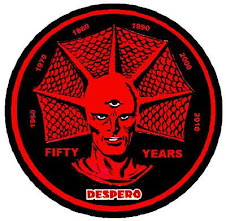
With commission rates skyrocketing and my interest in paying them for corporate-owned characters plummeting, you might be surprised to see that I actually have some brand new art to show off on this blog. This piece offers remedies. Firstly, I'd still kind of like to complete a set of Hyperclan spotlight pieces, but it especially bugged me that I hadn't gotten any of the female members. Heck, Primaid's the second best known member. I mean, I have an Armek because Rick Hoberg wanted to draw a mech, and an A-Mortal because the dude sitting with Tim Vigil did good Halloween stuff. Only Primaid and Protex were in the second big White Martian story arc and fought a member of the DC Trinity. Plus, she just looks cool, and can rarely by seen in full figure on the comics page.
The other motivator was that despite maintaining a career since the '90s on heavy-hitting properties like The Flash, Batgirl, Masters of the Universe, Raven: Daughter of Darkness, Ghost Rider, and a mini-series of The Demon, Pop Mhan still charges perfectly reasonable rates for high quality work. I've dug him since at least The Impulse/Atom Double Shot in '98, plus he co-created Spyboy with the late, great Peter David. He was also a cool guy who talked about the demands of the licensing work that he's been doing more heavily in recent years. He's work on another creator-owned project that he's developing, a sort of younger readers Hellboy, and I hope to see that come to fruition.
More Art Monday
Showing posts with label 1990s. Show all posts
Monday, October 6, 2025
Thursday, September 18, 2025
JLX #1 (April, 1996)
In my write-up for Amazon #1 (April, 1996), I went into a lot of detail about how the Amalgam Comics characters were not always, or even often, equally divided portions of two characters combined. Mister X is a perfect example of this, because he's almost wholly the Martian Manhunter, but combined with... stuff. The simplest equation is J'Onn J'Onzz + Professor X, which is truer of the sequel comic, 1997's JLX Unleashed #1, but still not. You see, Charles Xavier already had a much more important role in the Amalgam Comics scheme, Doctor StrangeFate. Marco Xavier is the X in Mr. X, and aside from shopping at The North Face over Turnbull & Asser, he was lifted whole from 1960s House of Mystery Manhunter strips. When the Amalgam story compels Mister X to reveal his true form, he's simply the Martian Manhunter with a big "M" stenciled over his right eye and down his face. That would indicate the X-Man Bishop, but he didn't turn up until a sequel mini-series where he was amalgamated with Superman. In several Marvel Comics parallel futures, mutants are branded in this same manner, although Mister X is explicitly not a mutant himself.
We have to look to the manufactured JLX letters column to get the real skinny. It notes, "When the rebel Skrull were driven from Mars by the Kree, one lone survivor fled to Earth. Any chance he could be the missing link to mutantkind's origin?" That doesn't entirely track with the narrative, but that skrull's role is confirmed by the book's editor. "And speaking of mysterious guys, what's the deal with this Mr. X? For years over in SLEUTH COMICS, he's been shown to be a ruthless power broker and master crook, but now he's the mutant's benefactor? Something weird has got to be up with that creep!" It doesn't sound like a villainous Mr. X would be starring in his own strip, so who exactly was he clashing with in the phony title? Was it like in House of Mystery where J'Onn J'Onzz and Marco Xavier turned out to be each other's own enemy, and if so, why wasn't that also referenced? Was Marco Xavier someone whose identity the alien replaced, or was it a construct that was always working toward the alien's interests. If this is all still mostly Manhunter from Mars myth, when does the Marvel come in?
Like Storm is Wonder Woman, there probably isn't a specific character that forms an amalgam with the Martian Marvel. Super-Skrull is the most well known member of the Marvel Comics shapeshifting alien race, but the only power that he possesses that the Alien Atlas doesn't is the ability to manifest and ensconce himself in fire. Now, most Skrulls just change their form, without the invisibility, elasticity, telekinesis, super-strength, or human torching. That last one is pretty key, and also, Mister X doesn't seem to have any of the personality or personal animosities of Super-Skrull. There are other Skrulls with exceptional powers, but are so obscure that they wouldn't rate an amalgamation with a Magnificent 7 member. Sadly, the Amalgam J'Onn J'Onzz is probably just Skymax, also known as the Skrullian Skymaster, who comes from the same parallel reality as the Squadron Supreme. Yes, Martian Manhunter rates so little consideration that they just made him the analogue of himself from the knock-off Justice League.
I've devoted so much space to the Mister X mystery (or lack thereof) because JLX #1 is mostly a plotless slugfest peppered with false continuity relations that I spelled out in JLX in The Amalgam Age of Comics: The DC Comics Collection (1996). The New Blood mutant members of the Amalgam JLA break their framed fellow Mariner out of jail, and the core Judgment League Avengers pursue them in the opening splash of the one-shot. It spoils the comic, frankly. Captain Marvel especially looks so good that I want to read the adventures of the JLA, not their genejoke off-shoot. As with Mister X, the JLX characters are largely bereft of any imagination or effort. Firebird and Mercury at least look like their DC counterparts, but everyone else appears (and more importantly acts) like the X-Men, in a story that reads like an X-Men comic. Mister X functions like Professor X, relying on his telepathy to communicate with and command his JLX. One nice swerve is that the combination of The Angel and Hawkman has been hiding his mutant status from the JLA, but Mr. X blackmails him into throwing a fight to give the JLX an advantage. They use the distraction to escape to Poseidonis in a leaky sub, where they are confronted by Will Magnus and his Sentinels. In that undersea battle, Rogue-but-brunette is nearly crushed to death, and Mister X has to assume his Skrull form to save her.
The alien has been revealed to friend and foe alike. He explains, "I am J'Onn J'Onzz. I am the last survivor of the Martian race known as... The Skrull. I have been hiding on your world for years with the aid of my shape-shifting powers. I know what it's like to be an outcast... alone. When I learned of mutants and their persecution, I saw a wrong that needed to be righted. And, too... I saw a community, one that might be mine... a place I might belong... at last." Not-Cyclops questioned why a non-mutant should lead the team, but Substitute-Mariner called out the bigotry and welcomed the help. Mister X's commitment to finding the lost birthplace of mutants probably didn't hurt. "Somewhere in this city there must rest the secrets of why the Atlanteans departed... and where they've gone. Follow me, and I will do all I can to help you find them."
"A League of Their Own" was written by Gerard Jones and Mark Waid, drawn by Howard Porter and John Dell. The disgraced Martian Manhunter: American Secrets was less than half a year away from getting the 1987 volume of Justice League America cancelled. He actually wrote several Amalgam Comics, despite being very near the end of his mainstream comics career, and having had the entire Green Lantern line taken from him. It really makes you question how much the Big Two were invested in the Amalgam books. Mark Waid helped Jones on most of his books, and was five months out from co-writing Justice League: A Midsummer's Nightmare, the book that made me build this blog. He would also often fill in for Grant Morrison on the relaunched JLA, and Waid eventually succeeded him on that title. Porter & Dell were the artists on that blockbuster success, which takes me back to that JLA splash page. JLX was one of the more popular and better selling Amalgam Comics, on the same glossy stock with similar coloring as JLA. Whether this was a trial run on what DC was planning for the future, or the template upon which it was built, it seems to me JLX was a harbinger in ways (even the abbreviated title) no one could have expected (and few seem to recognize today.) This is a literal pivot point from the creators and characters that were failing the franchise to those that would define it as a powerhouse property for the world in the coming months. That splash represented the book that I wanted to read, and would get to in 1997.
Thursday, September 11, 2025
JLX in The Amalgam Age of Comics: The DC Comics Collection (1996)
The plan for yesterday was to draft a larger post on the background of the Amalgam Comics stunt, halve that as appropriate, and then spin off narratives for the Wonder Woman titles and Martian Manhunter in JLX. What I hadn't considered was that Wonder Woman was far more central to the Marvel Versus DC event, and had more expansive lore within the Amalgam Comics pseudo-verse, meaning her side of the story dominated so fully that I simply ran out of time and energy to give a Martian perspective. There's an additional, anniversary-appropriate irony... I apparently never covered DC Versus Marvel on this Blogspot/Blogger/Google incarnation, only my oft-referenced-during-anniversaries WebTV incarnation from the late '90s / early '00s. What a reminder that I've been doing this too long, that I assume the presence of my DC Message Boards-era, 20th Century content here. One of the running jokes was that I was supposed to migrate all that WebTV content here and save myself work, instead of re-doing... well... clearly not everything. I wonder if I can even still run the CD a buddy burned to back the site up using a web crawler in 2000? Anyway, I'm not inclined to repeat myself, so if you want background, read it at Diana Prince as the New Wonder Woman.
While there are some notable characters dating back to the (falsified) Golden Age of Comics like Super-Soldier and Diana Prince, Amalgam Comics seems largely built on a (retconned) Silver Age. Super-Soldier (human Clark Kent given powers from materials found by scientists in a Kryptonian rocket) was put on ice until modern times, awakening to find his powers diminished by lingering radiation from Lex Luthor's K-bombs. In order to combat superhuman menaces, Kent put together a team that would counter them "without alliances to a particular country or political group." This team would be the Judgment League Avengers, or "JLA" for short. They consisted of Dark Claw, Captain Marvel, Angelhawk, Canary, Goliath, and Hawkeye. Their sometimes ally was Mariner, a combination of Namor and Aquaman who lived in the undersea city of Poseidonis with his wife and child. Poseidonis was mysteriously destroyed, taking everyone by Mariner in a cataclysm. The mourning Mariner launched two mission: to combat pollution to his water by the surface world, and to find the lost city of Homo Superior, Atlantis.
Mutants are present in Amalgam Comics, but seem to be more marginalized there than at Marvel. Even the JLA are somewhat discriminatory towards them, with members hiding their mutant genes from fellow heroes. However, the JLA also battle anti-mutant bigots like Will Magnus, who used his technological genius to build mutant-hunting robots called Sentinels. Will Magnus was motivated by his hatred of his brother Erik, who in the guise of Magneto formed The Brotherhood of Mutants. Will Magnus also created more humanoid automatons, like the Setinel Jocasta, who he tested by having her infiltrate the modeling industry under the name Millie. At one point, Will Magnus tried to infiltrate the JLA with a synthezoid spy called Crimson Whirlwind, but creation was turned against creator. Another mutant group was X-Patrol, led by a time-traveler from an apocalyptic future named Niles Cable. They are attempting to improve the fate of their kind, with each successful mission changing the history of Cable.
In the series JLA: The New Blood, the Avengers started to address the rising visibility of mutants by adopting more out members to the team. Among the earliest mentees were Firebird (The Green Flame + Phoenix,) Apollo (The Ray + Cyclops,) and Wraith (Obsidian + Gambit.) They were soon joined by Mercury (Impulse + Quicksilver,) Runaway (Gypsy + Rogue,) and Nightcreeper (The Creeper + Nightcrawler.) Among their enemies and frienemies were Lord Nimrod and his X-tremists, Ms. Tique's Brotherhood of Injustice, Sunstorm, and Metamimic, while a rival JLA spin-off group was Extreme Works. I'm not clear on their relationship to The Brotherhood of Mutants, but that team was murdered by Sentinels. Recently, the members were reborn in robot form as Magneto and the Magnetic Men.
Most recently, Mariner was framed for a mass murder, and the U.S. Government ordered his capture and imprisonment without trial. This created a rift between the Judgment League Avengers and their mutant new blood, who under the guidance of the notorious criminal mastermind Mr. X, orchestrated a jailbreak for Mariner with the renegade "JLX."
Labels:
1990s,
Gypsy,
Imaginary Stories,
JLA,
Marco Xavier,
Martian Manhunter,
Merchandise
Monday, September 8, 2025
1996 SkyBox Amalgam card #19: “Mister X”
When DC vs. Marvel was released, I was so ignorant about Martian Manhunter that I thought Mr. X was a wholly invented character. I just figured that when the two universes briefly merged, combining characters/concepts/histories into a new reality, that Professor X / Martian Manhunter just happened to look like Tony Stark. Only later did I get educated on Marco Xavier, who is mentioned on another card, but sadly the Alien Atlas was otherwise absent from the set. This was not our first time seing Howard Porter draw J'Onn J'Onzz, but it was his first pairing with John Dell in the style that they would eventually employ on JLA. I suspect that the gorgeous job done on the JLX one-shot paved the way for the blockbuster pairing with Grant Morrison.
Tuesday, August 12, 2025
2019 Protex Houston Comicpalooza Commission by Ramon Villalobos
There are a number of artists that I've commissioned over the years that I was very impressed with, and yet did not go on to make the splash I'd hoped or expected for them. Ramon Villalobos is right near the top of that list of talents that deserve better careers than they've gotten so far. I think the skills are clearly on display, but he's had far more than his share of bad breaks. Basically, through no fault of his own, the artist was linked to three abusive individuals, leading to the premature cancellations of promising titles such as the 2019 Wildcats revival (meant to spin out of The Wild Storm) and DC/Vertigo's Border Town. He's still had some higher profile projects, including the Secret Wars mini-series E Is For Extinction, the 2016 Nighthawk mini-series with David Walker, and contributing to the event series Original Sins, but it's been too quiet for the better part of a decade.
Anyway, Villalobos hit Houston as part of a stable under a manager, one of the first years where I saw that really becoming a thing at comic conventions (and certainly contributing to the nosebleed rates being commanded these days.) That said, there are benefits to having someone besides the artist handling the workflow, which included encouragement to use screentones in commissions. Man, if I have a kink, it's Zip-A-Tone, which is how I ended up bringing home saucy/Not Safe For Work original manga art by Kimura Tomoe during my one trip to Japan, despite not really being a manga guy (and I really need to rescan those pages from the originals instead of Xeroxes now that I have an 11x17" scanbed.) Blame Paul Gulacy firstly, but I just really love the contrast between the organic line and mechanical precision the process offers.
It's taken me years to final set down the ultimate Hyperclan biographical entry with Protex, both leader and most visible member of one of the rare Martian threats that rates under JLA terms. The character was co-created by Howard Porter, and where on most of the Hyperclan commissions I've gotten, we went more retro, I liked the idea of revisiting Protex through a different Image-caliber Morrison collaborator, Frank Quietly. Obviously Ramon Villalobos has his own vibe, but also obviously, Quietly is an influence on both his style and on his assignments. Protex started out lean, and got mantis-like once he stuck to a purely White Martian form, so it's neat to see this husky take that looks a lot more believable as someone who could wrestle with Superman. Dig on the spaghetti bowl hair, the gleaming liquid paper highlights, those gorgeous hands, the Jim Morrison crotch, and the bonus slavering White Martian head to undercut Protex's posing at divinity. I love this piece so much-- it's one of my favorites-- and I'm just sorry the lengthy wait for the bio also meant sitting on this art. My other regret is that Villalobos did a second commission for me of one of my self-created characters that I'll be holding onto until my dreams of ever realizing published stories about them are fully crushed.
Ramon Villalobos
Anyway, Villalobos hit Houston as part of a stable under a manager, one of the first years where I saw that really becoming a thing at comic conventions (and certainly contributing to the nosebleed rates being commanded these days.) That said, there are benefits to having someone besides the artist handling the workflow, which included encouragement to use screentones in commissions. Man, if I have a kink, it's Zip-A-Tone, which is how I ended up bringing home saucy/Not Safe For Work original manga art by Kimura Tomoe during my one trip to Japan, despite not really being a manga guy (and I really need to rescan those pages from the originals instead of Xeroxes now that I have an 11x17" scanbed.) Blame Paul Gulacy firstly, but I just really love the contrast between the organic line and mechanical precision the process offers.
It's taken me years to final set down the ultimate Hyperclan biographical entry with Protex, both leader and most visible member of one of the rare Martian threats that rates under JLA terms. The character was co-created by Howard Porter, and where on most of the Hyperclan commissions I've gotten, we went more retro, I liked the idea of revisiting Protex through a different Image-caliber Morrison collaborator, Frank Quietly. Obviously Ramon Villalobos has his own vibe, but also obviously, Quietly is an influence on both his style and on his assignments. Protex started out lean, and got mantis-like once he stuck to a purely White Martian form, so it's neat to see this husky take that looks a lot more believable as someone who could wrestle with Superman. Dig on the spaghetti bowl hair, the gleaming liquid paper highlights, those gorgeous hands, the Jim Morrison crotch, and the bonus slavering White Martian head to undercut Protex's posing at divinity. I love this piece so much-- it's one of my favorites-- and I'm just sorry the lengthy wait for the bio also meant sitting on this art. My other regret is that Villalobos did a second commission for me of one of my self-created characters that I'll be holding onto until my dreams of ever realizing published stories about them are fully crushed.
Ramon Villalobos
Labels:
1990s,
2020s,
JLA,
Martian Manhunter,
Pin-Up,
Vile Menagerie (Rogues Gallery)
Tuesday, August 5, 2025
The Vile Menagerie: PROTEX
Alter Ego: Protex
Occupation: Alien Invader
Group Affiliation: The Hyperclan, White Martians
Base of Operations: Varied
First Appearance: JLA #1 (January, 1997)
Height: Variable, but presents at approx. 6'5"
Build: Variable, often slim but muscular
Eyes: Variable, presents as light brown or red
Hair: Variable, presents as strawberry blond
History:
Before humanity had come into being, the early life forms on Earth indicated the potential for super-humanity, an entire race of veritable gods. At the time, White Martians had colonized the planet, and saw fit to manipulate and abuse the indigenous life as they chose. Under Commander Protex, the White Martians conducted horrific experiments that ended in "a biological catastrophe" that caused the metagene to lay dormant in most humans. Seventy White Martians working out of the now infamous Antarctic base Z'Onn Z'Orr were tried for their crimes and sentenced to "The Still Zone," an extra-dimensional prison outside the normal rules of space and time. Lacking much if any land mass or resources, the convicted White Martians were allowed a mothership by their accusers, the Green Martians, whom they would long outlive. Across millennia of incarceration, most Martian life was wiped out by a plague, and Earth evolved to its current state. It was only then, through unrevealed means, that these primitive White Martians finally freed themselves.
Aware of both the threat of the metahumans that had managed to come into being, despite their best efforts, as well as the ready access to the Martian's greatest weakness of fire, the next course chosen was subterfuge. Protex was intent on reclaiming Earth for his people, but those twin threats needed to be addressed. Seven White Martians were chosen to join Protex in assuming a more humanoid form, and the group presented themselves first before the White House as extraterrestrials from far further out than Mars. This Hyperclan were the last survivors of their unknown planet, and had long journeyed to find a world that they could save from itself, as they could not prevent the ecological ruin that befell their home. The Hyperclan immediately began a campaign of "fixing" parts of the Earth, such as bringing precipitation and vegetation to arid deserts, to a cheering population. They did this without any formal request or authority, all the while asking questions as to why Earth's metahumans hadn't done this before. At the same time, White Martians disguised by armor destroyed the Justice League's orbital base, while the Hyperclan itself openly tried and executed metahuman criminals like Judgment. As the leader and spokesman for the Hyperclan, Protex was always the media-forward face of the team, as well as the one most likely to engage with any critics.
The JLA soon discovered that the Hyperclan were using telepathic broadcasts from their multiple watchtowers, including the unearthed Z'Onn Z'Orr, to turn humanity against the heroes. The Martians had also targeted metahumans with fire-based powers, while Protex attempted to entice the J'Onn J'Onzz into betraying the JLA and joining his fellow Martians. Once things escalated to open conflict, it was Protex who defeated and captured Superman, by presenting him the psychic illusion of kryptonite in his presence. With five members of the League captive, and one seemingly in league with the Hyperclan, arrogance was their undoing. Protex was so dismissive of the threat potential of a mere human that he allowed the Batman to turn the tide. Upon this upset, Superman saw through the kryptonite ruse, and directly attacked Protex. Across a protracted one-on-one battle, Protex was finally beaten when Superman managed to guide the battle into the Earth's molten core. The defeated White Martians were telepathically brainwashed by the Manhunter from Mars into believing that they were individual human beings, and they were compelled to work in trades that would routinely bring them into close contact with open flames.
The plan was not foolproof, as one White Martian briefly assumed the identity of Bruce Wayne. During "The Id Case," J'Onn J'Onzz unknowingly reversed the brainwashing of the White Martians, who spent the next several weeks regrouping and planning. Protex's Martians developed a means of altering the oxygen in Earth's atmosphere in such a way as to suppress combustion-- affecting the ability of some lifeforms to breathe, suffocating plants, choking engines, and eliminating the Martians' primary weakness. The Martians also began abducting human telepaths. "At first, we gathered them to fully safeguard any detection-- only to make a fascinating discovery. Ingesting their healthy human brainmatter, it seems, allows for the first step in a rather glorious genetic mutation-- one that can multiply our telepathic powers a millionfold-- over distances measured in light-years. That was our true goal all along-- to gradually extend our control and sovereignty over the entire galaxy... all without ever having to physically leave a planet-turned-citadel where we were utterly invincible... because its atmosphere cannot support fire."
The disappearances caught the attention of J'Onn J'Onzz and Batman, with the Martians moving to capture and torture the Manhunter. Key figures in the lives of Earth's heroes were momentarily prompted to injure the JLA in various ways. The naval port of Murmansk was nearly wiped out by a nuclear explosion, its citizens saved by a Green Lantern construct. With the help of Batman and the Atom, the Manhunter freed himself from and weaponized the "psi-spikes" that had incapacitated him, and then destroyed the Martian watchtowers that were suffocating the Earth. The seventy strong White Martians engaged the JLA directly, breaking Green Lantern's arm and nearly bisecting Plastic Man with Laser Vision. However, they were repeatedly bested by the Martian Manhunter's psychic illusions, causing them to chase after phantom "Leaguers," or see each other as Earth's heroes and engaging in mortal, self-defeating combat.
Still, the White Martians effectively countered Earths' other metahuman forces, such as the JSA, Titans, and Young Justice. Protex eventually captured the JLA at the Fortress of Solitude, and with a telepathic prompt from J'Onzz, banished them to The Phantom Zone. Once there, the League could finally plan a strategy without eavesdropping, and were released by The Atom. Finally, Protex and the White Martians were lured to the moon, which was then dragged into near Earth atmosphere and ignited. Given the choice between immolation and banishment, Protex ordered his Martians to take physical form to be cast into the Phantom Zone.
Later, most if not all of the White Martians were massacred by Fernus the Burning Martian, although Protex's specific fate has not be revealed.
Powers: Unlike most of the Hyperclan, Protex demonstrated a more or less full compliment of know Martian abilities, including Telepathy, shape-shifting, invisibility, intangibility, flight, longevity, Martian Vision, and superhuman strength/stamina/durability/speed/senses. He was particularly potent at manipulation, casting mental illusions and swaying even powerful, well-trained Martian and Kryptonian minds.
Weaknesses: Protex has a catastrophic vulnerability to fire, causing diminishment of his abilities, and eventual death with prolonged exposure.
Distinguishing Features: Protex presents with golden, almost illuminated skin, and was especially aesthetically pleasing to humans, with one remarking on his resemblance to The Doors' singer-songwriter Jim Morrison.
Weapons: Protex deployed a variety of Martian tools and technology, such as The Flower of Wrath.
Vehicles:
As the leader of the White Martians of Z'Onn Z'Orr, Protex had access to the wonders of that base during its existence, as well as other, seemingly much less durable Martian watchtowers. He lived on the White Martian mothership in the Still Zone, which contained numerous away vessels.
Quote: "How long has it been? How long since we stood here the first time? What was the human species then? No more than dormant potential in the genetic material of jellyfish! How little they have changed. But remember the barges heaped with spices and precious metals? Remember the music of the brass gongs and the toiling of the warmills? Life was good then. Life will be better."
Created by: Grant Morrison & Howard Porter
Monday, March 17, 2025
Superman: The Man of Steel #92 (September, 1999)
In a "Fearful Symmetry" situation, this cross-title arc was dubbed "Secret Origins" by its writer, but marketing wanted to take advantage of a guaranteed sell logo, so all the covers call the arc "The One-Man JLA!" The absence of Superman is first noted by Martian Manhunter in Superman #147. The JLA were addressing a jail break at Stryker's Island Penitentiary in Metropolis, and an editors note causes confusion. Apparently, many of the villains were not up-to-date, tipping the hand that this was a month of inventory stories to cover the triangle-number, comics-by-committee crew of the Superman titles for a month. But also, most of the issue was already a fantasy about baby Kal-El having landed on Oa instead of Earth, and growing to become a Green Lantern Corpsman. The continuity nit-picking wasn't helpful. Manhunter telepathically detects Superman's mind somewhere in the depths of space, and calls for a team to seek him out. Steel and Green Lantern promptly volunteered, with Kyle Rayner pressing The Flash into service as well. Wonder Woman also wanted to come, but was denied by J'Onn J'Onzz, not wanting to leave Earth too short-handed of defenders. Aquaman was also left behind, but I felt a lot worse about Diana, because the artist rendered her in a gorgeous Frank Frazetta style.
The next couple of issues are pretty much a waste of time. Adventures of Superman #570 imagines Kal-El as a Rannian styled after Adam Strange. In Action Comics #757, Kal-El is a Thangarian that has displaced Katar Hol, and that's actually a more interesting spin than the overall "real" story. Across these two issues, the JLA search party travel through space and get attacked by a giant squid, multiple times. I final reveal is that they've been captured by the same aliens messing with Superman's memories, and are making the JLA replay the same corny adventure on repeat.
Finally, the Sleuth from Outer Space figures out the ruse, and mentally reaches out to "K'All L'Ell," who now thinks he's a Martian. The Manhunter eventually recovers Superman's psychic identity, and Kal-El suggests merging their minds to break free of the conditioning. This Supermanhunter frees the JLAers and the proper Man of Tomorrow, restoring Kal-El's psyche to his body. It turns out that their captor was himself from the conquered people of X'VyV'X. Rendered xenophobic by the invasion that propelled him into space, the X'VyV'X refugee tried to use a Kryptonian device to brainwash a champion to take back to X'VyV'X. Superman agrees to one more mind wipe to "become" a X'VyV'X Superman to repel the invaders without compromising their location or security. However, this selfless inspired X'VyV'X to trust again, and send the JLA to again recover Superman, who was grateful to have friends like these.
The arc was by Tom Peyer, Tom Grindberg, and various inkers, plus covers by Walt Simonson. It was fine-- I generally enjoy Peyer scripts more, but this was a space-filler with Silver Age influences. Some back issues that I can now release into the wild.
Labels:
1990s,
Aquaman,
Flash,
Green Lantern,
Guest Appearances,
JLA,
Superman,
Wonder Woman
Monday, February 17, 2025
Warner Bros Store DC Heroes Lithograph by Mike Deodato Jr.
I've been saving this one for a rainy day/few months/whenever I could find more details on it. I think I stumbled upon it at an auction site, and swiftly downloaded the jpeg, but can't find it again. The best information I could Google was on a 2015 Legion of Super Bloggers post about a different DC Universe art print that made the rounds in the late '90s, which I'm confident was by Dan Jurgens and Jerry Ordway. As a side bit of business, they offered a tiny scan from a WB Store catalog and a larger black & white version of the Deodato print with their http branded over it. Given the featured line-ups, both pieces were probably produced in the late '90s, but maybe offered in the early 2000s? The Jurgens/Ordway one is very post-Zero Hour, which makes sense because they're the art team on that mini-series, and for all I know it was a spread within the book (but I'm probably confusing it with a more packed but also more pedestrian scene where the extended cast all show up in Metropolis.) J'Onn J'Onzz is also in that one, and just (lower) left of center, but also only a head peek out over Connor Hawke. It's a total cheat not to have the Alien Atlas a full head taller, with exposed Martian Man-boobs/cape/etc. It's also dull as dishwater, which is why I was in no rush to cover it here.
I was always a bigger Mike Deodato Jr. fan than I was for either of the other print's artists, having appreciated how his Wizard-certified hot Image-style supercharged my favorite run of the Wonder Woman title. I mean, he also kind of ruined that title by turning it into a bad girl t&a book, but his earlier issues were much more story-dense. But more importantly at the time, Deodato finally got fans to take the Amazing Amazon seriously as a contender at DC Comics, rather than the annoying little sister that only had a title to lock in merchandising rights. It was sometime around this period tht DC finally bought all of the rights off the Marston Estate and began promoting the concept of a DC Trinity with their whole chest, and I felt that Deodato played a role in that. Plus, I was simply excited by his Chromium Age style, and bought a bunch of lousy Caliber Comics reprints of his old Brazilian work (in a much different art style) with hacked out new covers (plus "his" Thor run, which was probably more a product of the Deodato Studio.)
The hierarchy of power in the DC Universe is more status quo in the Deodato piece, with a huge Batman & Superman trailed by a considerably smaller Wonder Woman, though she is catching up. Instead of accursed Zauriel (so very Post-Zero Hour,) this one has the short-lived gestalt Hawkman with large wings spread right behind Diana. I adore the Atom sliding down the Batline. There's still a tiny pre-angel armor Zauriel deep in the background, plus a No Man's Land Batgirl and mix of Titans that leans hard into 1999 specifically. I'm tempted to call it on this blog post, but will hold back in hopes of future confirmation.
I got to the WB Store whenever I could in this period, and figure I'd have bought this if I'd seen it. That said, stuff giclée were crazy expensive, and I didn't have a vehicle for most of this period, so my access was limited. Still, there's a full body Deodato Sleuth from Outer Space dead center on this image, so I think I'd have at least remembered seeing it before. If you have more information, please leave a comment, and I'd also maybe be interested if you're selling one (but not at a crazy giclée price?)
I was always a bigger Mike Deodato Jr. fan than I was for either of the other print's artists, having appreciated how his Wizard-certified hot Image-style supercharged my favorite run of the Wonder Woman title. I mean, he also kind of ruined that title by turning it into a bad girl t&a book, but his earlier issues were much more story-dense. But more importantly at the time, Deodato finally got fans to take the Amazing Amazon seriously as a contender at DC Comics, rather than the annoying little sister that only had a title to lock in merchandising rights. It was sometime around this period tht DC finally bought all of the rights off the Marston Estate and began promoting the concept of a DC Trinity with their whole chest, and I felt that Deodato played a role in that. Plus, I was simply excited by his Chromium Age style, and bought a bunch of lousy Caliber Comics reprints of his old Brazilian work (in a much different art style) with hacked out new covers (plus "his" Thor run, which was probably more a product of the Deodato Studio.)
The hierarchy of power in the DC Universe is more status quo in the Deodato piece, with a huge Batman & Superman trailed by a considerably smaller Wonder Woman, though she is catching up. Instead of accursed Zauriel (so very Post-Zero Hour,) this one has the short-lived gestalt Hawkman with large wings spread right behind Diana. I adore the Atom sliding down the Batline. There's still a tiny pre-angel armor Zauriel deep in the background, plus a No Man's Land Batgirl and mix of Titans that leans hard into 1999 specifically. I'm tempted to call it on this blog post, but will hold back in hopes of future confirmation.
I got to the WB Store whenever I could in this period, and figure I'd have bought this if I'd seen it. That said, stuff giclée were crazy expensive, and I didn't have a vehicle for most of this period, so my access was limited. Still, there's a full body Deodato Sleuth from Outer Space dead center on this image, so I think I'd have at least remembered seeing it before. If you have more information, please leave a comment, and I'd also maybe be interested if you're selling one (but not at a crazy giclée price?)
Labels:
1990s,
Atom,
Batman,
Flash,
Green Lantern,
Hawkman/Hawkgirl,
JLA,
Martian Manhunter,
Merchandise,
Superman,
Wonder Woman
Monday, October 28, 2024
Justice Society of America #2 (September, 1992)
"As senior statesmen... or mystery men, we should have a role in society-- as mentors or advisors or helping hands in an emergency. I've worked with some of the Justice League and they're good... real good. I'm proud to say that maybe my experience made them even better... but they're not invincible-- no one is! And God knows there's plenty of trouble to go around in the modern world." -Carter HallI did that thing where I missed a week again. In my defense, I had a couple of doable posts in mind and had time set aside to get them done, but circumstances changed throughout the week. I kept having to push things back a day at a time, until Friday approached, and I figured, why bother? So to make it up, I intend to do a longer post on Wednesday. I have to say that 2024 has been full of exciting challenges, both good and bad. It's made me one poor correspondent, so if I owe you an email, I'm sorry and hope to catch up in November. I have to say that I'm in the safest, most comfortable place of my life. But also, time changes everything, I'm not one to just sit on a lilypad, and even if I could, a lot is simply outside my control. Thankful as I am, I was looking forward to enjoying Halloween this year, but there's been too many horrors this October to feel like seeking any more out. I'm sure we've all been extra tense this month, but whatever happens in November, I'm set on shoring things up on my end. 2024 has been defined by self-imposed degrees of drowning, and I need to find healthier ways to blog, podcast, and pursue other creative endeavors. Hopefully, that will include fewer skip weeks, but you've heard that before...
Sunday, May 19, 2024
Martian Manhunter Annual #2 (October, 1999)
"In the early years of my residence on Earth, I traveled to Africa, took the form of a gorilla and lived as one of them among a tribe in the wild." Though he was treated as one of the lowest status, J'Onn J'Onzz was at least tolerated, and even embraced as a friend by some. When human researchers came to study the apes, the G'Orilla studied them back. Then the poachers came while the Martian was elsewhere, slaughtering scientist and gorilla alike in pursuit of valuable... novelties. Severed heads. Ashtrays fashioned out of paws. The Sleuth from Outer Space tracked the poachers, and used his telepathy to force them to turn themselves in to authorities. He mused that the savage beast assumptions regarding gorillas was more a projection of human's own aggression and avarice than what he had seen amongst the tribe.
Even the various assaults and forced conversions during JLApe: Gorilla Warfare could all be understood as repercussions of the assassination of King Solovar-- but by whom? Who stood to gain? After purging his recent gorilla hybrid-form from his "shape-memory matrix" and restoring his super-hero default, J'Onn J'Onzz traveled to the JLA Watchtower to collaborate with The Batman on this impenetrable mystery. Following Green Lantern Annual #8, "The Morphic Resonance Array was destroyed, but not before a significant portion of the world's population had been transformed into gorillas. Chaos currently reigns. In response to your earlier comments, I'd like to point out that Green Lantern's condition was the reason for my hasty departure from the U.N." [JLA Annual #3 (September, 1999)]
Despite The Dark Knight Detective's constant condescension and dimminishment of his abilities, The Sleuth from Outer Space had also deduced the identity of the mastermind behind this incident, but felt the need to build a case in order to understand where to locate and how to defeat the culprit. To this end, private investigator John Jones, and other alien alter egos, interviewed known associates like Bobo T. Chimpanzee, Monsieur Mallah, Sam Simeon, and William "Congo Bill" Glenmorgan for insights. Sam fanboyed over the Manhunter from Mars, asking him to pose for a sketch.
While John Jones was playing Simian Team-Up, the JLA were doing real stuff, like averting nuclear catastrophe and joining Grogamesh in evacuating Gorilla City as a precaution. It was here that the Sleuth solved Cluedo, explaining that it was Gorilla Grodd in the coup with the assassination. Envy was the motive, and thanks to having absorbed all the mental energy of the gathered gorillas and neo-simians globally, Grodd had the power of a god to blast Martian Manhunter, who reverted to his natural form. However, fully ascending to a deity seemingly meant Grodd being stripped of his identity, and when the Martian pointed this out while "worshiping" the Super-Gorilla for his sacrifice, Grodd recoiled and collapsed. This was done in a sequence of three double-page spreads, joining the many Image-style visuals for big annual storytelling that did thankfully help the pacing on these thickish books. A babbling, vegetative Grodd was locked away in an asylum, and Ulgo sought to normalize relations between Gorilla City and the human world.
"Fear and Loathing on the Planet of the Apes" was by Len Kaminski, Gus Vasquez, & Mark Propst. As I was suffering discontent about a year into the run of the 1998 ongoing series, I especially enjoyed this, the final ever Martian Manhunter/Magnificent 7 JLA solo annual. Which I largely lay at the feet of Ostrander/Mandrake, but that's an admittedly minority opinion. Kaminski was a writer that I always tended to enjoy, who should have had a better career, and who I thought had a really good handle on the Alien Atlas. He and fill-in writer John Arcudi were the guys I kept hoping would take over the series when Ostrander was done with it, only for the title itself to give out after three years. But it was so good, the DC Message Board lectured me. Here, I loved stuff like J'Onn inserting himself into non-human Earth populations, and I really appreciated the trend of pitting J'Onn against Grodd. He's best known as a Flash villain, but the mental powers and outsider perspective made their pairings natural. Obviously it would have been even better if these Silver Age revivalists had, y'know, revived actual Silver Age Martian Manhunter villains, but that's asking too much. Grodd's one of my favorite DC villains, going all the way back to Challenge of the Super Friends, so bring him on.
Vasquez has a rubbery quality that suits J'Onn in a way it wouldn't any other JLAer, and I felt it was more of a piece with the popular style of Howard Porter on JLA broadly and Don Hillsman III very specifically on the Martian Marvel in this time period. I especially liked his Natural Form Martian, which I digitally "cut out" in one of my first forays into Microsoft Paint, to post on my late '90s Web-TV site, so we go way back. For the artist, it was mostly just back-ups and one-offs going forward, though he was still kicking around as late at the 2010s. Kaminski did some more JLA work here and there, but was mostly out of comics after the turn of the century, and I understand is currently committed to a wheelchair in a nursing home against his will. That certainly puts things in perspective. But hey, sorry for the delay in wrapping up this coverage. It's been a lot of apes for a long time. Despite generally liking this storyline, I had misgivings about taking it on in the blogging medium, especially once I felt compelled to look at each book for my different venues. Well founded misgivings, hence the delay.
Even the various assaults and forced conversions during JLApe: Gorilla Warfare could all be understood as repercussions of the assassination of King Solovar-- but by whom? Who stood to gain? After purging his recent gorilla hybrid-form from his "shape-memory matrix" and restoring his super-hero default, J'Onn J'Onzz traveled to the JLA Watchtower to collaborate with The Batman on this impenetrable mystery. Following Green Lantern Annual #8, "The Morphic Resonance Array was destroyed, but not before a significant portion of the world's population had been transformed into gorillas. Chaos currently reigns. In response to your earlier comments, I'd like to point out that Green Lantern's condition was the reason for my hasty departure from the U.N." [JLA Annual #3 (September, 1999)]
Despite The Dark Knight Detective's constant condescension and dimminishment of his abilities, The Sleuth from Outer Space had also deduced the identity of the mastermind behind this incident, but felt the need to build a case in order to understand where to locate and how to defeat the culprit. To this end, private investigator John Jones, and other alien alter egos, interviewed known associates like Bobo T. Chimpanzee, Monsieur Mallah, Sam Simeon, and William "Congo Bill" Glenmorgan for insights. Sam fanboyed over the Manhunter from Mars, asking him to pose for a sketch.
While John Jones was playing Simian Team-Up, the JLA were doing real stuff, like averting nuclear catastrophe and joining Grogamesh in evacuating Gorilla City as a precaution. It was here that the Sleuth solved Cluedo, explaining that it was Gorilla Grodd in the coup with the assassination. Envy was the motive, and thanks to having absorbed all the mental energy of the gathered gorillas and neo-simians globally, Grodd had the power of a god to blast Martian Manhunter, who reverted to his natural form. However, fully ascending to a deity seemingly meant Grodd being stripped of his identity, and when the Martian pointed this out while "worshiping" the Super-Gorilla for his sacrifice, Grodd recoiled and collapsed. This was done in a sequence of three double-page spreads, joining the many Image-style visuals for big annual storytelling that did thankfully help the pacing on these thickish books. A babbling, vegetative Grodd was locked away in an asylum, and Ulgo sought to normalize relations between Gorilla City and the human world.
"Fear and Loathing on the Planet of the Apes" was by Len Kaminski, Gus Vasquez, & Mark Propst. As I was suffering discontent about a year into the run of the 1998 ongoing series, I especially enjoyed this, the final ever Martian Manhunter/Magnificent 7 JLA solo annual. Which I largely lay at the feet of Ostrander/Mandrake, but that's an admittedly minority opinion. Kaminski was a writer that I always tended to enjoy, who should have had a better career, and who I thought had a really good handle on the Alien Atlas. He and fill-in writer John Arcudi were the guys I kept hoping would take over the series when Ostrander was done with it, only for the title itself to give out after three years. But it was so good, the DC Message Board lectured me. Here, I loved stuff like J'Onn inserting himself into non-human Earth populations, and I really appreciated the trend of pitting J'Onn against Grodd. He's best known as a Flash villain, but the mental powers and outsider perspective made their pairings natural. Obviously it would have been even better if these Silver Age revivalists had, y'know, revived actual Silver Age Martian Manhunter villains, but that's asking too much. Grodd's one of my favorite DC villains, going all the way back to Challenge of the Super Friends, so bring him on.
Vasquez has a rubbery quality that suits J'Onn in a way it wouldn't any other JLAer, and I felt it was more of a piece with the popular style of Howard Porter on JLA broadly and Don Hillsman III very specifically on the Martian Marvel in this time period. I especially liked his Natural Form Martian, which I digitally "cut out" in one of my first forays into Microsoft Paint, to post on my late '90s Web-TV site, so we go way back. For the artist, it was mostly just back-ups and one-offs going forward, though he was still kicking around as late at the 2010s. Kaminski did some more JLA work here and there, but was mostly out of comics after the turn of the century, and I understand is currently committed to a wheelchair in a nursing home against his will. That certainly puts things in perspective. But hey, sorry for the delay in wrapping up this coverage. It's been a lot of apes for a long time. Despite generally liking this storyline, I had misgivings about taking it on in the blogging medium, especially once I felt compelled to look at each book for my different venues. Well founded misgivings, hence the delay.
Labels:
1990s,
Batman,
Gorilla Grodd,
Green Lantern,
JLA,
Martian Manhunter
Tuesday, May 7, 2024
Green Lantern Annual #8 (October, 1999)
Like most of his fellow JLAers, Green Lantern Kyle Rayner briefly regressed to being controlled by Gorilla City while in his ape form, but took the problem further than most. Where the other heroes managed to shake both the influence and the form in relatively short order, the neophyte mostly gave in, becoming a proper gorilla soldier against mankind. As noted by the Sleuth from Outer Space in his own forthcoming, conclusive annual, "However, by this time, the orbital morphic resonator array is operational, defended by a force of space marines led by General Zolog-- aided by Green Lantern, who had been subverted to the gorilla cause." Building a close camaraderie with several of his fellow gorilla grunts, the Green Lantern would play an important role in General Zolog's bid to succeed as his contemporaries repeatedly failed. Essentially, as the last ape standing, all the future glory or blame fell on Zolog's fuzzy shoulders.
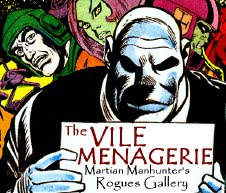
In a show of (increasingly limited) power, Zolog ordered the ape-ification of Honolulu, but had to deactivate cloaking to do so, allowing their detection by the Sleuth from Outer Space at the JLA Watchtower. I'm not sure who put it together, but the Alien Atlas has an unconventional team ready to go, made up of Golden Age Green Lantern Alan Scott, Warrior, and the Metal Men. J'Onn once worked with Scott in the 1970s, and of course had associated with him via the JLA/JSA crossovers. Guy Gardner of Justice League International was well familiar, and I was well pleased that he was played as his usual crass self, rather than the Beau Smith glow-up. The Metal Men was the curve ball, though they did go back to JLA: Year One.
Just as Gorilla Lantern engaged this force, he was teleported to the Watchtower, where he was greeted by a gorilla claiming to be part of a force that now occupied the facility. However, this ape slipped up in calling the Lantern "Kyle," rather than his ape name, and his power ring set tentacles upon the disguised Martian. However, J'Onn continued using Kyle's name, and helping him to remember who he truly was. The ring did the rest. "Thanks to my rather duplicitous efforts, Green Lantern was restored to normal, as have been the rest of the JLA." Kyle had initially been concerned for his ape comrades, and now for all of his friends, and rushed back into combat. Unfortunately, General Zolog was something of a simian Kissinger, willing and able to sacrifice many of his own men in a last bid for overall victory. Green Lantern helped mitigate the fallout, but still lost some of his former men, wounding hearts on both sides of this gorilla warfare.
"Grunts" was by Keith Giffen, Octavio J. Cariello, Jr., John Nadeau, Marcelo Campos, & Jordi Ensign. J'Onn's synopsis was written by Len Kaminski. Obviously, my coverage of "JLApril" is late and entirely prompted by the podcasting event that I linked to last week, but I wish I'd run even later, so that I could take advantage of the sharp digital scans in the newly released collection of these comics. The 1999 version were printed on lousy paper that gave everything a gray tinge and made the colors a drab mess. I don't always love the glossy sheen of modern printing, but trust that it's an improvement. Anyway, this was a nice read, my favorite of the satellite solo annuals (obviously not counting the bookends with our favorite Martian.) Giffen on his own doesn't sing like he did with his better collaborators, but his weary, cranky voice suits this material. Unfortunately, there's several instances of the editor blowing it, allowing dialogue balloons intended for one character to come out of the "mouth" of another. Thankfully, the dialogue is distinct enough for the reader to tell where the fault lies. Despite often being thought of as a funny guy, Giffen plays this one fairly straight, lending an unexpected poignancy. But also, he brings in JLI favorite Guy, who naturally plays well with our boy. Star Wars artist Nadeau leans into the grit, so that it's jarring when the style switches to more clean cut super-heroics mid-sequence. Further, Cariello demonstrated his own moody chops on Deathstroke, so maybe there was a heavy-handed inker? It all looks good, just different. Oddly enough, both pencillers moved out of comics and into painting after this. Man, it was so nice to see J'Onn working with people with whom he had a history, instead of whichever team-up tickled Ostrander's fancy on a given month.
In a show of (increasingly limited) power, Zolog ordered the ape-ification of Honolulu, but had to deactivate cloaking to do so, allowing their detection by the Sleuth from Outer Space at the JLA Watchtower. I'm not sure who put it together, but the Alien Atlas has an unconventional team ready to go, made up of Golden Age Green Lantern Alan Scott, Warrior, and the Metal Men. J'Onn once worked with Scott in the 1970s, and of course had associated with him via the JLA/JSA crossovers. Guy Gardner of Justice League International was well familiar, and I was well pleased that he was played as his usual crass self, rather than the Beau Smith glow-up. The Metal Men was the curve ball, though they did go back to JLA: Year One.
Just as Gorilla Lantern engaged this force, he was teleported to the Watchtower, where he was greeted by a gorilla claiming to be part of a force that now occupied the facility. However, this ape slipped up in calling the Lantern "Kyle," rather than his ape name, and his power ring set tentacles upon the disguised Martian. However, J'Onn continued using Kyle's name, and helping him to remember who he truly was. The ring did the rest. "Thanks to my rather duplicitous efforts, Green Lantern was restored to normal, as have been the rest of the JLA." Kyle had initially been concerned for his ape comrades, and now for all of his friends, and rushed back into combat. Unfortunately, General Zolog was something of a simian Kissinger, willing and able to sacrifice many of his own men in a last bid for overall victory. Green Lantern helped mitigate the fallout, but still lost some of his former men, wounding hearts on both sides of this gorilla warfare.
"Grunts" was by Keith Giffen, Octavio J. Cariello, Jr., John Nadeau, Marcelo Campos, & Jordi Ensign. J'Onn's synopsis was written by Len Kaminski. Obviously, my coverage of "JLApril" is late and entirely prompted by the podcasting event that I linked to last week, but I wish I'd run even later, so that I could take advantage of the sharp digital scans in the newly released collection of these comics. The 1999 version were printed on lousy paper that gave everything a gray tinge and made the colors a drab mess. I don't always love the glossy sheen of modern printing, but trust that it's an improvement. Anyway, this was a nice read, my favorite of the satellite solo annuals (obviously not counting the bookends with our favorite Martian.) Giffen on his own doesn't sing like he did with his better collaborators, but his weary, cranky voice suits this material. Unfortunately, there's several instances of the editor blowing it, allowing dialogue balloons intended for one character to come out of the "mouth" of another. Thankfully, the dialogue is distinct enough for the reader to tell where the fault lies. Despite often being thought of as a funny guy, Giffen plays this one fairly straight, lending an unexpected poignancy. But also, he brings in JLI favorite Guy, who naturally plays well with our boy. Star Wars artist Nadeau leans into the grit, so that it's jarring when the style switches to more clean cut super-heroics mid-sequence. Further, Cariello demonstrated his own moody chops on Deathstroke, so maybe there was a heavy-handed inker? It all looks good, just different. Oddly enough, both pencillers moved out of comics and into painting after this. Man, it was so nice to see J'Onn working with people with whom he had a history, instead of whichever team-up tickled Ostrander's fancy on a given month.
Monday, April 22, 2024
JLA Annual #3 (September, 1999)
After finally opening diplomatic relations with the U.N, and revealing the existence of Gorilla City to the world, King Solovar was assassinated. His nephew and successor, Prince Regent Ulgo, then blamed humanity and launched a counter-offensive. But also, Ulgo was secretly a member of the Inner Circle of the Simian Scarlet Cultural Purity Movement, an extremist faction of super intelligent gorillas. Other members included the mobster Grimm, General Zolog, Admiral Trafalgo, and the sorceress Abu-Gita, but they were all dancing on the strings of Gorilla Grodd.
Martian Manhunter received a request at the Watchtower from Gorilla City to send a diplomatic envoy of JLA members to help mitigate the damage. Superman, Wonder Woman, Aquaman, and Dark Flash were openly deployed, while an invisible Alien Atlas followed along in secret. Before reaching Gorilla City, the party was ambushed, and exposed to a gas that turned the lot into gorillas. Worse, some form of mind control was exerted over them, causing them to turn on the "hu-mans." However, the Martian Manhunter retained his wits, if not his form, and used his telepathy to mostly restore the JLA's more human instincts. Back at the Watchtower, Green Lantern Kyle Rayner thought that he was being hazed by the more veteran members of "JLApe." Batman and the Martian Hu-Manhunter worked together on a cure for the "Gorillabomb," but the Simian Sleuth from Outer Space had to pursue help from Animal Man, who was disoriented by troubling memories of a "Coyote Messiah" and the like. Recognizing "I'm important to the plot," Buddy Baker helps J'Onn J'Onzz understand how to use the morphogenetic field to restore the team.
In his absence, the male JLApes began posturing for dominance to court Wonder Woman as a mate, and the Manhunter had to reassert their identity matrices telepathically. Unfortunately, Ulgo then deployed gorillabombs at the United Nations, transforming the entire body while adding Green Lantern to the apes. The intended cure was used to restore the U.N., but the JLA were still trapped in gorilla form. The JLA divided their forces to address various fields in play in the conflict with Gorilla City, while Batman couldn't shake the nagging suspicion that J'Onn was hiding something.
"Gorilla Warfare" was by Len Kaminski, Jason Orfalas, and Jordi Ensign. Aside from poor work-life-podcasting balance this month, my ambivalence toward covering this event (and its scale/page count) contributed to my low productivity this month. I needn't have hesitated, because this was a fun and relatively brisk read with a bunch of puns and two-page spreads (one of which was interrupted by a fold-out ad for a video game about monkeys and bananas, appropriately enough. I'm not wild for the artist's Semeiks-influenced humans, but his apes strongly reflect the Arthur Adams covers, which is surely a welcome sight. If you're interested, the recent podcast Dial F for Flanger - Episode 24 covers the issue in greater detail.
Martian Manhunter received a request at the Watchtower from Gorilla City to send a diplomatic envoy of JLA members to help mitigate the damage. Superman, Wonder Woman, Aquaman, and Dark Flash were openly deployed, while an invisible Alien Atlas followed along in secret. Before reaching Gorilla City, the party was ambushed, and exposed to a gas that turned the lot into gorillas. Worse, some form of mind control was exerted over them, causing them to turn on the "hu-mans." However, the Martian Manhunter retained his wits, if not his form, and used his telepathy to mostly restore the JLA's more human instincts. Back at the Watchtower, Green Lantern Kyle Rayner thought that he was being hazed by the more veteran members of "JLApe." Batman and the Martian Hu-Manhunter worked together on a cure for the "Gorillabomb," but the Simian Sleuth from Outer Space had to pursue help from Animal Man, who was disoriented by troubling memories of a "Coyote Messiah" and the like. Recognizing "I'm important to the plot," Buddy Baker helps J'Onn J'Onzz understand how to use the morphogenetic field to restore the team.
In his absence, the male JLApes began posturing for dominance to court Wonder Woman as a mate, and the Manhunter had to reassert their identity matrices telepathically. Unfortunately, Ulgo then deployed gorillabombs at the United Nations, transforming the entire body while adding Green Lantern to the apes. The intended cure was used to restore the U.N., but the JLA were still trapped in gorilla form. The JLA divided their forces to address various fields in play in the conflict with Gorilla City, while Batman couldn't shake the nagging suspicion that J'Onn was hiding something.
"Gorilla Warfare" was by Len Kaminski, Jason Orfalas, and Jordi Ensign. Aside from poor work-life-podcasting balance this month, my ambivalence toward covering this event (and its scale/page count) contributed to my low productivity this month. I needn't have hesitated, because this was a fun and relatively brisk read with a bunch of puns and two-page spreads (one of which was interrupted by a fold-out ad for a video game about monkeys and bananas, appropriately enough. I'm not wild for the artist's Semeiks-influenced humans, but his apes strongly reflect the Arthur Adams covers, which is surely a welcome sight. If you're interested, the recent podcast Dial F for Flanger - Episode 24 covers the issue in greater detail.
Labels:
1990s,
Aquaman,
Batman,
Flash,
Gorilla Grodd,
Green Lantern,
JLA,
Martian Manhunter,
Podcast,
Superman,
Wonder Woman
Monday, March 6, 2023
Justice League Quarterly #9 (Winter, 1992)
So this is your basic temporal paradox. Booster Gold meets a homeless kid who he recognizes as a huge celebrity and Samaritan from his past in the far future. She died tragically in the 21st Century, so Booster helps her avoid an unscrupulous Hollywood type and reunite with her family. Her twin sister survives what was once an early death, and together they forge a brighter future. As a result, Booster mostly forgets both the runaway and her erased infamous fate.
That wasn't the temporal paradox that I was referring to, though.
The girl shines up real good for someone previously routinely mistaken for a boy, blossoming like a made-over nerd in a teen comedy. Everyone's jaw is on the floor when she *gasp* applies make-up and raids Fire's closet. Booster. Max. Beetle. Bloodwynd... who even requests an introduction. "Geralyn, this is J'Onn... Ted... Max. Send them your autograph--"
This story came out roughly the same month as Justice League America #69, the Doomsday tie-in where Blue Beetle is beaten into a coma right before seeing Bloodwynd transform into someone else while exposed to flames. Five months before Justice League America #74, where that form was revealed to be the Martian Manhunter. Maybe it was an accident, or at least written off as one, but Booster still outed Bloodwynd as J'Onn J'Onzz way ahead of it being anything but a Feudian slip...
"Tomorrow Belongs to Geralyn" was by Elliot S. Maggin, Dave Cockrum, & Jose F. Marzan, Jr. Quite the hoary lot in the '90s, and this was Cockrum's second story in the issue, so I'm sure the little fanboys were just thrilled.
That wasn't the temporal paradox that I was referring to, though.
The girl shines up real good for someone previously routinely mistaken for a boy, blossoming like a made-over nerd in a teen comedy. Everyone's jaw is on the floor when she *gasp* applies make-up and raids Fire's closet. Booster. Max. Beetle. Bloodwynd... who even requests an introduction. "Geralyn, this is J'Onn... Ted... Max. Send them your autograph--"
This story came out roughly the same month as Justice League America #69, the Doomsday tie-in where Blue Beetle is beaten into a coma right before seeing Bloodwynd transform into someone else while exposed to flames. Five months before Justice League America #74, where that form was revealed to be the Martian Manhunter. Maybe it was an accident, or at least written off as one, but Booster still outed Bloodwynd as J'Onn J'Onzz way ahead of it being anything but a Feudian slip...
"Tomorrow Belongs to Geralyn" was by Elliot S. Maggin, Dave Cockrum, & Jose F. Marzan, Jr. Quite the hoary lot in the '90s, and this was Cockrum's second story in the issue, so I'm sure the little fanboys were just thrilled.
Tuesday, February 21, 2023
Eclipso: The Darkness Within #2 (October, 1992)
One of the more popular posts in this blog's history was an April Fool's joke in 2009 regarding the announcement of a Bloodwynd mini-series by Bart Sears. I crudely cobbled together some art from the short-lived Ominous Press, and yet somehow, not only did the post get some traction, but I've even seen the featured art turn up elsewhere. Could have saved myself some time and just used some of Sears' Bloodynd art from the Eclipso event, but I guess it was worth it for the attention.
There certainly isn't much for Bloodwynd to do in the actual story, besides mill about in the background with a host of other non-essential heroes. His eyes peer over the throne on the cover. You can see him looking over Nightwing's shoulder in one of the splash pages where the remaining heroes confront the eclipsed ones before they're teleported by their master/possessor to the moon. He's standing around while the dust literally settles, mostly on Bloodwynd's cape. There's a nice overhead shot of his standing with the heroes as they reconvene to plan strategy. It was nice to see Sears draw members of the Suicide Squad Bronze Tiger and Nightshade, as well as my boy Blue Devil in the same splash. With Ben Turner, you can play the world's worst variation of Where's Waldo with "spot the Black guy." Looking over the Will Payton Starman's shoulder. Wearing a spacesuit in a craft with Booster Gold and the Element Man, the latter treated to Bloodwynd's first line of dialogue. "Each of us must follow his own concience on the matter, Metamorpho... wherever that may lead!" That ship is later grounded by an eclipsed Mon-El, reinforcing Metamorpho's stated desire to outright kill Eclipso.
Quoth Jamiroquai, "Everybody's Going to the Moon" (what, you don't own the Titan A.E. soundtrack? Your loss.) The heroic force walks into Eclipso's lunar palace like chumps, where he's powerful enough to immediately eclipse everybody when they get ticked at the eclipsed Starman for using his shapeshifting powers to conceal his condition until now. Once again, Bloodwynd's blue-tinged possessed head is seen over Nightwing's shoulder. I'll have to incorporate that pairing into my slashfic on Reddit*. Along similar lines, Eclipso got all Brian Yuzna with the meat sacks under his sway, until Superman and all the light-based/sun-tech characters break down the door. Eventually, they zap all the heroes until they're liberated, and Bloodwynd is seen standing in front(!!!) of Metamorpho (I ship it!) Bronze Tiger continues to stand behind a lower class of character who have to be way further in the foreground, because he's pretty tall. Pantha's head makes a cameo appearance, along with the rest of her still-attached body, which is my preference for Pantha. She's not a Highlander.
Starman made the ultimate sacrifice of having his trademark passed to the next legacy while seeming to be dead before inevitably being resurrected. I didn't see Bloodwynd standing behind anyone else, probably because they focus on injured people on cots and tables. Bloodwynd isn't one of those, so I'll take it as a win. Brought to you by Keith Giffen, Robert Loren Fleming, Bart Sears, and a bunch of inkers.
*Please don't tell me that Reddit is not a preferred avenue for slash fiction. I don't know or want to know to what degree my joke is reflected in reality.
There certainly isn't much for Bloodwynd to do in the actual story, besides mill about in the background with a host of other non-essential heroes. His eyes peer over the throne on the cover. You can see him looking over Nightwing's shoulder in one of the splash pages where the remaining heroes confront the eclipsed ones before they're teleported by their master/possessor to the moon. He's standing around while the dust literally settles, mostly on Bloodwynd's cape. There's a nice overhead shot of his standing with the heroes as they reconvene to plan strategy. It was nice to see Sears draw members of the Suicide Squad Bronze Tiger and Nightshade, as well as my boy Blue Devil in the same splash. With Ben Turner, you can play the world's worst variation of Where's Waldo with "spot the Black guy." Looking over the Will Payton Starman's shoulder. Wearing a spacesuit in a craft with Booster Gold and the Element Man, the latter treated to Bloodwynd's first line of dialogue. "Each of us must follow his own concience on the matter, Metamorpho... wherever that may lead!" That ship is later grounded by an eclipsed Mon-El, reinforcing Metamorpho's stated desire to outright kill Eclipso.
Quoth Jamiroquai, "Everybody's Going to the Moon" (what, you don't own the Titan A.E. soundtrack? Your loss.) The heroic force walks into Eclipso's lunar palace like chumps, where he's powerful enough to immediately eclipse everybody when they get ticked at the eclipsed Starman for using his shapeshifting powers to conceal his condition until now. Once again, Bloodwynd's blue-tinged possessed head is seen over Nightwing's shoulder. I'll have to incorporate that pairing into my slashfic on Reddit*. Along similar lines, Eclipso got all Brian Yuzna with the meat sacks under his sway, until Superman and all the light-based/sun-tech characters break down the door. Eventually, they zap all the heroes until they're liberated, and Bloodwynd is seen standing in front(!!!) of Metamorpho (I ship it!) Bronze Tiger continues to stand behind a lower class of character who have to be way further in the foreground, because he's pretty tall. Pantha's head makes a cameo appearance, along with the rest of her still-attached body, which is my preference for Pantha. She's not a Highlander.
Starman made the ultimate sacrifice of having his trademark passed to the next legacy while seeming to be dead before inevitably being resurrected. I didn't see Bloodwynd standing behind anyone else, probably because they focus on injured people on cots and tables. Bloodwynd isn't one of those, so I'll take it as a win. Brought to you by Keith Giffen, Robert Loren Fleming, Bart Sears, and a bunch of inkers.
*Please don't tell me that Reddit is not a preferred avenue for slash fiction. I don't know or want to know to what degree my joke is reflected in reality.
Monday, February 13, 2023
The Adventures of Superman Annual #4 (1992)
In one of his annuals, Superman became possessed by Eclipso, known as being "eclipsed". During the night, Eclipso could force the Man of Steel to do whatever he pleased (like putting Captain Marvel in the hospital,) but had to hide him from sunlight, or else Eclipso would lose his hold. Booster Gold, Fire, and Ice acted as Justice League America during this period, with Bloodwynd's whereabouts unexplained. The necromancer simply reappeared mid-story among the rest of League America at their headquarters as they gathered with Baby Wildebeest to determine the current location of the compromised Man of Steel... living inside an active volcano?
Aquaman, Metamorpho, Black Canary, Justice League Europe, Hawkman, Nightwing and L.E.G.I.O.N. all convened onto Kīlauea to plan their confrontation with the Man of Tomorrow. They were soon joined by Guy Gardner, who in his first solo Reborn mini-series tricked Lobo into helping his acquire Sinestro's Qwardian power ring to replace the Oan one he'd surrendered to Hal Jordan. Lobo's L.E.G.I.O.N. boss Vril Dox kept him from exacting his revenge until the more pressing matter at hand was addressed.
Dox & Hawkman chose Bloodwynd, Guy, Fire, Lobo, Strata, Booster, Metamorpho, and Phase as being best suited to withstand the volcano to reach Superman. "...The mystical nature of my powers serves to repel the molten lava from my body!" Boy, Martian Manhunter sure would benefit from a power like that! Reaching the Kryptonian, sans conscience and reserve, Lobo is swiftly felled by super-speed, full strength punches. Gardner fares a bit better, but is still bounced right out of the volcano. Bloodwynd and company try to rush Superman, but he repells them, in part by using Strata's crystaline body to repel powers like Fire's back at her teammmates like Bloodwynd. Not sure why plain fore would have an impact when freakin' lava didn't, though.
Bloodwynd exclaimed, "The sun is sinking beyond the horizon!" I hope he pronounces "horizon" like Ludacris. Anyway, without solar energy, the heroes would be unable to exorcise Eclipso from Superman's body. The heroes, led by a revived Lobo, continued to contain Superman in the dusky night after they're all blown out of the volcano by an eruption. All those lesser powered heroes focused on evacuating villagers, while Bloodwynd was felled by a freezing blast from a black diamond. "Allow me to show you the darkness of the human heart, 'hero'."
Superman had dismembered The Element Man and was poised to slay Ice when Guy Gardner returned to the scene. He had been ordered by Dox to collect actual solar matter, and though he protested at great length and volume, the ex-Green Lantern finally came through. It still took a while to drive Eclipso out, including a fall back into the volano, but ultimately Big Blue emerged restored. While most of the heroes next traveled to the moon to spy on Eclipso's lunar castle and get rooked by an eclipsed Starman masking his possession, Superman stayed behind to do science stuff, as you do. Well not you. Nobody would want Superman to hang back in that situation, but they had to pad out another annual and set up his disappearing before the grand finale in Eclipso: The Darkness Within #2. "In Blackest Night" was by Robert Loren Fleming & Bob McLeod.
I started covering Bloodwynd appearances in 2008, the second year of the blog, and about 16 years after his debut. It's been nearly that long since I started the posts, and I more or less abandoned them the following year. Part of it was a misguided plan to cover a bunch of the Eclipso annuals simultaneously and link between the posts. Part of it was also trying to cover the main Justice League America series at the same time on my Atom blog. Also, "The Death of Superman" was coming up, and I've never owned or read the whole thing (although I think I now have the cheapie trade collection on my bookcase.) I didn't even read all of the Superman annuals from the Eclipso event. I just found a partially completed draft of the first paragraph of this post sitting in a queue since 2012 and added this coda with the intent to fill in the middle. I think maybe I got tired of linking out to all the referenced characters. Mike Kooiman's old Cosmic Teams site apparently 404'd last year, but at least he wrote The Quality Companion for TwoMorrows in the meantime. Nobody ever asked me to write The Martian Manhunter Companion. I've clearly wasted my life.
Tuesday, February 7, 2023
Conjurors #1-3 (April-June, 1999)
There's a popular assumption that conservatives are bad at comedy, because you can't punch down from a position of authority without working against most of the populace's interests. I don't entirely buy into that, as evidenced by both sides having traction for laying claim to George Carlin, still one of the greatest and most prescient comedians to ever live. Comedy thrives in finding lines and then crossing them, and lines divide two ways. Most of my favorite funny people of the '80s landed on the wrong side of my personal line, but they're as much a product of their time as anything, and changing times change the context of the humor. If you don't adapt, and social norms have definitely trended leftward since peak neoliberalism, you get left behind and easily treated as though you never were funny to begin with. Carlin's dancing back and fourth across that line is where his immortality lies. Based on comedy routines alone, Bill Cosby wouldn't have been cancelled today, but Pryor and Murphy would have.
I think a similar if much less well reasoned or researched argument could be made that conservatives can't do high fantasy. You can point out plenty of regressive politics in the genre, which is why I'll put most of my weight on the "high" part of the claim. A lot of fantasy is just historical fiction married to a romanticized vision of feudal existence, when the men were men and the women were chattel. Bill Willingham capped his career and popularized unto cottage industry taking fairy tales and forcing them into a hard reality modern world. Chuck Dixon & Eduardo Barreto's Elseworlds mini-series Conjurors mini-series tracks similarly. It posits a world reliant and fidelitous to magic in the same way ours is to technology. It gets muddy from there, because I suppose medicine overlaps with mysticism, so they seem to have all the same stuff we have. Actually, they have all the same buildings and clothing and everything else we associate with mid-to-late 20th century life, emphasized by increasing globe-trotting toward the end, and flashes of cosmic consequences at various points in the world. One of the defining principles of conservatism is a belief that we pretty much got everything right, so the status quo should be defended. Conjurors is more like Harry Potter, wherein a micro-community practices magic in secret, except here it's the broad public default. A boy might get busted reading Popular Science during school hours, but he's still dressed like Beaver Cleaver in a classroom lined with individual desks and a marm at the helm. But with wands, see? At the end of the book, all the magic users deprived of their sorcery have ready access to airplanes and helicopters to meet at Machu Picchu. Despite the shift from our world to a magical one taking place in pre-history, it is still recognizably our world, only mildly stunted in its stigmatized technology by a few decades at most.
I remember the mini-series arriving with a bit of a stink on it. It debuted outside the top 100, outsold by the $5.95 Doctor Midnite prestige format mini-series that would have typically been used for an Elseworlds. This was a $2.95 double-length floppy, and there's no break point in any of the issues to indicate that it was ever a six issue mini-series, not that it wouldn't have also been a telling format change. DC Comics simply did not produce books like Conjurors the way it actually came out. Also, Chuck Dixon was still a draw, but with mainstream audiences, mostly on books involving well armed, non-powered urban vigilantes, not the Vertigo crowd. Dixon is a justifiably well regarded scripter, but this isn't his wheelhouse, and it shows.
The book co-stars Zatanna, except it's Jennifer Morgan from The Warlord instead. A stage magician who is part of the 10% of the population naturally gifted with real magic, who spends much of her free time playing detective within the mystical community. There's a guy who vaguely resembles the Jared Stevens Fate with his rad long hair and eye tattoo... but he's a stage magician called Brother Power. It feels like people never gave or revoked approval for the familiar character types, maybe because Paul Dini had dibs on Zee, and Fate was getting aced to launch JSA? And wouldn't stage magicians be like paying to watch mathematicians or engineers at a blackboard? Could 10% of the population even support the magic needs of the other 90%, and does that mean the kid was in a classroom of only the 10% adepts? That's the initial pleasure but overall frustration of this mini-series. You spend the first issue trying to figure out which established IP have been shoehorned into a generic, often inappropriate role in a world where you're constantly second-guessing the premise. But then in the second part, Dixon gives up and just goes back to his comfort zone with the Challengers of the Unknown running around in a bi-plane on an rugged adventure. That schoolboy ends up offering a big information dump, and then just lingers on the periphery to react to stuff until the whimper of a finale. Why even?
I bring all this up because I only bought Conjurors second-hand as a discounted set to eventually cover it here for its novel inclusion of Bloodwynd, who appears in costume on a square inch in the background of the first cover. In the actual story, he's a bald black guy in a business suit who captures a spirit in a bottle. Eventually, the spirit escapes, and sends Bloodwynd out a skyscraper window to fall head first to his death. He was basically JLI-era Dr. Mist, but I guess Bloodwynd had more *snicker* commercial cache? Or more simply, THIS IS THE REMIX, so the entirely gettable Mist uses somebody else's moniker. And then is disposed of off-panel, because the status quo dictates that the best kind of inclusion is tokenism.
Labels:
1990s,
Bloodwynd,
Imaginary Stories,
Martian Manhunter
Monday, January 30, 2023
RBA #1 VeraldarvĂg (March 2019)
When I first saw Pulp Fiction in 1994, a good fifteen years before I ever left the country, I fell in love with the "Royale With Cheese" discussion. I mean, the whole movie, but also, I still put mayonnaise on my waffle fries (but not french fries. I'm not a total heathen.) Now that I get to travel abroad with some regularity, I like to enjoy "the little differences" between countries. And being a lifelong comics geek, I always try to find some venue for a foreign four-color fix. Too often, I just muddle through imported copies of the same western comic book editions that I can find anywhere, or newsstand magazines that collect several modern comics, sometimes translated to local tongue. I find that more than a bit boring, because the older editions are much quirkier pieces of pop art, and I also like to find vintage material from the land I'm visiting. Ideally, I'll locate some hole in the wall on a back street that's the impure, adulterated experience. Like this multi-fandom spot in a quasi-strip mall in ReykjavĂk that looked more like a duplex, guided by a crude sandwich board sign from the sidewalk.
From visiting a local flea market and some book stores, it was pretty clear that Iceland wasn't historically big on super-heroes. There's a lot of Disney comics, adventure heroes like Tarzan, and of course the European staples Tintin and Asterix. This shop was no exception, plus a lot of fantasy, viking stuff, and some very quaint softcore behind a curtain that barely showed more than ankles and mid-drifts. Most of the stock were on wooden bookshelves, and as per usual, most of the western heroes were imports. I think I scored a hardcover annual a piece for my best friends-- I belive one was a British Hulk and the other a French Iron Man, or vice versa. I found a few oddball floppies stored in some sort of plastic clothing hampers for myself.
We eventually made our way to Nexus, the biggest comic/fan chain on the island. This particular location was in the basement of a multi-story mall, exactly where I would want it to be. You had to take a staircase that was flanked on one side by life-size statues of the Gal Gadot Wonder Woman, Spider-Man, and Deadpool. The view from the entry is deceptive, because the store snakes around to the left with expansive areas for more comics, gaming, and LARPing gear. They also had lit columns with stock images of Wonder Woman, Batman, Sailor Moon, Hellboy, MCU heroes, Darth Vader, and more. It was no Forbidden Planet, but London has nearly 9 million people to ReykjavĂk's 325K, so proportionately much grander, if taken on a per capita basis.
Most appealing to me was a small selection of trade paperback made specifically for Nexus stores featuring western comics translated into Icelandic. I texted Fryhole to see if he wanted Þór Bok 1, a trade collecting Thor: Son of Asgard, but he preferred a local Viking hardcover edition, Vargöld fyrsta bók.
For myself, I got a real treat, the first collection of the 1997 reboot of RĂ©ttlætisbandalag AmerĂku, or as translated from Icelandic, "American Justice Alliance." We of course know it better as the start of Grant Morrison and Howard Porter's run on JLA from 1997. It collects the trades we know as "New World Order" and "American Dreams," as well as most of JLA Secret Files & Origins #1, under the title "VeraldarvĂg," or "World Slaying." Period covers are reprinted for each chapter, and it appears Iceland was getting their monthlies more or less at the same time as us. Secret Files entries for the JLA members are used as interstitials to help with pagination.
After the first arc, there's the bio page for Superman Blue, followed by his short story "trial" for reentry into the JLA, so more or less in chronological order ahead of the membership drive in #5. Marian Manhunter's secret file by Don Hillsman III is ahead of the Neron/Asmodel two-parter. We continue on through #9, then the Starro lead story from Secret Files, and then the 3-issue Paradise Lost mini-series starring Zauriel by Mark Millar and Ariel Olivetti is also reprinted. My copy had a folded insert tucked into the back cover with the Multiversity map and advertising blurbs for other DC collections, which came standard for the edition based on copyright information in the trade's indicia. The package cost me 3,999 Krona or so, which would currently be about $28, though I think I paid more. Everything is pricier on an island. Anyway, a swell collection and souvenir. I wish there was an English language edition on glossy stock I liked as much as this one.
Labels:
1990s,
2010s,
JLA,
Martian Manhunter,
Merchandise
Subscribe to:
Posts (Atom)