Showing posts with label JLA. Show all posts

Monday, October 6, 2025

2025 Primaid Baytown Eastern Rim Funny Book & Vintage Con Commission by Pop Mhan

With commission rates skyrocketing and my interest in paying them for corporate-owned characters plummeting, you might be surprised to see that I actually have some brand new art to show off on this blog. This piece offers remedies. Firstly, I'd still kind of like to complete a set of Hyperclan spotlight pieces, but it especially bugged me that I hadn't gotten any of the female members. Heck, Primaid's the second best known member. I mean, I have an Armek because Rick Hoberg wanted to draw a mech, and an A-Mortal because the dude sitting with Tim Vigil did good Halloween stuff. Only Primaid and Protex were in the second big White Martian story arc and fought a member of the DC Trinity. Plus, she just looks cool, and can rarely by seen in full figure on the comics page.

The other motivator was that despite maintaining a career since the '90s on heavy-hitting properties like The Flash, Batgirl, Masters of the Universe, Raven: Daughter of Darkness, Ghost Rider, and a mini-series of The Demon, Pop Mhan still charges perfectly reasonable rates for high quality work. I've dug him since at least The Impulse/Atom Double Shot in '98, plus he co-created Spyboy with the late, great Peter David. He was also a cool guy who talked about the demands of the licensing work that he's been doing more heavily in recent years. He's work on another creator-owned project that he's developing, a sort of younger readers Hellboy, and I hope to see that come to fruition.

More Art Monday

Thursday, September 18, 2025

JLX #1 (April, 1996)

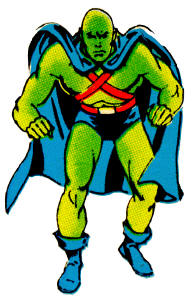
In my write-up for Amazon #1 (April, 1996), I went into a lot of detail about how the Amalgam Comics characters were not always, or even often, equally divided portions of two characters combined. Mister X is a perfect example of this, because he's almost wholly the Martian Manhunter, but combined with... stuff. The simplest equation is J'Onn J'Onzz + Professor X, which is truer of the sequel comic, 1997's JLX Unleashed #1, but still not. You see, Charles Xavier already had a much more important role in the Amalgam Comics scheme, Doctor StrangeFate. Marco Xavier is the X in Mr. X, and aside from shopping at The North Face over Turnbull & Asser, he was lifted whole from 1960s House of Mystery Manhunter strips. When the Amalgam story compels Mister X to reveal his true form, he's simply the Martian Manhunter with a big "M" stenciled over his right eye and down his face. That would indicate the X-Man Bishop, but he didn't turn up until a sequel mini-series where he was amalgamated with Superman. In several Marvel Comics parallel futures, mutants are branded in this same manner, although Mister X is explicitly not a mutant himself.

We have to look to the manufactured JLX letters column to get the real skinny. It notes, "When the rebel Skrull were driven from Mars by the Kree, one lone survivor fled to Earth. Any chance he could be the missing link to mutantkind's origin?" That doesn't entirely track with the narrative, but that skrull's role is confirmed by the book's editor. "And speaking of mysterious guys, what's the deal with this Mr. X? For years over in SLEUTH COMICS, he's been shown to be a ruthless power broker and master crook, but now he's the mutant's benefactor? Something weird has got to be up with that creep!" It doesn't sound like a villainous Mr. X would be starring in his own strip, so who exactly was he clashing with in the phony title? Was it like in House of Mystery where J'Onn J'Onzz and Marco Xavier turned out to be each other's own enemy, and if so, why wasn't that also referenced? Was Marco Xavier someone whose identity the alien replaced, or was it a construct that was always working toward the alien's interests. If this is all still mostly Manhunter from Mars myth, when does the Marvel come in?

Like Storm is Wonder Woman, there probably isn't a specific character that forms an amalgam with the Martian Marvel. Super-Skrull is the most well known member of the Marvel Comics shapeshifting alien race, but the only power that he possesses that the Alien Atlas doesn't is the ability to manifest and ensconce himself in fire. Now, most Skrulls just change their form, without the invisibility, elasticity, telekinesis, super-strength, or human torching. That last one is pretty key, and also, Mister X doesn't seem to have any of the personality or personal animosities of Super-Skrull. There are other Skrulls with exceptional powers, but are so obscure that they wouldn't rate an amalgamation with a Magnificent 7 member. Sadly, the Amalgam J'Onn J'Onzz is probably just Skymax, also known as the Skrullian Skymaster, who comes from the same parallel reality as the Squadron Supreme. Yes, Martian Manhunter rates so little consideration that they just made him the analogue of himself from the knock-off Justice League.

I've devoted so much space to the Mister X mystery (or lack thereof) because JLX #1 is mostly a plotless slugfest peppered with false continuity relations that I spelled out in JLX in The Amalgam Age of Comics: The DC Comics Collection (1996). The New Blood mutant members of the Amalgam JLA break their framed fellow Mariner out of jail, and the core Judgment League Avengers pursue them in the opening splash of the one-shot. It spoils the comic, frankly. Captain Marvel especially looks so good that I want to read the adventures of the JLA, not their genejoke off-shoot. As with Mister X, the JLX characters are largely bereft of any imagination or effort. Firebird and Mercury at least look like their DC counterparts, but everyone else appears (and more importantly acts) like the X-Men, in a story that reads like an X-Men comic. Mister X functions like Professor X, relying on his telepathy to communicate with and command his JLX. One nice swerve is that the combination of The Angel and Hawkman has been hiding his mutant status from the JLA, but Mr. X blackmails him into throwing a fight to give the JLX an advantage. They use the distraction to escape to Poseidonis in a leaky sub, where they are confronted by Will Magnus and his Sentinels. In that undersea battle, Rogue-but-brunette is nearly crushed to death, and Mister X has to assume his Skrull form to save her.

The alien has been revealed to friend and foe alike. He explains, "I am J'Onn J'Onzz. I am the last survivor of the Martian race known as... The Skrull. I have been hiding on your world for years with the aid of my shape-shifting powers. I know what it's like to be an outcast... alone. When I learned of mutants and their persecution, I saw a wrong that needed to be righted. And, too... I saw a community, one that might be mine... a place I might belong... at last." Not-Cyclops questioned why a non-mutant should lead the team, but Substitute-Mariner called out the bigotry and welcomed the help. Mister X's commitment to finding the lost birthplace of mutants probably didn't hurt. "Somewhere in this city there must rest the secrets of why the Atlanteans departed... and where they've gone. Follow me, and I will do all I can to help you find them."

"A League of Their Own" was written by Gerard Jones and Mark Waid, drawn by Howard Porter and John Dell. The disgraced Martian Manhunter: American Secrets was less than half a year away from getting the 1987 volume of Justice League America cancelled. He actually wrote several Amalgam Comics, despite being very near the end of his mainstream comics career, and having had the entire Green Lantern line taken from him. It really makes you question how much the Big Two were invested in the Amalgam books. Mark Waid helped Jones on most of his books, and was five months out from co-writing Justice League: A Midsummer's Nightmare, the book that made me build this blog. He would also often fill in for Grant Morrison on the relaunched JLA, and Waid eventually succeeded him on that title. Porter & Dell were the artists on that blockbuster success, which takes me back to that JLA splash page. JLX was one of the more popular and better selling Amalgam Comics, on the same glossy stock with similar coloring as JLA. Whether this was a trial run on what DC was planning for the future, or the template upon which it was built, it seems to me JLX was a harbinger in ways (even the abbreviated title) no one could have expected (and few seem to recognize today.) This is a literal pivot point from the creators and characters that were failing the franchise to those that would define it as a powerhouse property for the world in the coming months. That splash represented the book that I wanted to read, and would get to in 1997.

Monday, September 15, 2025

JLA JAM Martian Manhunter segment by Larry Stroman

Click To Enlarge


Like most of your basic Marvel Zombies, I was introduced to Larry Stroman through his 1991 run on X-Factor with Peter David, part of the same "Mutant Genesis" initiative that brought us X-Force and the best-selling single comic book of all time, X-Men #1. I'd started buying that series again because of the dynamic art of Whilce Portacio, but Stroman was not of the reigning styles of his fellows like Jim Lee, Rob Liefeld, or Marc Silvestri. Stroman work was more sophisticated, urbane, and design-oriented, but he was still flashy and detailed enough to hold his own. His run of interiors was a mere ten issues, but remain memorable to this day. Marvel went after big names like Jae Lee and Joe Quesada to fill those shoes. Stroman's follow-up project was meant to be DC's Darkstars, but I understand that he abandoned it after three issues when the offer of an Image book came through, and his replacement Travis Charest provided all the cover even before he took over interiors. As we know, most of the Image Comics founders struggled with deadlines when they also had to run a whole business unto themselves, but the second wave of creators were punished for committing the same sins of the first. Tribe was an interesting book with a lot of neat ideas and potential, but only one issue was released through Image, and only a handful followed elsewhere.

I think Larry Stroman was an extraordinary talent whose influence would have elevated the quality of comic art, if he'd had a greater amount of output an visibility. He could have been the Bill Sienkiewicz of X-Factor, if a few things had gone different ways. Stroman's output after Tribe has been light and not exactly high profile, though I've picked up much of it. I was really excited about the prospect of seeing what he would do with the New 52 Martian Manhunter, and I certainly feel like I checked a box by getting something from him. I understand he made some investments from the money Tribe #1 brought in that sustained him after the market fell out, and you can still get original art from him at shows, if not in comics. I wish things had gone differently, but at the same time, how much longer do you figure we've got, anyway?


Artful Mondfay

Thursday, September 11, 2025

JLX in The Amalgam Age of Comics: The DC Comics Collection (1996)

The plan for yesterday was to draft a larger post on the background of the Amalgam Comics stunt, halve that as appropriate, and then spin off narratives for the Wonder Woman titles and Martian Manhunter in JLX. What I hadn't considered was that Wonder Woman was far more central to the Marvel Versus DC event, and had more expansive lore within the Amalgam Comics pseudo-verse, meaning her side of the story dominated so fully that I simply ran out of time and energy to give a Martian perspective. There's an additional, anniversary-appropriate irony... I apparently never covered DC Versus Marvel on this Blogspot/Blogger/Google incarnation, only my oft-referenced-during-anniversaries WebTV incarnation from the late '90s / early '00s. What a reminder that I've been doing this too long, that I assume the presence of my DC Message Boards-era, 20th Century content here. One of the running jokes was that I was supposed to migrate all that WebTV content here and save myself work, instead of re-doing... well... clearly not everything. I wonder if I can even still run the CD a buddy burned to back the site up using a web crawler in 2000? Anyway, I'm not inclined to repeat myself, so if you want background, read it at Diana Prince as the New Wonder Woman.

While there are some notable characters dating back to the (falsified) Golden Age of Comics like Super-Soldier and Diana Prince, Amalgam Comics seems largely built on a (retconned) Silver Age. Super-Soldier (human Clark Kent given powers from materials found by scientists in a Kryptonian rocket) was put on ice until modern times, awakening to find his powers diminished by lingering radiation from Lex Luthor's K-bombs. In order to combat superhuman menaces, Kent put together a team that would counter them "without alliances to a particular country or political group." This team would be the Judgment League Avengers, or "JLA" for short. They consisted of Dark Claw, Captain Marvel, Angelhawk, Canary, Goliath, and Hawkeye. Their sometimes ally was Mariner, a combination of Namor and Aquaman who lived in the undersea city of Poseidonis with his wife and child. Poseidonis was mysteriously destroyed, taking everyone by Mariner in a cataclysm. The mourning Mariner launched two mission: to combat pollution to his water by the surface world, and to find the lost city of Homo Superior, Atlantis.

Mutants are present in Amalgam Comics, but seem to be more marginalized there than at Marvel. Even the JLA are somewhat discriminatory towards them, with members hiding their mutant genes from fellow heroes. However, the JLA also battle anti-mutant bigots like Will Magnus, who used his technological genius to build mutant-hunting robots called Sentinels. Will Magnus was motivated by his hatred of his brother Erik, who in the guise of Magneto formed The Brotherhood of Mutants. Will Magnus also created more humanoid automatons, like the Setinel Jocasta, who he tested by having her infiltrate the modeling industry under the name Millie. At one point, Will Magnus tried to infiltrate the JLA with a synthezoid spy called Crimson Whirlwind, but creation was turned against creator. Another mutant group was X-Patrol, led by a time-traveler from an apocalyptic future named Niles Cable. They are attempting to improve the fate of their kind, with each successful mission changing the history of Cable.

In the series JLA: The New Blood, the Avengers started to address the rising visibility of mutants by adopting more out members to the team. Among the earliest mentees were Firebird (The Green Flame + Phoenix,) Apollo (The Ray + Cyclops,) and Wraith (Obsidian + Gambit.) They were soon joined by Mercury (Impulse + Quicksilver,) Runaway (Gypsy + Rogue,) and Nightcreeper (The Creeper + Nightcrawler.) Among their enemies and frienemies were Lord Nimrod and his X-tremists, Ms. Tique's Brotherhood of Injustice, Sunstorm, and Metamimic, while a rival JLA spin-off group was Extreme Works. I'm not clear on their relationship to The Brotherhood of Mutants, but that team was murdered by Sentinels. Recently, the members were reborn in robot form as Magneto and the Magnetic Men.

Most recently, Mariner was framed for a mass murder, and the U.S. Government ordered his capture and imprisonment without trial. This created a rift between the Judgment League Avengers and their mutant new blood, who under the guidance of the notorious criminal mastermind Mr. X, orchestrated a jailbreak for Mariner with the renegade "JLX."

Monday, September 8, 2025

1996 SkyBox Amalgam card #19: “Mister X”

When DC vs. Marvel was released, I was so ignorant about Martian Manhunter that I thought Mr. X was a wholly invented character. I just figured that when the two universes briefly merged, combining characters/concepts/histories into a new reality, that Professor X / Martian Manhunter just happened to look like Tony Stark. Only later did I get educated on Marco Xavier, who is mentioned on another card, but sadly the Alien Atlas was otherwise absent from the set. This was not our first time seing Howard Porter draw J'Onn J'Onzz, but it was his first pairing with John Dell in the style that they would eventually employ on JLA. I suspect that the gorgeous job done on the JLX one-shot paved the way for the blockbuster pairing with Grant Morrison.

Tuesday, August 12, 2025

2019 Protex Houston Comicpalooza Commission by Ramon Villalobos

There are a number of artists that I've commissioned over the years that I was very impressed with, and yet did not go on to make the splash I'd hoped or expected for them. Ramon Villalobos is right near the top of that list of talents that deserve better careers than they've gotten so far. I think the skills are clearly on display, but he's had far more than his share of bad breaks. Basically, through no fault of his own, the artist was linked to three abusive individuals, leading to the premature cancellations of promising titles such as the 2019 Wildcats revival (meant to spin out of The Wild Storm) and DC/Vertigo's Border Town. He's still had some higher profile projects, including the Secret Wars mini-series E Is For Extinction, the 2016 Nighthawk mini-series with David Walker, and contributing to the event series Original Sins, but it's been too quiet for the better part of a decade.

Anyway, Villalobos hit Houston as part of a stable under a manager, one of the first years where I saw that really becoming a thing at comic conventions (and certainly contributing to the nosebleed rates being commanded these days.) That said, there are benefits to having someone besides the artist handling the workflow, which included encouragement to use screentones in commissions. Man, if I have a kink, it's Zip-A-Tone, which is how I ended up bringing home saucy/Not Safe For Work original manga art by Kimura Tomoe during my one trip to Japan, despite not really being a manga guy (and I really need to rescan those pages from the originals instead of Xeroxes now that I have an 11x17" scanbed.) Blame Paul Gulacy firstly, but I just really love the contrast between the organic line and mechanical precision the process offers.

It's taken me years to final set down the ultimate Hyperclan biographical entry with Protex, both leader and most visible member of one of the rare Martian threats that rates under JLA terms. The character was co-created by Howard Porter, and where on most of the Hyperclan commissions I've gotten, we went more retro, I liked the idea of revisiting Protex through a different Image-caliber Morrison collaborator, Frank Quietly. Obviously Ramon Villalobos has his own vibe, but also obviously, Quietly is an influence on both his style and on his assignments. Protex started out lean, and got mantis-like once he stuck to a purely White Martian form, so it's neat to see this husky take that looks a lot more believable as someone who could wrestle with Superman. Dig on the spaghetti bowl hair, the gleaming liquid paper highlights, those gorgeous hands, the Jim Morrison crotch, and the bonus slavering White Martian head to undercut Protex's posing at divinity. I love this piece so much-- it's one of my favorites-- and I'm just sorry the lengthy wait for the bio also meant sitting on this art. My other regret is that Villalobos did a second commission for me of one of my self-created characters that I'll be holding onto until my dreams of ever realizing published stories about them are fully crushed.

Ramon Villalobos

Tuesday, August 5, 2025

The Vile Menagerie: PROTEX


Alter Ego: Protex
Occupation: Alien Invader
Group Affiliation: The Hyperclan, White Martians
Base of Operations: Varied
First Appearance: JLA #1 (January, 1997)
Height: Variable, but presents at approx. 6'5"
Build: Variable, often slim but muscular
Eyes: Variable, presents as light brown or red
Hair: Variable, presents as strawberry blond

History:
Before humanity had come into being, the early life forms on Earth indicated the potential for super-humanity, an entire race of veritable gods. At the time, White Martians had colonized the planet, and saw fit to manipulate and abuse the indigenous life as they chose. Under Commander Protex, the White Martians conducted horrific experiments that ended in "a biological catastrophe" that caused the metagene to lay dormant in most humans. Seventy White Martians working out of the now infamous Antarctic base Z'Onn Z'Orr were tried for their crimes and sentenced to "The Still Zone," an extra-dimensional prison outside the normal rules of space and time. Lacking much if any land mass or resources, the convicted White Martians were allowed a mothership by their accusers, the Green Martians, whom they would long outlive. Across millennia of incarceration, most Martian life was wiped out by a plague, and Earth evolved to its current state. It was only then, through unrevealed means, that these primitive White Martians finally freed themselves.

Aware of both the threat of the metahumans that had managed to come into being, despite their best efforts, as well as the ready access to the Martian's greatest weakness of fire, the next course chosen was subterfuge. Protex was intent on reclaiming Earth for his people, but those twin threats needed to be addressed. Seven White Martians were chosen to join Protex in assuming a more humanoid form, and the group presented themselves first before the White House as extraterrestrials from far further out than Mars. This Hyperclan were the last survivors of their unknown planet, and had long journeyed to find a world that they could save from itself, as they could not prevent the ecological ruin that befell their home. The Hyperclan immediately began a campaign of "fixing" parts of the Earth, such as bringing precipitation and vegetation to arid deserts, to a cheering population. They did this without any formal request or authority, all the while asking questions as to why Earth's metahumans hadn't done this before. At the same time, White Martians disguised by armor destroyed the Justice League's orbital base, while the Hyperclan itself openly tried and executed metahuman criminals like Judgment. As the leader and spokesman for the Hyperclan, Protex was always the media-forward face of the team, as well as the one most likely to engage with any critics.

The JLA soon discovered that the Hyperclan were using telepathic broadcasts from their multiple watchtowers, including the unearthed Z'Onn Z'Orr, to turn humanity against the heroes. The Martians had also targeted metahumans with fire-based powers, while Protex attempted to entice the J'Onn J'Onzz into betraying the JLA and joining his fellow Martians. Once things escalated to open conflict, it was Protex who defeated and captured Superman, by presenting him the psychic illusion of kryptonite in his presence. With five members of the League captive, and one seemingly in league with the Hyperclan, arrogance was their undoing. Protex was so dismissive of the threat potential of a mere human that he allowed the Batman to turn the tide. Upon this upset, Superman saw through the kryptonite ruse, and directly attacked Protex. Across a protracted one-on-one battle, Protex was finally beaten when Superman managed to guide the battle into the Earth's molten core. The defeated White Martians were telepathically brainwashed by the Manhunter from Mars into believing that they were individual human beings, and they were compelled to work in trades that would routinely bring them into close contact with open flames.

The plan was not foolproof, as one White Martian briefly assumed the identity of Bruce Wayne. During "The Id Case," J'Onn J'Onzz unknowingly reversed the brainwashing of the White Martians, who spent the next several weeks regrouping and planning. Protex's Martians developed a means of altering the oxygen in Earth's atmosphere in such a way as to suppress combustion-- affecting the ability of some lifeforms to breathe, suffocating plants, choking engines, and eliminating the Martians' primary weakness. The Martians also began abducting human telepaths. "At first, we gathered them to fully safeguard any detection-- only to make a fascinating discovery. Ingesting their healthy human brainmatter, it seems, allows for the first step in a rather glorious genetic mutation-- one that can multiply our telepathic powers a millionfold-- over distances measured in light-years. That was our true goal all along-- to gradually extend our control and sovereignty over the entire galaxy... all without ever having to physically leave a planet-turned-citadel where we were utterly invincible... because its atmosphere cannot support fire."
The disappearances caught the attention of J'Onn J'Onzz and Batman, with the Martians moving to capture and torture the Manhunter. Key figures in the lives of Earth's heroes were momentarily prompted to injure the JLA in various ways. The naval port of Murmansk was nearly wiped out by a nuclear explosion, its citizens saved by a Green Lantern construct. With the help of Batman and the Atom, the Manhunter freed himself from and weaponized the "psi-spikes" that had incapacitated him, and then destroyed the Martian watchtowers that were suffocating the Earth. The seventy strong White Martians engaged the JLA directly, breaking Green Lantern's arm and nearly bisecting Plastic Man with Laser Vision. However, they were repeatedly bested by the Martian Manhunter's psychic illusions, causing them to chase after phantom "Leaguers," or see each other as Earth's heroes and engaging in mortal, self-defeating combat.

Still, the White Martians effectively countered Earths' other metahuman forces, such as the JSA, Titans, and Young Justice. Protex eventually captured the JLA at the Fortress of Solitude, and with a telepathic prompt from J'Onzz, banished them to The Phantom Zone. Once there, the League could finally plan a strategy without eavesdropping, and were released by The Atom. Finally, Protex and the White Martians were lured to the moon, which was then dragged into near Earth atmosphere and ignited. Given the choice between immolation and banishment, Protex ordered his Martians to take physical form to be cast into the Phantom Zone.

Later, most if not all of the White Martians were massacred by Fernus the Burning Martian, although Protex's specific fate has not be revealed.
Powers: Unlike most of the Hyperclan, Protex demonstrated a more or less full compliment of know Martian abilities, including Telepathy, shape-shifting, invisibility, intangibility, flight, longevity, Martian Vision, and superhuman strength/stamina/durability/speed/senses. He was particularly potent at manipulation, casting mental illusions and swaying even powerful, well-trained Martian and Kryptonian minds.

Weaknesses: Protex has a catastrophic vulnerability to fire, causing diminishment of his abilities, and eventual death with prolonged exposure.

Distinguishing Features: Protex presents with golden, almost illuminated skin, and was especially aesthetically pleasing to humans, with one remarking on his resemblance to The Doors' singer-songwriter Jim Morrison.

Weapons: Protex deployed a variety of Martian tools and technology, such as The Flower of Wrath.

Vehicles:
As the leader of the White Martians of Z'Onn Z'Orr, Protex had access to the wonders of that base during its existence, as well as other, seemingly much less durable Martian watchtowers. He lived on the White Martian mothership in the Still Zone, which contained numerous away vessels.

Quote: "How long has it been? How long since we stood here the first time? What was the human species then? No more than dormant potential in the genetic material of jellyfish! How little they have changed. But remember the barges heaped with spices and precious metals? Remember the music of the brass gongs and the toiling of the warmills? Life was good then. Life will be better."

Created by: Grant Morrison & Howard Porter

Tuesday, May 13, 2025

JLA/JSA Secret Files & Origins #1 (January, 2003)

Unlike JLA/JSA: Virtue and Vice, I bought the related Secret Files book new. For starters, it was only $4.95, equivalent to $8.63 for a 64 page special. A better deal, I'd say. Also, I bought nearly all of the Secret Files books new, because I love DC's Who's Who-style comic format reference editions, as evidence by my having started a devoted podcast to them. But perhaps most importantly, because all of the character interaction stuff that I wanted from a JLA/JSA meet-up but was cut from Virtue and Vice ended up here. There's the explanation of who Captain Marvel and the Wizard Shazam even are, how they and the Rock of Eternity relate to The Seven Deadly Enemies of Man, and the story ends on a neat horror movie beat. There's Mr. Terrific checking out mementos in the Batcave, including a framed picture from the first JLA/JSA meet that includes J'Onn J'Onzz. Setting aside the painful Ace Ventura version of Plastic Man from this period, there's a cute grouping of two Flashes and an Hourman at a professional hockey match. There's The Atom going microscopic to study the mystical emerald flames that Green Lantern Alan Scott is made up of. How about Wonder Woman, Power Girl, and Stargirl rating the hotness of their teammates? Or Zatanna at the Tower of Fate? This was all the good stuff cleared out for empty spectacle. "The Day Before" was by Geoff Johns & David S. Goyer and Stephen Sadowski & Andrew Pepoy.

But that's not all! As per usual, there's a bunch of short stories and character profile pages by some notable talents. Most relevant here is the Department of Extranormal Operations feature, a regular part of Secret Files books, and also the organization J'Onn J'Onzz ran (as Hank Henshaw) on the CBS/CW Supergirl. TV show. In the comics, that was Director Bones' job. If you saw Thunderbolts*, it's hard not to think of its take on La Contessa Valentina Allegra de la Fontaine being a whitewashing of the DCEU's Amanda Waller. Technically, Bones is a cynical African-American along the lines of Ultimate Nick Fury, whom he predates, but it's easy to forget that part when all anyone can see is a talking (and smoking) skeleton. No confuse of who's who there. Anyway, the story involves the Director intentionally leaking controversial information on the D.E.O., and seeing how long it takes Earth's heroes to confront them regarding the misinformation. Just over an hour, as it happened, with the Martian Manhunter among those heroes. "Telephone" was by Dan Curtis Johnson, Kelly Yates, & Mick Gray.

Monday, May 5, 2025

JLA/JSA: Virtue and Vice (2003)

Outside the JLA Watchtower on the moon, Superman and Sentinel gaze upon the distant Earth from the frigid blackness of space-- placing the two Golden Age heroes on an equal standing for the only time ever. The Justice Society and their successors, the Justice League, have decided to reinstate an old tradition of the two teams fraternizing on a regular basis, breaking bread in fellowship. However, the twin figureheads of the respective teams maintain a watch, with the Manhunter from Mars breaking in telepathically to direct them toward unrest in Arusha, Tanzania. Detroit-era Leaguer Vixen was already on the scene, but she's backed up by two of the best to repel an assault on President Lex Luthor by Doctor Bedlam of the New Gods. The other combined heroes soon follow suit, with Martian Manhunter continuing to direct their activities.

At JSA Headquarters, J'Onn J'Onzz notes psychic interference that he experienced in East Africa. The heroes begin to get catty with one another. Hostilities erupt. The Martian Marvel begins to lose physical coherence from the constant psychic assault, and is more or less out of the story from there. Seven of the heroes' personalities are so severely warped that their compromise becomes obvious. On page 28, the reveal that they've become possessed by the The Seven Deadly Enemies of Man, archetypes of sin usually confined to the Rock of Eternity by the wizard Shazam. The general population of the globe is also acting irrationally. The tortured Sleuth from Outer Space warns that Luthor is a key factor in this, before being placed in a magical coma by Zatanna and other reinforcements. In an already crowded book, a lot of space is allotted to the second-stringers. Clearly going for a Morrisonian maximalist approach, there's so much going on with so many players in so many locations that it all becomes noisy bullet points instead of the intended spectacle.
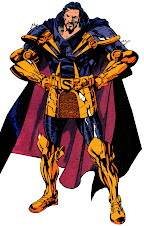
Black Canary leads the confrontation of the President in the Oval Office. Along with everything else, the chess pieces carved in the likenesses of the heroes should have been a dead giveaway. Luthor is actually Despero, "Extraterrestrial dictator. One of the League's first adversaries." Mentally freezing the heroes in place, there's a truly tortured backstory involving a swift overview of Despero history, including his relatively recent final discorporation by the Earth Angel incarnation of Supergirl. His spirit ended up in whatever dimension the JSA villain Johnny Sorrow hails from, and their combined psychic power crossed dimensions to posses Dr. Bedlam on Apokolips. While Despero was being smuggled into Luthor, Sorrow was handling Shazam and freeing the Enemies. It goes on and on for pages, but at least in the end, Despero turns a U.S. flag into a cape to mirror that time he accidentally did the U.N. one similar. He did the thing! We love when they do the thing! I mean, I do here, but still. The least among them, Green Arrow, uses gas (not from chili) to free the heroes to escape, hunted by third eye blinded U.S. troops with orders to kill.

Eventually, the heroes trick the Gluttony-possessed Captain Marvel to call down his lighting, with Billy Batson exorcised of the Sin. That same lighting flows back to Shazam, reviving him so that he can recapture the other Deadly Enemies. The JLA, JSA, and reserves combine their might. Despero makes a great showing by surviving a quantum leaping Captain Atom, having the Rock of Eternity almost land on him, and then got a faceful of an unmasked Johnny Sorrow. He also slammed Superman and Captain Marvel's heads together at one point. A grateful Luthor was imposed upon to replace the destroyed old stone JSA headquarters with a shiny new one.

"Virtue and Vice" was by David S. Goyer & Geoff Johns and Carlos Pacheco & Jesus Merino. Technically, this book came out in 2002, after my retailing days, and once the bloom was well off the JLA rose-- about halfway through the Kelly/Mahnke run. The premiere hardcover cost $24.95, which in adjusted dollars would be $44.35, and was the equivalent of over 11 standard contemporaneous comics. If you want to split hairs, it was 96 pages of original content, roughly 4 & a third comics, while that same month's Green Arrow: The Archer's Quest reprinted six comics for five bucks less. All I know is that it felt egregious, and then it took nearly a year to come out on softcover for $17.95 ($31.20 in 2025.) My memory of this time period is really hazy, so I may have been between brick & mortars getting some pitiful barely-covers-sales-tax discount, stopping by once or twice a month, barely keeping a toe in the industry. I may have swallowed hard and bought the softcover new, but probably got it as a backlist later, and thoroughly resented it. I kept buying JLA and related projects until Infinite Crisis, but I only occasionally read it, and the strip-mining of that brand put me off. It took until Fanholes did a podcast on it for this year's inaugural #JSApril social media event that I finally sat down to read the thing nearly a quarter century late. In fact, I figured I might just harvest some extra eyes and do this post last week, but I thought it would be uncool to bite F@nholes' action, and also I'd be a Debbie Downer about it, besides.

The late Carlos Pacheco was a fantastic artist whose detailed work did not lend itself to long runs, and I mostly admired from afar since those runs were typically on books I didn't follow. For instance, he did four issues of The Flash that one year I tried hard to get into Mark Waid's run, and that's the longest streak I ever had buying Pacheco comics. I'd say his strongest influence was Alan Davis, but he had flashy Image qualities, including some particular anatomical quirks, that made him feel more modern. The Spanish scene vibes were also there, not that I could articulate exactly what that means practically. So, I enjoyed his stuff, and think he was particularly great on Fantastic Four... just not to the degree that he could get me to buy a book just for his art. I like looking at this book, and it makes me wish he'd had a proper run on JLA, but it doesn't overcome what a shallow and convoluted mess this story was. Likewise, this is one of the best renditions of Despero ever, his chief representation online for years afterward-- but probably not in my top five, personally. Kind of rubbery, not that menacing, and I'd swear Ordway inked him on one panel. I think Johns has love for him, and I preferred his second pass (with blessedly more Martian Manhunter) in one of the last JLA arcs. Besides J'Onn's lackluster use here, the Alien Atlas is maybe the character Pacheco has the worst handle on here. He won't commit to the beetle-brow, so his head is just lumpy like a potato. He's got a resting Grinch face, and the classic costume isn't rendered very flattering. Alan Davis has a much better take, including tweaking the suit to his style. I do really like Pacheco's Atom & Hawkman, but Wonder Woman's breast and thing are out of control. Goyer/Johns also give us one of the more obnoxious Plastic Man takes of the dire Ace Ventura period of his characterization, which is painful.

Tuesday, April 1, 2025

Aquaman #1-2 (February-March, 2003)

I continue going through the pile of comics that I got solely for blogging purposes-- left unbagged and otherwise unfiled for decades, now finally getting written up and written off. I figured the first issue of a new series with a small Martian Manhunter cameo would be a good opportunity to get in and out, quick and easy. I knew that I had long ago covered JLA: Our Worlds At War, where Aquaman went missing and was assumed dead, so I at first thought this issue would pick up from there. Actually reading the issue, I was quickly reminded that no, Aquaman had actually come back in a lengthy JLA arc, and I dreaded having to start reading and covering that instead. Then I reminded myself-- no, this is the debut of a new series, and it damned well should get me up-to-speed and draw me in on its own.

Well... no. I mean, I got the basics. Atlantis had been drawn into something called "The Obsidian Age" with some bad juju. Aquaman had to re-sink Atlantis to save it in some unclear capacity, as well as the JLA. The Atlanteans had then decided that their former king had ruined everything and betrayed his people for his true friends, and therefore must die. DC's Atlanteans (or actually Poseidoneans, as Aquaman actually presides over a domed city-stated, not the full continent) have always been a murderous and superstitious lot, prone to attempting to kill little babies and young children over their having the wrong colored hair or eyes. Their turning to regicide is on-brand, including the involvement of Vulko, who is basically Aquaman's Alfred if Alfred substituted being openly catty with constant outright backstabbing. Aquaman being in any way associated with this lot makes him look worse.

Guided by Mera, Aquman's crazy ex-babymama (before her Geoff Johns glow-up,) the Atlanteans busted Aquaman's Justice League signal and harpoon hand. Through sorcery, they were able to all ocean life against Aquaman, rendering his telepathy useless. Certainly not against the *snort* barnacles that bound him to a surface rock until he died by desiccation. Around this turn of events, Aquman was seeing flashes of his past that would be obtuse to anyone not well versed in at minimum a half-dozen Peter David written comics from a decade earlier (across a volume, a mini-series, and an annual, no less.) There's no in-depth captions or editor's notes elaborating on any of this, just an aggressive indifference to any potential new readers no arriving directly from JLA. Most of the rest of the issue is Aquaman breaking loose of the barnacles, continuing to be driven away from the sea by the Atlanteans, and most unintentionally funny, being swarmed by crabs. At least, I think it was unintentionally, rather than a piss take. Don't get me wrong, if this were happening to Capt. Storm or some other normal human protagonist, it could be harrowing. In a super-hero comic, it turns Aquaman into a clownfish.

Near death, in Ireland of all places, Aquaman tosses his useless spearhand into a body of water, and it's caught by... The Lady of the Lake?!? Because King Arthur, see, like we haven't been down this road before. Never so incompetently, though, as I don't think they actually refer to Aquaman as "Arthur" until going full Arthurian. So the Lady of the Lake not only heals all of Aquman's wounds with the water of The Secret Sea (I guess,) but she also gives him a bracelet that allows Aquaman to form a... water hand? They make a point of saying he can make it solid enough to grab things and such, plus he eventually has visions in the palm of it, but nobody's impressed with a water hand, dude.

As for the cameo, the Manhunter from Mars caught a bit of Aquman in the "JLA neural net" during the Sea King's semi-failed telepathic call for help. J'Onn J'Onzz was flying around the general area, while also having a psychic exposition dump with Wonder Woman, Batman, and Superman... on page 20, way after the reader I either figured it out and stopped caring. And again, it's too vague to qualify as useful-- mostly just restating what we already knew instead of expanding upon it. Mostly, it just absolves the JLA's absence by stating that he wanted to deal with his (murderous) people on his own. By the time the Alien Atlas locates his teammate, Arthur is relating the Arthurian developments like we hadn't already read that part. This continued into the second issue, where J'Onn got some clothes and credit cards for Arthur, while they sniped at each other over who was the most stand-offish or least likely to stay with the Justice League. Aquaman then goes on alone on some meandering adventure involving captaining some old man's boat through a storm, using his water hand for magic CPR, fighting those Atlantean stormtroopers a little, and weathering a police investigation. Or something. I checked out four pages in, when the cameo stopped, but after another dumb dream sequence that alluded to stuff I didn't care about.

"Castaway" and "To Die by the Light of the Sea" were by Rick Veitch, Yvel Guichet, and Mark Propst. The writer seemed inclined toward Silver Age cheese, but lacked the chops of Silver Age revivalists like Morrison and Waid. The art was fine, but I had to actively remind myself that it wasn't by the same art team as did the JLA arc. The year that this lasted yielded few waves, but the book would pick steam in the second year under another Mahnke-indebted creative team and the premise of "Sub Diego."

Monday, March 24, 2025

Orion #13 (June, 2001)

Jack Kirby's greatest non-Marvel contribution to pop culture was providing the influence that formed the spine of George Lucas' Star Wars. DC Comics certainly knew that, because when Jedis became all the rage, they did their level best to foist the Fourth World Saga onto a largely disinterested public. As a member of Generation X, I'm well aware of The Force's pervasive presence, and my entry into The Source was Kenner's Super Powers Collection of action figures, whose Kirby-infused lore also absorbed the final seasons of the Super Friends Saturday Morning cartoon that I watched. It's main accomplishment was to set up Darkseid as one of DC's biggest super-villains, and if I didn't know him before, he's been inescapable ever since. I had figures of Darkseid and a Parademon, while my half-brother had Steppenwolf, DeSaad, and maybe Kalibak. I can't recall if either of us bothered with Orion or Mr. Miracle.

Even when I was generally disinterested in DC, John Byrne on Legends couldn't be missed, and Darkseid was there. He popped up in lots of stuff, so that even when I was only occasionally buying DC, the Lord of Apokolips found his way into my collection. By the mid '90s, I was hot and heavy with DC, so I felt obligated to at least try some Fourth World material, and that's exactly how it felt to read that stuff. Finally, I picked up an early proto-Essential/Showcase Presents black & white collection of New Gods, and finally found a way into Kirby's lore. I "got" Orion, at least, but I wasn't convinced that anyone else did. In most of his appearances, he was a hothead jerk with neither the charisma nor menace of, say, Namor the Sub-Mariner. Even favored creators like Jim Starlin came up short.

Of all the attempts to continue the Fourth World without Kirby, I figure mine and the consensus opinion of who came the closest was Walt Simonson's Orion. He'd arguably bettered Kirby on The Mighty Thor, though he admittedly had the whole of Norse mythology to fall back on, and was at the peak of his powers in the '80s. Like John Byrne, some of that luster had faded in the '90s, though Byrne still tapped Simonson to provide the covers to his year-plus attempt at reviving Jack Kirby's Fourth World. When Byrne moved on, Simonson was tapped for the next bid, and I was intrigued enough to give it a try for half a year. The story was about the will-enslaving Anti-Life Equation taking over people's minds in the American heartland. This built to what was presented as a climactic battle between father and son, with Darkseid seeming to perish under the blast of his own Omega Effect beams. Simonson was successful at drawing the characters with a divine Kirby bigness, and create a visual language for the New Gods' cosmic power through ornate and arcane displays. But it also embraced the decompressed storytelling trend that persists to this day, and I simply ran out of interest.

After I left, Orion was forced to take up his father's mantle as leader of a wasteland autocracy, and was manipulated down a dark path. He killed DeSaad, gained control of the Anti-Life Equation, and used it to conquer several worlds. As heel turns went, it was pretty benevolent, actually. Less so was Simonson's clear intent to keep his story New Gods-centric despite middling sales and the imposition of gimmicks. There were hot guest artists like Rob Liefeld and Jim Lee doing back-ups, and a particularly grating and incompetent two month tie-in with the Jokers Last Laugh crossover stunt. By 2001, JLA wasn't the juggernaut that it once was, but their prominence on the right cover was still enough to get my dollars.

Simonson had drawn a couple issues of John Byrne's run, and Byrne returned the favor on the two additional issues that I bought for the Justice League guest spot. I bought #14 assuming that things would pick up from their barely-there cameo in #13, but I was too generous and/or gullible. Orion had used the Anti-Life Equation on Captain (Shazam!) Marvel, who was sort of his herald to the JLA Watchtower base. The Big Red Cheese talked the League into listening to Orion's global broadcast of the Equation, the League's will ceased to be their own, but they still flew around performing good deeds, as usual. Orion just took the fighting aspect out of the... equation... for a hot minute. In his sole line, Martian Manhunter stated his intent to build a dam in China. Like he wouldn't have been up for that any other day?

Predictably, Darkseid turned up alive and the mastermind behind much of this, but also plotted Orion's demise to halt his threat. Orion lost the Anti-Life Equation, but otherwise got better. The book really meandered after that, seemingly marking time until cancellation. Two new villainesses introduced and mostly contained in this volume continued to plague Orion, helping to gouge his eyes out, but he got better across a narratively listless but illustratively compelling five-parter. A final oversized issue set all the pieces back to default. As you can probably tell, I'm glad I kept that money in my wallet.

"The Ordering of Earth!" was by Walter Simonson, John Byrne, and Terry Austin. It was nice to see the classic X-Men art team reunited, and the embellishment was a welcome change from Byrne's solo efforts, but say it with me-- Austin wasn't what he once was by that point.

Monday, March 17, 2025

Superman: The Man of Steel #92 (September, 1999)

In a "Fearful Symmetry" situation, this cross-title arc was dubbed "Secret Origins" by its writer, but marketing wanted to take advantage of a guaranteed sell logo, so all the covers call the arc "The One-Man JLA!" The absence of Superman is first noted by Martian Manhunter in Superman #147. The JLA were addressing a jail break at Stryker's Island Penitentiary in Metropolis, and an editors note causes confusion. Apparently, many of the villains were not up-to-date, tipping the hand that this was a month of inventory stories to cover the triangle-number, comics-by-committee crew of the Superman titles for a month. But also, most of the issue was already a fantasy about baby Kal-El having landed on Oa instead of Earth, and growing to become a Green Lantern Corpsman. The continuity nit-picking wasn't helpful. Manhunter telepathically detects Superman's mind somewhere in the depths of space, and calls for a team to seek him out. Steel and Green Lantern promptly volunteered, with Kyle Rayner pressing The Flash into service as well. Wonder Woman also wanted to come, but was denied by J'Onn J'Onzz, not wanting to leave Earth too short-handed of defenders. Aquaman was also left behind, but I felt a lot worse about Diana, because the artist rendered her in a gorgeous Frank Frazetta style.

The next couple of issues are pretty much a waste of time. Adventures of Superman #570 imagines Kal-El as a Rannian styled after Adam Strange. In Action Comics #757, Kal-El is a Thangarian that has displaced Katar Hol, and that's actually a more interesting spin than the overall "real" story. Across these two issues, the JLA search party travel through space and get attacked by a giant squid, multiple times. I final reveal is that they've been captured by the same aliens messing with Superman's memories, and are making the JLA replay the same corny adventure on repeat.

Finally, the Sleuth from Outer Space figures out the ruse, and mentally reaches out to "K'All L'Ell," who now thinks he's a Martian. The Manhunter eventually recovers Superman's psychic identity, and Kal-El suggests merging their minds to break free of the conditioning. This Supermanhunter frees the JLAers and the proper Man of Tomorrow, restoring Kal-El's psyche to his body. It turns out that their captor was himself from the conquered people of X'VyV'X. Rendered xenophobic by the invasion that propelled him into space, the X'VyV'X refugee tried to use a Kryptonian device to brainwash a champion to take back to X'VyV'X. Superman agrees to one more mind wipe to "become" a X'VyV'X Superman to repel the invaders without compromising their location or security. However, this selfless inspired X'VyV'X to trust again, and send the JLA to again recover Superman, who was grateful to have friends like these.

The arc was by Tom Peyer, Tom Grindberg, and various inkers, plus covers by Walt Simonson. It was fine-- I generally enjoy Peyer scripts more, but this was a space-filler with Silver Age influences. Some back issues that I can now release into the wild.

Monday, February 17, 2025

Warner Bros Store DC Heroes Lithograph by Mike Deodato Jr.

I've been saving this one for a rainy day/few months/whenever I could find more details on it. I think I stumbled upon it at an auction site, and swiftly downloaded the jpeg, but can't find it again. The best information I could Google was on a 2015 Legion of Super Bloggers post about a different DC Universe art print that made the rounds in the late '90s, which I'm confident was by Dan Jurgens and Jerry Ordway. As a side bit of business, they offered a tiny scan from a WB Store catalog and a larger black & white version of the Deodato print with their http branded over it. Given the featured line-ups, both pieces were probably produced in the late '90s, but maybe offered in the early 2000s? The Jurgens/Ordway one is very post-Zero Hour, which makes sense because they're the art team on that mini-series, and for all I know it was a spread within the book (but I'm probably confusing it with a more packed but also more pedestrian scene where the extended cast all show up in Metropolis.) J'Onn J'Onzz is also in that one, and just (lower) left of center, but also only a head peek out over Connor Hawke. It's a total cheat not to have the Alien Atlas a full head taller, with exposed Martian Man-boobs/cape/etc. It's also dull as dishwater, which is why I was in no rush to cover it here.

I was always a bigger Mike Deodato Jr. fan than I was for either of the other print's artists, having appreciated how his Wizard-certified hot Image-style supercharged my favorite run of the Wonder Woman title. I mean, he also kind of ruined that title by turning it into a bad girl t&a book, but his earlier issues were much more story-dense. But more importantly at the time, Deodato finally got fans to take the Amazing Amazon seriously as a contender at DC Comics, rather than the annoying little sister that only had a title to lock in merchandising rights. It was sometime around this period tht DC finally bought all of the rights off the Marston Estate and began promoting the concept of a DC Trinity with their whole chest, and I felt that Deodato played a role in that. Plus, I was simply excited by his Chromium Age style, and bought a bunch of lousy Caliber Comics reprints of his old Brazilian work (in a much different art style) with hacked out new covers (plus "his" Thor run, which was probably more a product of the Deodato Studio.)

The hierarchy of power in the DC Universe is more status quo in the Deodato piece, with a huge Batman & Superman trailed by a considerably smaller Wonder Woman, though she is catching up. Instead of accursed Zauriel (so very Post-Zero Hour,) this one has the short-lived gestalt Hawkman with large wings spread right behind Diana. I adore the Atom sliding down the Batline. There's still a tiny pre-angel armor Zauriel deep in the background, plus a No Man's Land Batgirl and mix of Titans that leans hard into 1999 specifically. I'm tempted to call it on this blog post, but will hold back in hopes of future confirmation.

I got to the WB Store whenever I could in this period, and figure I'd have bought this if I'd seen it. That said, stuff giclée were crazy expensive, and I didn't have a vehicle for most of this period, so my access was limited. Still, there's a full body Deodato Sleuth from Outer Space dead center on this image, so I think I'd have at least remembered seeing it before. If you have more information, please leave a comment, and I'd also maybe be interested if you're selling one (but not at a crazy giclée price?)

Tuesday, September 10, 2024

2016 Armek Commission by Rick Hoberg

I returned to comic conventions after something like a decade and started collecting commissions in 2010. I'd been daily blogging on J'Onn J'Onzz for going on three years at that point, and it seemed like a great way to visually realize the potential I saw in the non-franchise. I kept up that pace until a month after the seventh anniversary in 2014, the same year I began all those jams that took forever to finish (where applicable) and still await posting. Even though I'd pulled way back, I kept up with (on average) weekly posting for another couple years, but only bothered with seven total posts in 2017. My priorities shifted to podcasting sure, but also, I was just kind of sick of putting so much time and money into something that had made me that guy who shoehorned Martian Manhunter into conversations where he (or I) weren't wanted. I've kept my Alien Atlas art to a minimum in the COVID era, but old habits die hard, and I was still gathering a substantial body of material through at least 2017. So much of it, over such an expanse of time, that the process started to fall apart for me.

For instance, I approached Rick Hoberg at a convention. I'm pretty sure that it was in Houston, but I don't think it was Comicpalooza. Both Space City Comic Con and Amazing were still operating in town in 2016, the date on the finished piece, but it was a take-home that ultimately got to me later. For all I know, we might have first talked about it the previous year. I'd been getting 1950s-1980s characters done in modern styles, so I thought it would be fun have a comparatively recent (1996?!?) character created in the post-Image school done by a more classical Bronze Age veteran. There was an added layer of irony, because Hoberg is likely best known for his work on DC's Golden Age heroes in All-Star Squadron, but I mostly associated him with the Ultraverse's Image-adjacent team book The Strangers. I dug his clean line, and I think I gave him a choice of characters (I usually do,) with him picking the Hyperclan's robot member, Armek.

It turned out great, and I think you can tell that he had fun working on something outside what was expected from him. This poor guy probably never wants to draw another archer or old-timey mystery man again. His Armek reminds me of Geoff Senior's Death's Head, with all the armor layers and battle damage. There's another blog I could have threatened. Anyway, the same year as the art arrived, I was working on the first volume of Who's Who in Martian Manhunter, making a bunch of mistakes with it while chasing a stupid self-imposed deadline. That project was a ton of work, but I had every intention of getting back to it, and "saved" Armek for the first page of Vol II. Eight years later, I wouldn't hold your breath over that happening. So here I am, poorly serving Hoberg's efforts by sitting on them and forgetting most of the finer points behind the piece's creation. John Cassaday, twenty years Hoberg's junior, died today, and I'm still playing around with time like it's infinite. Sorry, Rick. The piece came out awesome. Thank you!

Sunday, May 19, 2024

Martian Manhunter Annual #2 (October, 1999)

"In the early years of my residence on Earth, I traveled to Africa, took the form of a gorilla and lived as one of them among a tribe in the wild." Though he was treated as one of the lowest status, J'Onn J'Onzz was at least tolerated, and even embraced as a friend by some. When human researchers came to study the apes, the G'Orilla studied them back. Then the poachers came while the Martian was elsewhere, slaughtering scientist and gorilla alike in pursuit of valuable... novelties. Severed heads. Ashtrays fashioned out of paws. The Sleuth from Outer Space tracked the poachers, and used his telepathy to force them to turn themselves in to authorities. He mused that the savage beast assumptions regarding gorillas was more a projection of human's own aggression and avarice than what he had seen amongst the tribe.

Even the various assaults and forced conversions during JLApe: Gorilla Warfare could all be understood as repercussions of the assassination of King Solovar-- but by whom? Who stood to gain? After purging his recent gorilla hybrid-form from his "shape-memory matrix" and restoring his super-hero default, J'Onn J'Onzz traveled to the JLA Watchtower to collaborate with The Batman on this impenetrable mystery. Following Green Lantern Annual #8, "The Morphic Resonance Array was destroyed, but not before a significant portion of the world's population had been transformed into gorillas. Chaos currently reigns. In response to your earlier comments, I'd like to point out that Green Lantern's condition was the reason for my hasty departure from the U.N." [JLA Annual #3 (September, 1999)]

Despite The Dark Knight Detective's constant condescension and dimminishment of his abilities, The Sleuth from Outer Space had also deduced the identity of the mastermind behind this incident, but felt the need to build a case in order to understand where to locate and how to defeat the culprit. To this end, private investigator John Jones, and other alien alter egos, interviewed known associates like Bobo T. Chimpanzee, Monsieur Mallah, Sam Simeon, and William "Congo Bill" Glenmorgan for insights. Sam fanboyed over the Manhunter from Mars, asking him to pose for a sketch.

While John Jones was playing Simian Team-Up, the JLA were doing real stuff, like averting nuclear catastrophe and joining Grogamesh in evacuating Gorilla City as a precaution. It was here that the Sleuth solved Cluedo, explaining that it was Gorilla Grodd in the coup with the assassination. Envy was the motive, and thanks to having absorbed all the mental energy of the gathered gorillas and neo-simians globally, Grodd had the power of a god to blast Martian Manhunter, who reverted to his natural form. However, fully ascending to a deity seemingly meant Grodd being stripped of his identity, and when the Martian pointed this out while "worshiping" the Super-Gorilla for his sacrifice, Grodd recoiled and collapsed. This was done in a sequence of three double-page spreads, joining the many Image-style visuals for big annual storytelling that did thankfully help the pacing on these thickish books. A babbling, vegetative Grodd was locked away in an asylum, and Ulgo sought to normalize relations between Gorilla City and the human world.

"Fear and Loathing on the Planet of the Apes" was by Len Kaminski, Gus Vasquez, & Mark Propst. As I was suffering discontent about a year into the run of the 1998 ongoing series, I especially enjoyed this, the final ever Martian Manhunter/Magnificent 7 JLA solo annual. Which I largely lay at the feet of Ostrander/Mandrake, but that's an admittedly minority opinion. Kaminski was a writer that I always tended to enjoy, who should have had a better career, and who I thought had a really good handle on the Alien Atlas. He and fill-in writer John Arcudi were the guys I kept hoping would take over the series when Ostrander was done with it, only for the title itself to give out after three years. But it was so good, the DC Message Board lectured me. Here, I loved stuff like J'Onn inserting himself into non-human Earth populations, and I really appreciated the trend of pitting J'Onn against Grodd. He's best known as a Flash villain, but the mental powers and outsider perspective made their pairings natural. Obviously it would have been even better if these Silver Age revivalists had, y'know, revived actual Silver Age Martian Manhunter villains, but that's asking too much. Grodd's one of my favorite DC villains, going all the way back to Challenge of the Super Friends, so bring him on.

Vasquez has a rubbery quality that suits J'Onn in a way it wouldn't any other JLAer, and I felt it was more of a piece with the popular style of Howard Porter on JLA broadly and Don Hillsman III very specifically on the Martian Marvel in this time period. I especially liked his Natural Form Martian, which I digitally "cut out" in one of my first forays into Microsoft Paint, to post on my late '90s Web-TV site, so we go way back. For the artist, it was mostly just back-ups and one-offs going forward, though he was still kicking around as late at the 2010s. Kaminski did some more JLA work here and there, but was mostly out of comics after the turn of the century, and I understand is currently committed to a wheelchair in a nursing home against his will. That certainly puts things in perspective. But hey, sorry for the delay in wrapping up this coverage. It's been a lot of apes for a long time. Despite generally liking this storyline, I had misgivings about taking it on in the blogging medium, especially once I felt compelled to look at each book for my different venues. Well founded misgivings, hence the delay.

Tuesday, May 7, 2024

Green Lantern Annual #8 (October, 1999)

Like most of his fellow JLAers, Green Lantern Kyle Rayner briefly regressed to being controlled by Gorilla City while in his ape form, but took the problem further than most. Where the other heroes managed to shake both the influence and the form in relatively short order, the neophyte mostly gave in, becoming a proper gorilla soldier against mankind. As noted by the Sleuth from Outer Space in his own forthcoming, conclusive annual, "However, by this time, the orbital morphic resonator array is operational, defended by a force of space marines led by General Zolog-- aided by Green Lantern, who had been subverted to the gorilla cause." Building a close camaraderie with several of his fellow gorilla grunts, the Green Lantern would play an important role in General Zolog's bid to succeed as his contemporaries repeatedly failed. Essentially, as the last ape standing, all the future glory or blame fell on Zolog's fuzzy shoulders.
In a show of (increasingly limited) power, Zolog ordered the ape-ification of Honolulu, but had to deactivate cloaking to do so, allowing their detection by the Sleuth from Outer Space at the JLA Watchtower. I'm not sure who put it together, but the Alien Atlas has an unconventional team ready to go, made up of Golden Age Green Lantern Alan Scott, Warrior, and the Metal Men. J'Onn once worked with Scott in the 1970s, and of course had associated with him via the JLA/JSA crossovers. Guy Gardner of Justice League International was well familiar, and I was well pleased that he was played as his usual crass self, rather than the Beau Smith glow-up. The Metal Men was the curve ball, though they did go back to JLA: Year One.

Just as Gorilla Lantern engaged this force, he was teleported to the Watchtower, where he was greeted by a gorilla claiming to be part of a force that now occupied the facility. However, this ape slipped up in calling the Lantern "Kyle," rather than his ape name, and his power ring set tentacles upon the disguised Martian. However, J'Onn continued using Kyle's name, and helping him to remember who he truly was. The ring did the rest. "Thanks to my rather duplicitous efforts, Green Lantern was restored to normal, as have been the rest of the JLA." Kyle had initially been concerned for his ape comrades, and now for all of his friends, and rushed back into combat. Unfortunately, General Zolog was something of a simian Kissinger, willing and able to sacrifice many of his own men in a last bid for overall victory. Green Lantern helped mitigate the fallout, but still lost some of his former men, wounding hearts on both sides of this gorilla warfare.

"Grunts" was by Keith Giffen, Octavio J. Cariello, Jr., John Nadeau, Marcelo Campos, & Jordi Ensign. J'Onn's synopsis was written by Len Kaminski. Obviously, my coverage of "JLApril" is late and entirely prompted by the podcasting event that I linked to last week, but I wish I'd run even later, so that I could take advantage of the sharp digital scans in the newly released collection of these comics. The 1999 version were printed on lousy paper that gave everything a gray tinge and made the colors a drab mess. I don't always love the glossy sheen of modern printing, but trust that it's an improvement. Anyway, this was a nice read, my favorite of the satellite solo annuals (obviously not counting the bookends with our favorite Martian.) Giffen on his own doesn't sing like he did with his better collaborators, but his weary, cranky voice suits this material. Unfortunately, there's several instances of the editor blowing it, allowing dialogue balloons intended for one character to come out of the "mouth" of another. Thankfully, the dialogue is distinct enough for the reader to tell where the fault lies. Despite often being thought of as a funny guy, Giffen plays this one fairly straight, lending an unexpected poignancy. But also, he brings in JLI favorite Guy, who naturally plays well with our boy. Star Wars artist Nadeau leans into the grit, so that it's jarring when the style switches to more clean cut super-heroics mid-sequence. Further, Cariello demonstrated his own moody chops on Deathstroke, so maybe there was a heavy-handed inker? It all looks good, just different. Oddly enough, both pencillers moved out of comics and into painting after this. Man, it was so nice to see J'Onn working with people with whom he had a history, instead of whichever team-up tickled Ostrander's fancy on a given month.

Monday, April 29, 2024

Podcast: Dial F for Flanger episode 26

DIAL F FOR FLANGER is a comic chat show.

Flanger is joined by Martian Manhunter super-fan Diabolu Frank to conclude #JLApril2024

The boys are looking at Martian Manhunter Annual 2 from 1999 which is part 8. the final chapter of JLAPE GORILLA WARFARE. The issue is by Len Kaminski, Gus Vasquez, Claude St Aubin, Mark Probst, Carla Feeny, Kurt Hathaway, edited by Dan Raspler and an epic cover by Arthur Adams.

Follow along with all the podcasts participating in the JLApril crossover by searching #JLApril2024 on social media
JLApril Podcasts