From the creator of the free online comic strip Bullfinch.


In late 2000, a consortium of comic publishers came up with the idea to create a financial safety net for comic creators, much in the same fashion that exists in almost any other trade from plumbing to pottery. By March of 2001, the federal government approved The Hero Initiative as a publicly supported not-for-profit corporation under section 501 (c) (3).
Since its inception, The Hero Initiative (Formerly known as A.C.T.O.R., A Commitment To Our Roots) has had the good fortune to grant over $400,000 to the comic book veterans who have paved the way for those in the industry today.
The Hero Initiative is the first-ever federally chartered not-for-profit corporation dedicated strictly to helping comic book creators in need. Hero creates a financial safety net for yesterdays' creators who may need emergency medical aid, financial support for essentials of life, and an avenue back into paying work. It's a chance for all of us to give back something to the people who have given us so much enjoyment.
ALL 104 JUSTICE LEAGUE #50 ORIGINALS…NOW ON DISPLAY!
Please enjoy this gallery of ALL 104 original Justice League of America #50 Hero Initiative covers!
Hardcover and softcover versions of a book collecting all the covers will be available in December, 2011. AND all the originals will be auctioned off according to the following schedule:
• December 3, 2011, Meltdown Comics, Los Angeles, CA: Display of all 104 covers and auction of first one-third
• Jan. 20-22, 2012, Tate's Comics, Lauderhill, FL (Miami/Ft. Lauderdale area): Display of remaining covers and auction of second one-third.
• Feb. 17-19, 2012: Orlando MegaCon, Orlando, FL: Display and auction of final one-third.
All covers will be sold via LIVE AUCTION on-site at the venues above. If you cannot attend but wish to bid, proxy bidding is available.
Contact Joe Davidson at: yensid4disney@gmail.com
Deadlines for each grouping are below, and each cover carries a minimum bid of $100.
 Doctor Trap fared better than Mister Bones, probably because of his more truncated and Manhunter-specific history. J'Onn J'Onzz did end up part of his origin, even if only in a roundabout way. Still, 60% of ten votes is a modest mandate.
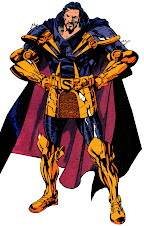
As I've surely noted more times on this blog than anyone ever wanted to hear, the Vile Menagerie name was born in the late '90s on a WebTV fan page where my base of knowledge about Martian Manhunter rogues started with contemporaneous publishing and worked backward. Asmodel debuted in a 1997 JLA two-parter, and his whole history to that point was five comics, so he was one of the easiest, earliest (and therefore arguably one of the first premature) inclusions into the menagerie. I find it appropriate that we end 2012 with Asmodel as the last subject to face the trials of SurVILEvor Island.
Doctor Trap fared better than Mister Bones, probably because of his more truncated and Manhunter-specific history. J'Onn J'Onzz did end up part of his origin, even if only in a roundabout way. Still, 60% of ten votes is a modest mandate.
As I've surely noted more times on this blog than anyone ever wanted to hear, the Vile Menagerie name was born in the late '90s on a WebTV fan page where my base of knowledge about Martian Manhunter rogues started with contemporaneous publishing and worked backward. Asmodel debuted in a 1997 JLA two-parter, and his whole history to that point was five comics, so he was one of the easiest, earliest (and therefore arguably one of the first premature) inclusions into the menagerie. I find it appropriate that we end 2012 with Asmodel as the last subject to face the trials of SurVILEvor Island.
 When Justice League Task Force writer Christopher Priest took on the new assignment of Hawkman in 1996, he didn't know that he would only be allowed three issues to bring the series to a close and seal the drum on a character labelled "radioactive" to continuity by DC editorial. Priest liked his titles to be interrelated, and brought the Martian Manhunter (and 1997 Special cover and interior artists Howard Porter and Mike Collins) in to wrap things up. Similarly, he was blindsided when editorial decided to arbitrarily cancel all three current Justice League titles to set the stage for a relaunch. It was a very bad year to be on the B-list. Sixteen years later, many of the characters from those titles haven't made significant appearances anywhere else. Hawkman's being consigned to a literary limbo was kinder than the practical one where Zan and Jayna still reside.
 Anyhow, Katar Hol had just been disposed of when Grant Morrison and Howard Porter (him again!) revived the Silver Age League line-up with postmodern flair for the monster hit JLA. Morrison decided that since the prior incarnation of Hawkman had become toxic, it might be time to offer a modern age interpretation of the concept as revolutionary as those overseen by Julie Schwartz when he mined 1940s trademarks for 1960s hits. Mainstream comics have no stomach for actual permanent change though, and were only putting Hawkman on ice until the stink of Hawkworld and Zero Hour left him, so Morrison's take on a Hawkman as fallen angel amidst the Lord's host was distanced from the source material to become simply Zauriel.
 Not-Hawkman needed his own nemesis to get the ball rolling though. Zauriel had fallen from grace by falling in love with the human woman he was tasked to guardian, which conveniently made him a non-credible witness to a planned rebellion in Heaven led by the King Angel of the Bull Host. Asmodel needed to silence Zauriel all the same, and this murderous pursuit caused him to cross paths with the Justice League. The Martian Manhunter was one of the members who clashed with Asmodel's renegade angels. Memorably, and tellingly of his status in the universe, a weary and singed Alien Atlas was told to "stand down" by Superman, who proceeded to wrestle with Asmodel while Green Lantern Kyle Raynor stared in awe. Kal-El is Jacob becoming Israel; J'Onn J'Onzz merely Esau the red-tinged and rough other brother who plays his part and is then set aside.
 The not-yet-infamous Mark Millar wrote a Zauriel mini-series in all but name with frequent period Martian Manhunter illustrator Ariel Olivetti called JLA: Paradise Lost that expanded the story. As part of a revenge play by Asmodel, he sucker-punched J'Onn J'Onzz to death. A major throughline of the narrative was that while his JLA buddies tried to revive J'Onn J'Onzz, his spirit was in Heaven aiding Zauriel in his conflict with Asmodel. J'Onzz returned from the hereafter at an inopportune point, leaving the final resolution up to Zauriel, the story's star. Once again, Asmodel was the heel, Martian Manhunter the jobber, and only the face changed from story to story. Of course, Zauriel himself swiftly proved to be "enhancement talent," but couldn't even die in Morrison's climactic JLA arc "World War III" with the credibility of Aztek, and subsequently served as a "green-ham-n-egger" in DC magical collectives. I guess it's a tribute of a sort that Zauriel was like the Martian Manhunter of the Shadowpact, or something.
 In his first gambit, Asmodel teamed up with Neron, a demon lord with established ties to Martian lore that were never elaborated upon. The same could be said of any lasting role for Asmodel as a thorn in Martian Manhunter's side. Asmodel merged with the Spectre Force to freeze Hell over in the unloved event mini-series Day of Judgment, and continued in his role as subordinate to Neron in the similarly dismissed Reign in Hell. The lion's share of Asmodel's career was played out by 1999, and the Sleuth from Outer Space has had no role in it since. The supernatural is one of the few genres that isn't a comfortable fit for the Martian Marvel, and lots of comic readers in general would rather not play around in Judeo-Christian-Islamist lore. I'd like to see red planet theology toyed with more, but direct comparison invites controversial knee jerk reactions better suited to Vertigo (to the degree that brand is relevant anymore) than the DCU. At a conceptual level, the Martian Manhunter and Asmodel are simply incompatible, and the stunt of "killing" J'Onn J'Onzz just set the precedent for the broad net of varied culpability cast over the gang murder of the hero in Final Crisis. Maybe someday, someone will make the Alien Atlas die like they really mean it, instead of just killing the only vulnerable hero in the room because he's there.

 Rott was responsible for Bloodwynd appearing in all those "Death of Superman" tie-ins instead of the Martian Manhunter, but then again, J.M. DeMatteis was just trying to put him up on a shelf (or off into solo land without success) anyway. Rott (and perhaps Dreamslayer) constitutes what passes for the Bloodwynd rogues gallery, and I share misgivings about his joining J'Onn J'Onzz's, so the poll results seem to have reflected a general ambivalence with a 100% split of ten votes.
Gathered together in this time of peace and good will is a family of survivors, bonded together by the purpose of enslaving, vivisecting or outright exterminating mankind to take our planet for their own. After the 1988 Martian Manhunter mini-series essentially wiped out all Silver and Bronze Age history of the red planet, the vision of Martians remained as peaceful green tribesmen for the next decade. The racial strife that was so central to the Alien Atlas' 1970s stories and the creation of Jemm, Son of Saturn was cast aside, but no one told Grant Morrison, who built the opening arc of his Magnificent Seven JLA relaunch around it. No one had attempted to put all of DC's most powerful and successful heroes on one team since the early '80s, and simultaneously repairing their old villains while selling the public on a long abandoned approach must have seemed daunting. Instead, Morrison and artist Howard Porter introduced a new team of seeming heroes with extraterrestrial origins and powers comparable to the Justice League's.
Rott was responsible for Bloodwynd appearing in all those "Death of Superman" tie-ins instead of the Martian Manhunter, but then again, J.M. DeMatteis was just trying to put him up on a shelf (or off into solo land without success) anyway. Rott (and perhaps Dreamslayer) constitutes what passes for the Bloodwynd rogues gallery, and I share misgivings about his joining J'Onn J'Onzz's, so the poll results seem to have reflected a general ambivalence with a 100% split of ten votes.
Gathered together in this time of peace and good will is a family of survivors, bonded together by the purpose of enslaving, vivisecting or outright exterminating mankind to take our planet for their own. After the 1988 Martian Manhunter mini-series essentially wiped out all Silver and Bronze Age history of the red planet, the vision of Martians remained as peaceful green tribesmen for the next decade. The racial strife that was so central to the Alien Atlas' 1970s stories and the creation of Jemm, Son of Saturn was cast aside, but no one told Grant Morrison, who built the opening arc of his Magnificent Seven JLA relaunch around it. No one had attempted to put all of DC's most powerful and successful heroes on one team since the early '80s, and simultaneously repairing their old villains while selling the public on a long abandoned approach must have seemed daunting. Instead, Morrison and artist Howard Porter introduced a new team of seeming heroes with extraterrestrial origins and powers comparable to the Justice League's.
 Possibly taking a cue from the failed farmed out '90s Clive Barker superhero concept Hyperkind and the contemptible antiheroes of the Alex Ross/Mark Waid parable Kingdom Come, this "Hyperclan" embodied the visual aesthetic and vicious streak of the Chromium Age of Comics. Protex was a golden god Superman analogue along the lines of Rob Liefeld's Supreme, Jim Lee's Mister Majestic, Comics' Greatest World's Titan, and so on. The leader of the team was coupled with a female partner in Primaid, the semi-submissive Lois Lane/Wonder Woman stand-in not dissimilar from another in-house analogue, the Earth-3 Superwoman. Picking up on tropes both generic to super-hero comics and still largely paralleling the JLA, there was Züm the manic speedster, Armek the robotic hulk, A-Mortal the vengeful specter, Fluxus the elemental (rocky) guy, Zenturion the shield slinging centurion, and Tronix the sadistic alterna-chick (a more recent cliche, with origins dating back to Golden Age femme fatales but crystallized during the "bad girl" fad.) In a bit of metacommentary, the flashy cretins displaced the classic heroes in the public's hearts by dispatching criminals in brutal fashion while smirking endlessly.
 The twist was that all of the Hyperclan's good deeds were faked, that they used technology to twist the minds of the general public, and that rather than being from a host of worlds, the team was composed entirely of White Martians isolating powers established as belonging to the Martian Manhunter, but rarely displayed in full spectrum. You would expect the Alien Atlas to play a major role in the arc, and you would be mistaken. J'Onn J'Onzz was shown having a secret meeting with Protex on one page, and he helped the Flash and Green Lantern beat Züm, Armek, and Zenturion off-panel as part of a gambit to enter the Hyperclan's secret base, Z'Onn Z'Orr. Admittedly, this was in part to keep the secret of the Hyperclan long enough for Batman to make the big, fan pleasing reveal, but it also sidelined the Martian Marvel for most of the tale. While the JLA were shown as hurting by the midpoint of the arc, they were never truly down, so J'Onn was at best part of a rally spearheaded by the Dark Knight.
 J'Onzz's only on-panel fight was against Primaid, "the girl" of the team, who kicked his ass and was later hogtied by Wonder Woman. By comparison, Batman took down four members of the Hyperclan by himself. Sure, it was the Alien Atlas who borrowed a trick from Reed Richards by telepathically mindscrewing the White Martians into believing they were humans in professions that would inhibit their powers through fire, but only after the JLA had apprehended them. I guess J'Onzz repossessed Z'Onn Z'Orr as his own temporary base in the first year of a solo series before tossing it into the sun during Malefic's arc. Also, he got ambushed by the White Martians in a story arc four years later, but again, he never delivered the knockout punch to anyone important.
 Comics have a long history of beating a dead horse. Characters are created to serve a specific function in a certain story, then should go away, but instead get brought back again and again (often without any actual demand.) Does the world really need more Squadron Supreme comics set in the core Marvel continuity involving an ersatz JLA frozen in their 1970s interpretation? Yet, while clearly designed to tap into then-popular tropes, the Hyperclan were not analogues of particular characters, simply types. Their designs were fun, and still look pretty nifty fifteen years later. Nobody cares that much about individual Skrulls, only name players like the Super-Skrull and Paibok who stand apart from the crowd. It might have been a stretch to make story sense of the White Martians retaining their humanoid Hyperclan identities, but surely some compromise could be found better than letting them all recede into the homogenic throng of their army.
 Purely White Martian versions of Protex and Primaid were name-checked in "Terror Incognita," but visually they were indistinguishable aside from (human) sexual characteristics in their matching tan one-pieces. The JLA does not have the strongest collection of foes, and it seems a waste to relegate the Hyperclan to the scrap heap in favor of a few appearances from generic White Martians before the lot appeared to be exterminated by Fernus the Burning. More than being thrown under the bus, they were tied to the train tracks and obliterated as an afterthought.
 That said, the Hyperclan have never functioned as Martian Manhunter foes, only JLA ones. The war between the White and Green Martians took place uncounted generations before the time of J'Onn J'Onzz, and he was raised with them as practically mythological entities. The Hyperclan planned to trick J'Onzz into working with them against the League, only to murder him after, but they were just being ruthlessly practical. There's no legitimate personal animosity between the Manhunter and any individual members of the team, nor have we seen any serious one-on-one combat. The Hyperclan as a unit seem to be too much heat to bring down on the Manhunter alone, especially since he's yet to prove his effectiveness against any one of them. Barring a New 52 revision, the ease of ultimate takedown of the Hyperclan at the end of "New World Order" neutered them before the League, or any other team with members capable of flicking a Bic. There's no glory in beating the Hyperclan, yet J'Onn J'Onzz can't believably do it, and would only be motivated by ancient obligations to try. There are ways of working around this, but as we know the Hyperclan that exists in print, they don't truly belong amidst the Vile Menagerie.


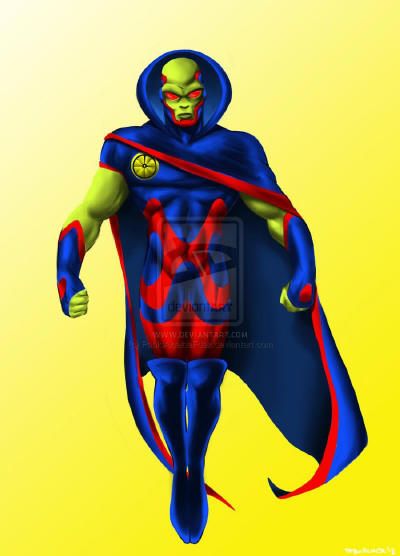
"Dying after the Mars civil war between the White and Green Martians, J'onn arrived Earth as the sole survivor of his planet, finding his soul mate in The Man Of Steel, and a new family in the members of the JLA."Pretty much what we already know and love in the Martian, but with an unexpected Midnighter twist on the Manhunter part. This is an extremely thoughtful design in the way it incorporates past costume elements in revolutionary ways (Bloodwynd headgear, One Year Later piping, chest straps into a quasi-girdle, "pie" symbol as asymmetrical emblem.) This is a design I really like that is way too flashy for a Sleuth from Outer Space, but would be fantastic tweaked for a villain or fellow hero.

JUSTICE LEAGUE OF AMERICA #2Think the variant cover by Scott Clark will spotlight the new back-up feature? I love how they refer to it as the "alien MANHUNTER" strip. Maybe DC will finally let J'Onn J'Onzz be THE Manhunter, and spin all the others off into their own identities (save perhaps Paul Kirk on Earth 2?)
Written by GEOFF JOHNS
Backup story written by GEOFF JOHNS and MATT KINDT
Art and cover by DAVID FINCH
Backup story art by SCOTT CLARK
Variant cover by SCOTT CLARK
1:100 B&W Variant cover by DAVID FINCH
On sale MARCH 6 • 40 pg, FC, $3.99 US • RATED T
Combo pack edition: $4.99 US
Retailers: This issue will ship with two covers. Please see the order form for more information.
• The new Justice League of America team continues to form, but the question remains: What do these heroes want in return for their membership?
• Secret motives are everywhere, and the outcome will have a huge impact on this team and the rest of The New 52!
• Plus, the alien MANHUNTER’s back-up series begins revealing more about J’onn’s plans for this team...and the other Justice League.
This issue is also offered as a combo pack edition with a redemption code for a digital download of this issue.
JUSTICE LEAGUE OF AMERICA’S VIBE #2Don't tell me it wouldn't have been hilarious to have mixed FINAL ISSUE in there somewhere. Anyway, I've only read one Andrew Kreisberg comic so far, and am about to read a second, so I hope I don't regret preordering this. That cover is pretty nifty for Vibe, and Pete Woods' recent fill-in on Aquaman was solid. Beyond wanting to sell better than Paco Ramone numbers on this comic, do you think its unwieldy title has something to do with Vibe Magazine and trademark infringement?
Written by ANDREW KREISBERG and GEOFF JOHNS
Art by PETE WOODS and SEAN PARSONS
Cover by DAVID FINCH
1:25 B&W Variant cover by DAVID FINCH
On sale MARCH 20 • 32 pg, FC, $2.99 US • RATED T
Retailers: This issue will ship with two covers. Please see the order form for more information.
• Vibe makes a massive discovery when he learns of the secret of his power!
• Plus: Vibe’s first public outing with the Justice League of America team sends him into conflict with one of his teammates.
ABSOLUTE BLACKEST NIGHT HCI'm tired of hearing about this event, three years gone.
Written by GEOFF JOHNS, PETER J. TOMASI and others
Art by IVAN REIS and others
Cover by IVAN REIS and OCLAIR ALBERT
RESOLICIT • On sale JUNE 26 • 576 pg, FC, 8.25” x 12.5”, $125.00 US
DC UNIVERSE: SECRET ORIGINS TPI have one of the individual issue. It was nice enough.
Written by various
Art by various
Montage cover
On sale APRIL 3 • 328 pg, FC, $24.99 US
• Collecting the legendary SECRET ORIGINS annuals from the 1960s, this is an amazing look back at how DC’S heroes gained their powers and abilities.
• Featuring the work of Jack Kirby, Gardner Fox, Gil Kane, Carmine Infantino, Curt Swan and more!
• Collects SECRET ORIGINS #1, MORE SECRET ORIGINS #1, EVEN MORE SECRET ORIGINS #1 and WEIRD SECRET ORIGINS #1.
TINY TITANS: AW YEAH TITANS TPTime for a new Miss Martian vehicle, as all I see presently on the horizon is the last Young Justice trade collection.
Written by ART BALTAZAR and FRANCO
Art and cover by ART BALTAZAR
On sale APRIL 10 • 128 pg, FC, $12.99 US
• It’s the final TINY TITANS collection, and Batgirl and her pals take over the Batcave! Plus: Coach Lobo’s Secret Soccer team plays the Birds of Prey, our heroes get lost in Metropolis, and the Tiny Titans take a big step toward becoming grown-up heroes!
• Collecting TINY TITANS #45-50.
STORMWATCH #18Martian Manhunter was ultimately replaced by a fake Wonder Woman to join the fake World's Finest? No wonder this book has bled an average of a thousand readers a month every month since #7.
Written by PETER MILLIGAN
Art by WILL CONRAD
Cover by KEN LASHLEY
On sale MARCH 6 • 32 pg, FC, $2.99 US • RATED T+
• The team battles one of their own for their very survival!
• The relationship of Midnighter and Apollo hits a rough patch when the Amazon-like Zealot joins the team!
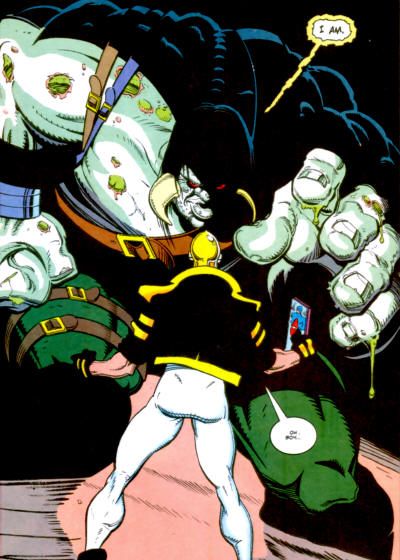 After spending almost all of the two weeks of voting at 100%, one contrary choice landed Triumph at 90% favorability as a Martian Manhunter villain out of ten votes. Jeez, the guy can't even catch a break at being absolutely demonized.
Rott should have made for a short and sweet entry in the SurVILEvor Island series, but there's just too many scabs to pick. Basically, antebellum negro slaves performed voodoo to make an Eclipso diamond thingy to kill their master, which created a demon that grew ever more powerful over the centuries by drawing strength from the darkness in their Black Person hearts. This was the idea of the honky that created Booster Gold. White men from Ortonville, Minnesota should not write stories like that. It's unseemly, not to mention convoluted and inane.
After spending almost all of the two weeks of voting at 100%, one contrary choice landed Triumph at 90% favorability as a Martian Manhunter villain out of ten votes. Jeez, the guy can't even catch a break at being absolutely demonized.
Rott should have made for a short and sweet entry in the SurVILEvor Island series, but there's just too many scabs to pick. Basically, antebellum negro slaves performed voodoo to make an Eclipso diamond thingy to kill their master, which created a demon that grew ever more powerful over the centuries by drawing strength from the darkness in their Black Person hearts. This was the idea of the honky that created Booster Gold. White men from Ortonville, Minnesota should not write stories like that. It's unseemly, not to mention convoluted and inane.
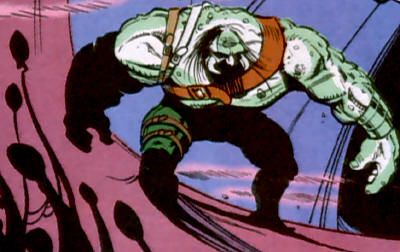 Let's break this down. First, why do expatriate Africans always practice voodoo? It's the same deal as Native American and Jewish mysticism. If these guys could create golems and magic gems and stuff, how come soulless white thugs still end up killing/enslaving the hell out of them? Who saves their God Mode code until after their weapons cache is down to a pocket knife so that you have to kill all your enemies in the most tedious manner possible? You don't see Japanese comic book people, who all know martial arts, doing that stuff. Every Japanese man, woman and child was a super-stealth ninja assassin who could glide on air currents until World War II, which is why we had to drop the bomb on them, and even then they just harnessed its power to grow Ultraman to combat Godzilla. Only Japanese-Americans went to internment camps, because they were technically Americans, who don't have any special powers that don't involve being such dirty cheats that we still manage to overcome magic crap like manitou spirits with smallpox blankets. Point being, if you're going to open up a big 'ol can of creepy crawly worms, you'd best have set aside the time and effort to bait fish.
 Secondly, the creation of the Blood Gem was spearheaded by a priestess named Clemma. She's the one who snuck into the bedroom of slave master Jacob Whitney to kill him where he lay... as opposed to just stabbing or bludgeoning him with whatever was handy en route? Why was a Blood Gem needed if all it did was steal the guy's soul or whatever? Did it empower the gem and allow the plantation slaves their freedom? Was that the plan, but it went awry? If the Blood Gem was in Bloodwynd's family for generations, what were they doing with it all this time, and why did in take a sesquicentennial to attract the JLA's attention? It's kind of important to explain those small but crucially important details.
 Third, Rott's plan was to use a major energy source to free himself from the Blood Gem. However, he'd already pretty much beaten Bloodwynd before Martian Manhunter stumbled along. What would have happened if it had gone another way? Would Bloodwynd and Rott have just waited in the gem for some other poor sap to come along? Why wasn't the Martian Manhunter form just included in the plot? Having taken control of Manhunter's body, why shapeshift into Bloodwynd and then try to join the Justice League? He'd be more readily trusted as J'Onn J'Onzz, but why bother if he was simply looking to wrangle a power source? Does that require a team effort? Why risk life and limb against the likes of Starbreaker and Doomsday? Why not directly engage an energy powerhouse like the Ray, instead of waiting months for one to join your team after a completely unforeseeable event like the death of Superman? Hell, pass immaterially into a S.T.A.R. Lab and commandeer experimental technology to feed the Blood Gem. There are so many ways a geek could spitball a more effective and sensible plan than Rott's that wouldn't involve inviting super-heroes into your home domain at a vulnerable point in your master plan. The only way it could halfway work at all is by force of a bad writer's will.
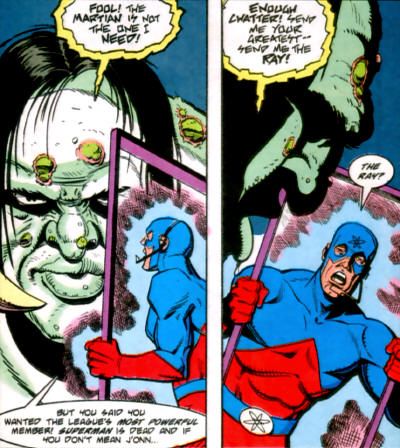 Fourth, did Dan Jurgens consider that by making Rott control the Manhunter/Bloodwynd, he invalidated the first year of Bloodwynd appearances and rendered him merely "the Black Martian Manhunter clone?" Was it his idea to diversify the League, or perhaps to recast Martian Manhunter with a black alter ego? Was Bloodwynd initially intended to be a standalone character, or just a device that became a separate character by semi-popular demand? Was the whole thing dreamed up by editorial and forced on him? Was Bloodwynd's origin so full of plot holes and political incorrectness because it was hacked together as an afterthought, or perhaps outright authorial sabotage?
Fifth, like his counterpart Bloodwynd, we never really find out what the hell this guy can do. This story made a point of explaining away everything Bloodwynd had done as creative applications of the Martian Manhunter's powers, and the character wasn't redefined to a substantial degree afterward. Rott brought heroes into the Blood Gem where they either had no powers or were neutralized by his situational partner, Weapons Master. When Rott escaped, he wielded the power of the Blood Gem against non-powered humans and a notably diminished Martian Marvel. He's big, he's probably strong, and what? All we know is that whatever power Rott did have was taken back by Bloodwynd, which I guess establishes that Bloodwynd has the power to keep undefined power from Rott, so he's got that going for him.
Fourth, did Dan Jurgens consider that by making Rott control the Manhunter/Bloodwynd, he invalidated the first year of Bloodwynd appearances and rendered him merely "the Black Martian Manhunter clone?" Was it his idea to diversify the League, or perhaps to recast Martian Manhunter with a black alter ego? Was Bloodwynd initially intended to be a standalone character, or just a device that became a separate character by semi-popular demand? Was the whole thing dreamed up by editorial and forced on him? Was Bloodwynd's origin so full of plot holes and political incorrectness because it was hacked together as an afterthought, or perhaps outright authorial sabotage?
Fifth, like his counterpart Bloodwynd, we never really find out what the hell this guy can do. This story made a point of explaining away everything Bloodwynd had done as creative applications of the Martian Manhunter's powers, and the character wasn't redefined to a substantial degree afterward. Rott brought heroes into the Blood Gem where they either had no powers or were neutralized by his situational partner, Weapons Master. When Rott escaped, he wielded the power of the Blood Gem against non-powered humans and a notably diminished Martian Marvel. He's big, he's probably strong, and what? All we know is that whatever power Rott did have was taken back by Bloodwynd, which I guess establishes that Bloodwynd has the power to keep undefined power from Rott, so he's got that going for him.
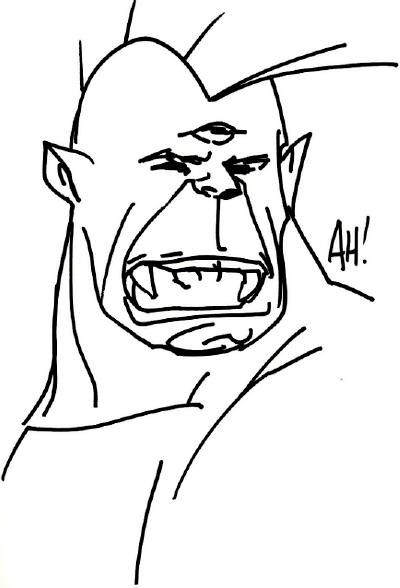
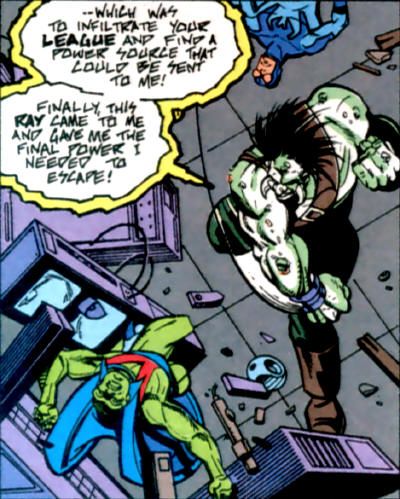 Finally, Rott has no personal enmity toward J'Onn J'Onzz, nor does he contrast all that well conceptually. He doesn't appear to have any plans beyond getting loose from the Blood Gem, which is a bad thing only because he's an ass and goes about it in a rude way. Rott is apparently some vague combination of the restless soul of an especially nasty slave owner and the dark parts of the souls of the descendants of his killer. He's mostly white, but has some African features, which could have been a subtle twist in a Milestone book but just confuses things in DC black & white. He also looks like a mythical ogre. Jacob Whitney probably didn't have to deal a lot with immigrants, and J'Onn J'Onzz wasn't part of an oppressed/slave race like Jemm. I guess there's the supernatural versus science fiction aspect, in which case Rott can go to the back of a long line of better candidates (Korge, Diabolu, etc.) and that's more of a Superman thing besides. It didn't help that Rott is the generational foe of Bloodwynd who targeted the Ray and tussled with a bunch of other Leaguers. Rott screwed-up J'Onn's intended sabbatical and kept him out of comics for a period of time in which the Alien Atlas was supposed to be out of sight anyway. He feels very tangential to the Sleuth from Outer Space narrative, and as such, seems unsuitable for the Vile Menagerie.
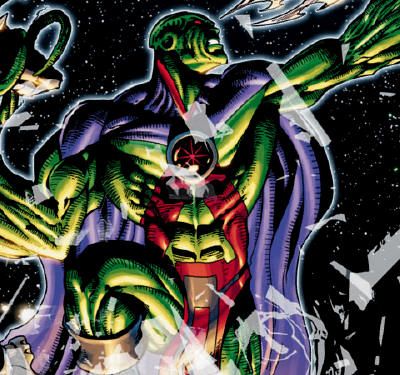 Idol-Head regular commentator will_in_chicago alerted me to an MTV exclusive news story before any of the comic-specific outlets could deliver the word.* The Manhunter from Mars will receive a monthly back-up feature in the pages of the new Justice League of America series, validating the extra dollar cover price in the same fashion as "The Curse of Shazam" in the main Justice League book. I confess to some ambivalence about the creative team of Geoff Johns, Matt Kindt and Scott Clark, but I'm buying the book anyway, so I much prefer a J'Onn J'Onzz back-up of any kind to other members of the team filling that slot (although I would be tempted to trade out Vibe for Justice League of America's Martian Manhunter, the indefinite series.)
The bloom was off the Johns rose years ago, and I've somehow managed to read absolutely nothing Kindt has written. I was a fan of Clark's art in the '90s, but he's dreadful today with his heroin chic digitally lacquered chicken scratch, and I find it telling that articles keep throwing up Dave Finch Manhunter Manhunter images instead. On the other hand, Johns is adept at rebuilding icons, and Clark's rendition of the Alien Atlas and Miss Martian have been solid in the past (especially when "painted" in Justice League: Cry for Justice.) Kindt's the only one talking to the media about the project so far though, and his words fall a bit short of heartening.
For instance, I want a new writer to talk about how they've always liked/had a strong interest in the Martian Manhunter, even if they're full of it. That's comic book boilerplate, equivalent to jocks discussing giving 110% on the field while thanking their deity of choice for granting a victory. Then of course you state your bona fides as a pro-fan by namedropping sacred texts. Batman writers all love The Dark Knight Returns and Man of Steel scribes these days typically nod toward All-Star Superman or "For The Man Who Has Everything." Martian Manhunter's catalog is much dodgier, but you could pretty much mention any of his eponymous series and get a green light from readers, though Ostrander/Mandrake, Giffen/DeMatteis or American Secrets would get the best popular reception.
Idol-Head regular commentator will_in_chicago alerted me to an MTV exclusive news story before any of the comic-specific outlets could deliver the word.* The Manhunter from Mars will receive a monthly back-up feature in the pages of the new Justice League of America series, validating the extra dollar cover price in the same fashion as "The Curse of Shazam" in the main Justice League book. I confess to some ambivalence about the creative team of Geoff Johns, Matt Kindt and Scott Clark, but I'm buying the book anyway, so I much prefer a J'Onn J'Onzz back-up of any kind to other members of the team filling that slot (although I would be tempted to trade out Vibe for Justice League of America's Martian Manhunter, the indefinite series.)
The bloom was off the Johns rose years ago, and I've somehow managed to read absolutely nothing Kindt has written. I was a fan of Clark's art in the '90s, but he's dreadful today with his heroin chic digitally lacquered chicken scratch, and I find it telling that articles keep throwing up Dave Finch Manhunter Manhunter images instead. On the other hand, Johns is adept at rebuilding icons, and Clark's rendition of the Alien Atlas and Miss Martian have been solid in the past (especially when "painted" in Justice League: Cry for Justice.) Kindt's the only one talking to the media about the project so far though, and his words fall a bit short of heartening.
For instance, I want a new writer to talk about how they've always liked/had a strong interest in the Martian Manhunter, even if they're full of it. That's comic book boilerplate, equivalent to jocks discussing giving 110% on the field while thanking their deity of choice for granting a victory. Then of course you state your bona fides as a pro-fan by namedropping sacred texts. Batman writers all love The Dark Knight Returns and Man of Steel scribes these days typically nod toward All-Star Superman or "For The Man Who Has Everything." Martian Manhunter's catalog is much dodgier, but you could pretty much mention any of his eponymous series and get a green light from readers, though Ostrander/Mandrake, Giffen/DeMatteis or American Secrets would get the best popular reception.
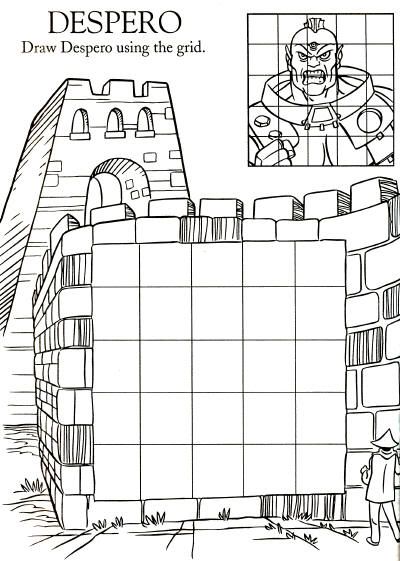
 Kindt instead said, "I hadn’t thought about [Martian Manhunter] for a while, but I knew this was coming up, so I went back and read a bunch of things." Seriously, "things?" What "things?" There aren't a lot of things out there beyond comic books involving the Sleuth from Outer Space, which limits the options of the most vague statement possible, but you still can't rule out the sum total of Kindt's research being coloring books and greeting cards. I don't think "Martian Manhunter is holding back an army of creatures... FINISH THE PICTURE" quite cuts it. You know, this blog is a thing. I got the thing you need right here, baby. C'mere. That's right.
Kindt continues projecting indifference and passive opportunism by offering the laziest character observations possible, including such old saws as "Martian Manhunter is just like Superman, 'cept different," and "gee, he's really an alien" and "golly he has a lot of powers" and "it isn't easy being green." How profound, Wizard!
Kindt has been writing books about spies and psychic mind tricks, and says the Manhunter strip will be about spying and psychic mind tricks. He's going out of his way to make sure the back-up is enslaved to each issue's main narrative as a side story instead of being independent. The focus appears to be on how crazy powerful J'Onn J'Onzz is, rather than his history, personality or supporting cast, and the writer practically ran away screaming at the mention of a humorous element like the old Oreo addiction. So basically, Matt Kindt ticked off a veritable checklist of everything I don't want in a Martian Manhunter strip, as demonstrated in every other failed initiative with the character, even vaguely alluding to the probability that all the building up of the Martian Marvel will end with his being jobbed down the line.
I went into the launch of Stormwatch with a lot of hope and optimism, so it stung when that book stank up the place. The good thing about this interview is that my expectations going into the Martian Manhunter back-ups are about as low as possible. Rather than "onward and upward," I'm braced for "numbing adequacy." Cheers.
* Actually, its being buried on CBR's Robot 6 blog, bundled with several brief items on Newsarama, and overlooked entirely by Comics Alliance and Bleeding Cool tells the tale of how far our favorite Martian has to go to earn any industry respect. I'd have missed this if not for Will and Anj, although Comic Vine and The Source blog did give the news proper attention.
Kindt instead said, "I hadn’t thought about [Martian Manhunter] for a while, but I knew this was coming up, so I went back and read a bunch of things." Seriously, "things?" What "things?" There aren't a lot of things out there beyond comic books involving the Sleuth from Outer Space, which limits the options of the most vague statement possible, but you still can't rule out the sum total of Kindt's research being coloring books and greeting cards. I don't think "Martian Manhunter is holding back an army of creatures... FINISH THE PICTURE" quite cuts it. You know, this blog is a thing. I got the thing you need right here, baby. C'mere. That's right.
Kindt continues projecting indifference and passive opportunism by offering the laziest character observations possible, including such old saws as "Martian Manhunter is just like Superman, 'cept different," and "gee, he's really an alien" and "golly he has a lot of powers" and "it isn't easy being green." How profound, Wizard!
Kindt has been writing books about spies and psychic mind tricks, and says the Manhunter strip will be about spying and psychic mind tricks. He's going out of his way to make sure the back-up is enslaved to each issue's main narrative as a side story instead of being independent. The focus appears to be on how crazy powerful J'Onn J'Onzz is, rather than his history, personality or supporting cast, and the writer practically ran away screaming at the mention of a humorous element like the old Oreo addiction. So basically, Matt Kindt ticked off a veritable checklist of everything I don't want in a Martian Manhunter strip, as demonstrated in every other failed initiative with the character, even vaguely alluding to the probability that all the building up of the Martian Marvel will end with his being jobbed down the line.
I went into the launch of Stormwatch with a lot of hope and optimism, so it stung when that book stank up the place. The good thing about this interview is that my expectations going into the Martian Manhunter back-ups are about as low as possible. Rather than "onward and upward," I'm braced for "numbing adequacy." Cheers.
* Actually, its being buried on CBR's Robot 6 blog, bundled with several brief items on Newsarama, and overlooked entirely by Comics Alliance and Bleeding Cool tells the tale of how far our favorite Martian has to go to earn any industry respect. I'd have missed this if not for Will and Anj, although Comic Vine and The Source blog did give the news proper attention.
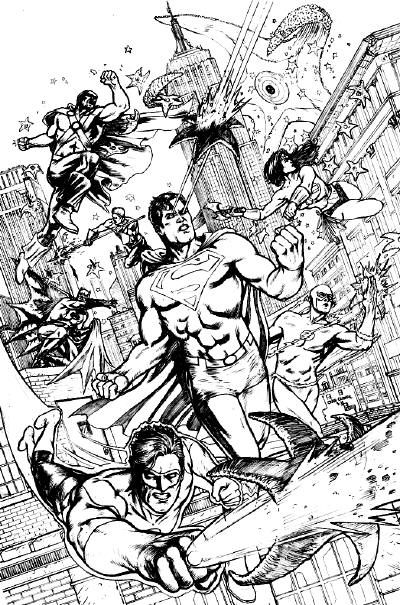
"Justice League pencils done for my portfolio. Battlin’ the ever annoying Starro the Conqueror. Ah, such an awesome, angry, giant starfish from space."Featuring Brightest Day Martian Manhunter, Aquaman, the Flash, Wonder Woman, Superman, Batman, and Green Lantern Hal Jordan in New York. I seriously jacked up the contrast to make the piece pop at 400px, so you need to click the link to see the unspoiled detail of the piece.
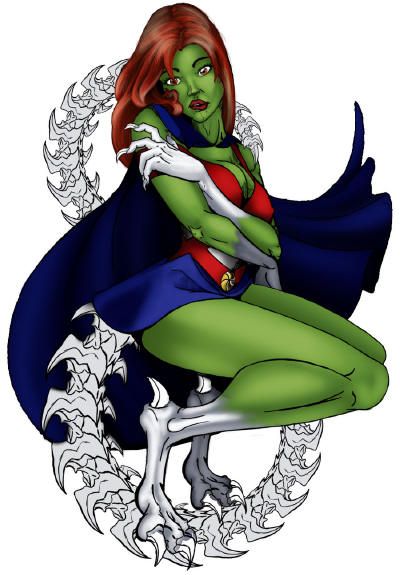
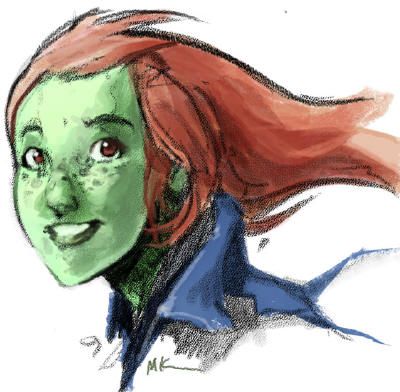
I absolutely ADORE this character. She is currently my top favorite with Superboy pulling up in a close second (can you guess what I ship?). I don't even mind the "Hello, Megan" at all. I actually even like how her character's developing. She's not yet a hero, but she's learning the role and that endears her to me because she's going to make mistakes, a lot more than the others because she's so new, but it enables the viewer to see her grow from start to finish as compared to the middle to finish like with the others. The same could be said about Superboy...
I drew this a while back and decided to use the drawing to practice inking on my new tablet. I like how it came out a lot, especially since this is my first time using this style of inking with my tablet (and using my tablet at all for this kind of thing). Anywho, any feedback would be greatly appreciated for future works...