Showing posts with label 1930-40s. Show all posts

Monday, July 2, 2018

2017 Roh Kar Jam Sketch Detail by Allen Bellman

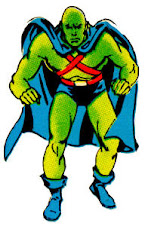
Allen 'Al' Bellman was a staff artist at Timely during The Golden Age of Comics. The majority of his work was on Captain America Comics and Marvel Mystery Comics, and he drew characters like The Patriot, Cap, Sub-Mariner, The Whizzer and Human Torch. He's probably best known for his "Let's Play Detective" strip. He'd appeared several times at Houston's Space City Cons, and I tried to angle for a commission. At the time, he was only working on characters he'd been associated with back in the day (the same answer Jim Steranko always gives me, not to mention Frank Brunner,) and I have always made a point of not doing that very thing. Well, that and I get all this Martian Manhunter stuff that nobody living ever drew before I hit them up.

I was at the 2017 Charlotte Heroes Convention, and I was specializing in new and ongoing jam pieces at that show. I saw Bellman once again, as usual with his wife (decked out in a Captain America themed get-up.) They're adorable. Anyway, for whatever reason, Mr. Bellman was amenable to not only doing a "golden age" character from a company he'd refused to work for (DC,) but to do it as one of the finishing touches on a jam. I'd always wanted to see his take on Roh Kar, First Lawman of Mars, and he seemed genuinely honored and anxious about joining the artists who'd previously worked on the collaboration. I think he said something about being afraid of messing it up, but to me this was absolutely the capstone on two years of effort with a joyful, luminous take on the first Manhunter from Mars! It's the only part of the piece that is drawn solely in pencil, and I briefly considered having it inked, but it would be a travesty to alter Bellman's shading and linework. Personally, I think it's his best work, but I'm kinda biased!

If you'd like your own commission, click here!

Sunday, January 6, 2013

Martian Manhunter Prototype: Radar the International Policeman?


Never underestimate synchronicity.

For instance, I was reading a post at Supergirl Comic Box Commentary about an Amazing Heroes article on the early years of the Maid of Might. Supergirl was co-created by Otto Binder, who was one of the primary writers on Captain Marvel comics back when Shazam routinely outsold Superman. Binder had been brought over to the Superman line when Fawcett finally folded shop due to a shrinking market and DC's decade-plus-long lawsuit over the similarities between the Man of Tomorrow and World's Mightiest Man. The Superman titles were edited by the monolithic Mort Weisinger at the time, and while he often disparaged the Fawcett books, it's pretty obvious that those rival comics inspired huge swaths of Superman's Silver Age adventures, including the development of a whole "family" of similar heroes. In a 1974 interview, Binder said of Weisinger, "He was really an idea man. Most editors aren't, you know." Binder said that it was Weisinger's idea to create Supergirl and hand the assignment to Binder, despite his past as co-creator and writer of Mary Marvel.


History has not been kind to the memory of Mort Weisinger, who was later revealed to be anything but an idea man, and rather a manipulative abuser of talent and associates. Most of the creations unofficially ascribed to Weisinger (as DC has a policy of not crediting their editors as creators in most instances) were blatant swipes of proven successes. Weisinger was noted for the dire habit of hearing a pitch from one writer, lambasting it, then turning around and giving the "rejected" idea to another writer to develop as though it were Weisinger's own.


At the same time I was reading the Supergirl blog, I was also playing a bit of catch-up on the infotainment site Comics Alliance, including an article titled Bizarro Back Issues: Boxing Day With Captain Marvel! (1944). Discussing the lead story from Captain Marvel Adventures #35, we're introduced to U.S. Army Private Pep Pepper, whose background as the child of circus performers led him to an impromptu performance at a U.S.O. show alongside Bob Hope and Billy Batson. Pepper ends up in a boxing match with Captain Marvel, and displays extraordinary abilities before knocking out a Nazi spy impersonating a major. Pepper is revealed to have inherited super-powers from his parents, and the Big Red Cheese is so impressed that Pepper is taken before President Franklin Delano Roosevelt and a secret collective of world powers to compel Pepper to become a covert International Policeman under the alias "Radar." The story was clearly a backdoor pilot for a new strip, which debuted in Master Comics #50, and ran for a couple of years.


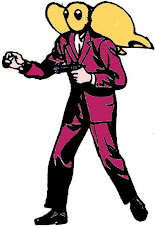
Here's where things get interesting. Radar was a brown-haired Caucasian male with an athletic build who wore a white trenchcoat and fedora while conducting clandestine investigations using telepathy, heightened strength, and enhanced vision. Sound familiar? After spending many years considering the origins of John Jones, it's hard not to see this character as a missing link. Radar got a heavy push early on, but never caught on, though it seems the sort of property right up Mort Weisinger's alley. Radar was a back-up feature in the comic Captain Marvel Junior starred in, and Radar was also the subject of an illustrated "Comics Novel" called Anarcho, Dictator of Death written by Otto Binder. As a spy hunter, it isn't hard to see why Radar would have failed in the closing days of World War II, much too late to a crowded party that was rapidly winding down. I think it's very likely Weisinger could have been exposed to the property, seen its potential, and married it to the extremely popular crime drama and science fiction material of the mid-50s. It's not such a great leap from international to interstellar policeman.


Of course, the strong similarities between John Jones and Radar faded fairly quickly. Jones ditched the coat and hat, and artist Joe Certa began altering the character's features to that of a lantern jawed Irishman from the more WASPish look of the early stories. As the series progressed under editor Jack Schiff, the telepathy was soon forgotten, and when the super-hero trend was embraced, a fantastic alien appearance and more physical powers were emphasized. Still, the Sleuth from Outer Space came from somewhere, and creatively, it wasn't necessarily Mars.


Some Radar sample stories for your perusal... Captain Marvel Adventures #35/Master Comics #50
"Arsenal of Hate"
Master Comics #64

Saturday, August 6, 2011

Zatara in Action Comics #16 (September, 1939)


"Walking in the country one night, Zatara and Tong pause to look at a man who stands in the moonlight..." They noticed that any part of the farmer that came in contact with a moonbeam was turned to mist, and suddenly the fellow was being swept off the Earth against his will. Zatara conjured magic hands through backward speech to catch the farmer, then questioned the man. The farmer was disoriented, having been immaterial, but never losing his senses during the change. Zatara decided that they should consult his scientist friend Djersinsky, who was aware that Harron in England was experimenting with such a principle. The idea was to convert a man to "cosmic molecules" and transfer the weightless being across planets, but it was only theoretical. Zatara thought this was unreal, "but adventurous," and vowed to investigate fully.

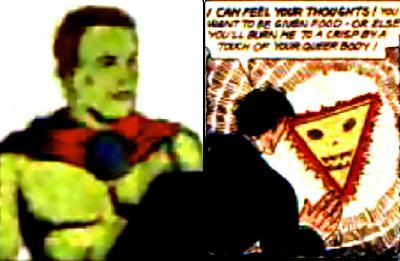
Back at the farm the next night, Tong was shot in the shoulder by a would-be assassin looking to deal with these "meddlers." Zatara caused his arms to freakishly extend and "sic" the gunman. Zatara then made the goon see visions of ghouls surrounding him as a means of extorting information. Zatara was magically able to see what happened as the man spoke. The gunman had been confronted by a glowing triangular being that communicated directly with his mind. "You want to be given food- or else you'll burn me to a crisp by a touch of your queer body!" The gunman directed Zatara to the observatory where the alien had first arrived, and from which he had sent food to some elsewhere.


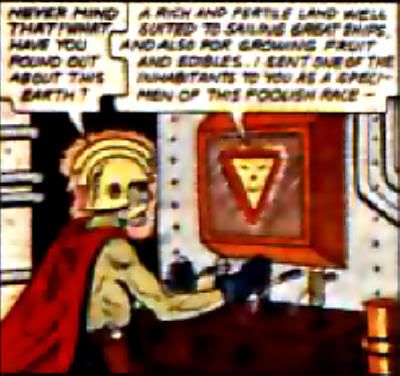
Zatara met with Gorla, the triangle creature, who demanded obedience. The Master Magician tried to read its mind, but was left reeling as if struck by a physical blow. For centuries, Gorla's planetmen had been forming a small pool that would help the aliens transmit themselves anywhere in the universe. Zatara was placed in this pool, and sent to the mother planet Saturn, where he would serve as a sample Earthman for their ruler Ool. The method of transport was beyond Zatara's knowledge or ability to affect, so he passively traveled to Saturn.

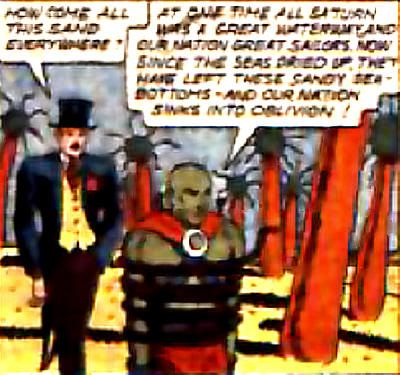
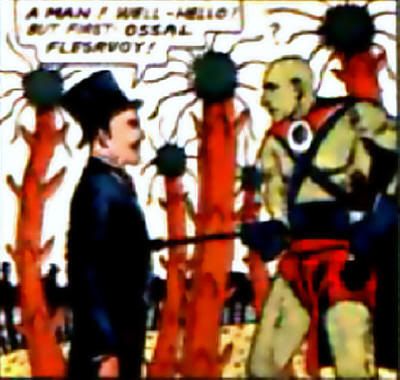
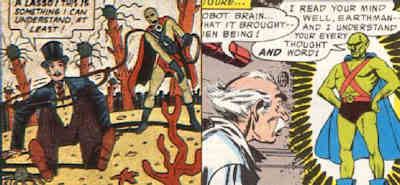
Once there, Zatara was bound by a green alien with "A lasso! This is something I can understand, at least." Zatara commanded "Ossal flesruoy," and the alien was himself lassoed, rather than the magician. Poora was surprised Gorla had sent such a dangerous Earthling back home, but agreed to take Zatara to Ool. "He will know how to handle you!"

Poora revealed that Saturn had once been covered in water and navigated by great sailors, but since drying up was left as nothing but sandy sea bottom. Tests were being conducted to determine if Earth was inhabitable, and if so, all of Saturn would migrate there. The "grand and noble" city of Ool yet stood. "Look how its walls and towers gleam in the sun!" Zatara released Poora so that he could command the city's guards to clear a path to his father. Poora was concerned about Ool's anger should they catch him in the midst of one of his experiments.


Ool was in contact with Gorla, and although surprised by his strange appearance, was pleased the scout could confirm Earth's habitability. A guard then alerted mighty Ool of his son's arrival with Zatara, and the ruler looked forward to meeting a foolish Earthling. Zatara tried to negotiate a peace pact, but Ool mocked the magician and proclaimed, "Know that I, Ool, command- and you obey!" The Saturnians are really big on dominance and S&M imagery, something that would turn up again in Jemm, Son of Saturn.

Zatara continued trying to make nice with Ool, but upon threat of imprisonment, turned the tables on the ruler of Saturn. When reversed words caused the city of Ool to disappear, the leader yet refused to relent. "I- I'll have your blood for this, Earthman!" Zatara showed Ool visions of a revived Saturn, and Ool tried to stab the magician to death. Zatara simply vanished, and Poora attempted to sooth his father's fury. Ool cursed Gorla for sending such a powerful opponent, and when Zatara and the city reappeared, Ool continued his attempts on the magician's life through a guard's chucked spear.


Zatara had enough of this nonsense, and proceeded to initiate a protracted regimen of humiliation and demonstration to finally cow Ool into accepting his defeat, ending with a vision of Saturn's destruction. Ool ordered Gorla's return from Earth and the cessation of all activities there. Upon returning, Gorla reverted back to his normal form. Ool saw Zatara as a "god like friend" after the magician constructed an "irrigation canal system" to help Saturn produce vegetation anew, as well as instruction on how to build more. Zatara then bid Saturn adieu, returning to his wounded manservant Tong, who was still laying in the grass. Zatara figured Djersinsky would never believe his tale, but thought he might share it with his more accepting readers in "Action Comics!"

"Zatara the Master Magician and the Terror from Saturn" was produced by Fred Guardineer.

More Blasts From The Past

Wednesday, March 23, 2011

Mighty Ool of Saturn


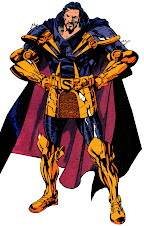
Ool was the green-skinned ruler of the planet Saturn circa 1939. Reigning from a great city which shared his name, Ool was quick-tempered and generally unreasonable. After the great waters of Saturn dried up, Ool sent Gorla to Earth to determine its suitability as a new home for his people. Ool was warned off from Earth by the magician Zatara, who caused the city of Ool to vanish as a demonstration or power. Despite his returning the city, Ool repeatedly tried to murder Zatara out of anger and fear of his power. A final spectacle convinced Ool that he was no match for Zatara, and he vowed to live in peace with the planet forever. Zatara in turn helped show Ool how to make Saturn inhabitable again.

The green-skinned Ool's large white mustache and temperament strongly resembled the Red Saturnian military leader Jogarr of modern times. Ool wore a golden helmet, and red-orange cape with a blue cabochon. Ool had blue gloves, belt and sash, while his legs were covered by maroon skirt.

First Appearance: Action Comics #16 (September, 1939)
Quote: "Such insolence! I'll tear your tongue out!"

Golden Age Day

Friday, March 18, 2011

Poora of Saturn


Poora was the son of Ool, ruler of the planet Saturn circa 1939. Poora bore a strong resemblance to the classical green-skinned Martians, but he possessed no powers to speak of. Poora was good with a lasso, was much more even-tempered than his father, and carried a knife strapped to his belt. Poora wore a red-orange cape with a large white clasp and a blue cabochon in the center. His shorts matched his cape, and he had blue gloves, boots and chest straps.

First Appearance: Action Comics #16 (September, 1939)
Quote: "I like this not, father... You have angered the Earthman!"

Thursday, March 17, 2011

Gorla of Saturn


Gorla was the green-skinned Saturnian sent to Earth to determine it's suitability as a new home for the Saturnian race. Gorla claimed to be one of the handsomest of the royal princes, but neither Ool nor Poora displayed any strong familial bond with him. Like Ool, Gorla was extremely arrogant and prone to rash violence. While on Earth, Gorla transformed into a "triangular thing," due to the effects of cosmic rays. While in this form, Gorla could communicate telepathically, levitate, project psychic attacks, and manipulate solid objects through energy appendages. Gorla threatened to burn an Earthling with his touch, but never actually demonstrated this power.

Gorla managed to get the better of Zatara after a failed assassination attempt, sending the magician back to Saturn for study. Zatara proved more than the Saturnians could handle, and Gorla was called back home, where he was restored to his normal appearance. Gorla dressed similarly to Poora, but had a full head of brown-purple hair.


First Appearance: Action Comics #16 (September, 1939)
Quote: "I command you, Earthman, to render obedience unto me, or I shall burn you to a crisp!"

Tuesday, May 18, 2010

Creators of Mars: Joe Certa


Little is known about the life of Joe Certa, co-creator and longest serving artist of the Martian Manhunter. Certa was born in 1919, educated through the Art Students League, and entered the field in 1946 through Funnies Inc. As part of the comic strip packaging service, Certa's first published work was on titles for Lev Gleason, including the infamous Crime Does Not Pay and Crime and Punishment. For Novelty Press, Certa worked on the strips Bull's-Eye Bill, Target and the Targeteers, The Cadet and Dick Cole, The Wonder Boy. For other publishers, Certa produced work on True Comics, Picture News and more.

The comic book series for which Certa initially made his name were Captain Marvel Jr. (1947-1953,) Joe Palooka (1950-1959,) and The Durango Kid (1950-1952.) Certa also dealt with the newspaper syndicates on Straight Arrow and Curly Kayoe. Most significantly, after the suicide of series originator Ham Fisher, Certa was called up from the Joe Palooka comic book to contribute to the newspaper strip from 1956-59.

Certa began his long association with National/DC in 1949 on The Adventures of Alan Ladd, continuing with Captain Compass, Casebook Mystery, Gang Busters, Robotman, and The Phantom Stranger. For Harvey Comics, Certa regularly contributed to War, First Romance and pre-code horror titles like Black Cat Mystery. Certa produced for the company that would become Marvel Comics throughout the 1950s, mostly on their western and war strips.

In 1955, Joe Certa began his thirteen year run on DC's Manhunter from Mars, co-creating John Jones/J'onn J'onzz and his entire supporting cast, including Zook, Diane Meade, and Captain Harding. With the exception of Professor Hugo, Certa co-created every noteworthy Martian Manhunter villain of the Silver Age, including Mr. V, Marco Xavier, Vulture and the Diabolu Idol-Head.

The lion's share of Certa's art in the 1960s was produced for Western Publishing, for whom he worked exclusively after the Manhunter from Mars ended in 1968. Most of Certa's assignments were in horror titles and licensed properties like Boris Karloff Tales of Mystery, Dark Shadows, The Twilight Zone and Ripley's Believe It or Not!

Joe Certa retired in 1979 after thirty-three years in the industry, and passed away in 1986.

Reference
Lambiek.net
Jerry Bails' Who's Who of American Comic Books 1928-1999
Comicvine

Wednesday, November 11, 2009

Chest Straps and Leather Gloves, Oh My!


Back in my message board days, that dark and lonely time when flame wars were a kick, there were a slew of learned commentators trying to piece together all of DC Comics' history into a single, logical timeline. That way lies madness, I assure you, but it can be fun to investigate. For years, I heard about this elusive "Golden Age Martian Manhunter" called Roh Kar, as well as this or that random, never reprinted story involving Martians. I gave up on trying to work out all those details in that bygone time, so when a discussion broke out about Joe Certa possibly swiping the look of J'onn J'onzz, I kept my trap shut.

According to Wikipedia,
In Action Comics #16 (September 1939), the Zatara story is called "Terror from Saturn". A teleportation beam plucks Zatara from Earth to Saturn where he meets Porra who is the spitting image of the Martian Manhunter.
Honestly, it isn't as though the Martian Manhunter's costume is particularly strong or original, and we've had green men from the red planet since the pulps that inspired adventure comic strips. When you get down to the conceptual core, J'onn J'onzz is just John Carter traveling in the opposite direction, heavily influenced by his pal Tars Tarkas.

However, Idol-Head regular LissBirds chimed in with a pair of nice scans from the Zatanna story, and by gosh, that really does look like J'onn J'onzz! His colors are reversed, so that the straps across his chest are blue, while his cape and trunks are orange/red. Rather than a circular belt buckle, its a neck clasp. Like Michael Netzer and Mike Sekowsky before him, there are blue gloves over his green hands, with boots to match. Curiously, like the primordial Batman, this alien action star has a holstered pistol, plus a knife and whip! What a find!

LissBirds' images sent me scurrying for more reference on the internet. The Martian Manhunter Fotolog had a side-by-side comparison of the two aliens. Even accounting for paper stock, J'onn J'onzz is much more brightly colored, with solid black trunks, and cavalier boots. Aside from the differences noted, the costumes are strikingly similar. However, you'll notice J'onzz's oversized head, somewhat flat nose, overbite, and pronounced brow. The Golden Age character is much more classically handsome than the bizarre Martian in his earliest appearances. Facially especially, but also in general build, the resemblance doesn't really come into play until the 1960s. By that point, Joe Certa had reach his third reworking of the Martian Manhunter, beginning with the skinny, Simpson-headed initial model, through a bulkier, thuggish look, and ending with the svelte, handsome leading Manhunter that most resembles the Zatara villain.

The Fotolog also provided scans of "Terror from Saturn" in its entirety, if rather small, so I hope copyright laws are a bit looser in Spain. The first thing revealed is that Zatara was a pimp who put Superman's powers to shame, and Fletcher Hanks' Stardust the Super Wizard wasn't created in a vacuum. The next thing is that, like J'onn J'onzz, this story is centered around stealing from Edgar Rice Burroughs (more directly, in fact.) The Saturnian Porra greets Zatara with his whip, but is easily trounced, and revealed to be the Prince of Saturn, like Jemm: Son of Saturn. Porra's father Ool even looks like Jemm's uncle Jogarr, and has a similar warlike disposition. Zatara punks them both, convincing them that invading Earth isn't in Saturn's best interest.

Considering the links made between Mars and Saturn in the John Ostrander Martian Manhunter series, these green-skinned Saturnians could go a long way toward explaining the disparities between Silver Age Martians and the "Natural Form" version introduced in the 1980s. The story is definitely an intriguing artifact I'd love to see explored further by competent hands. Still, the Saturnians exhibit no superhuman powers, and are only superficially comparable to the Manhunter from Mars. Unlike Roh Kar, I think it's safe to say the two projects were created independently from one another, and connected only by coincidence and common inspiration.

Sunday, October 12, 2008

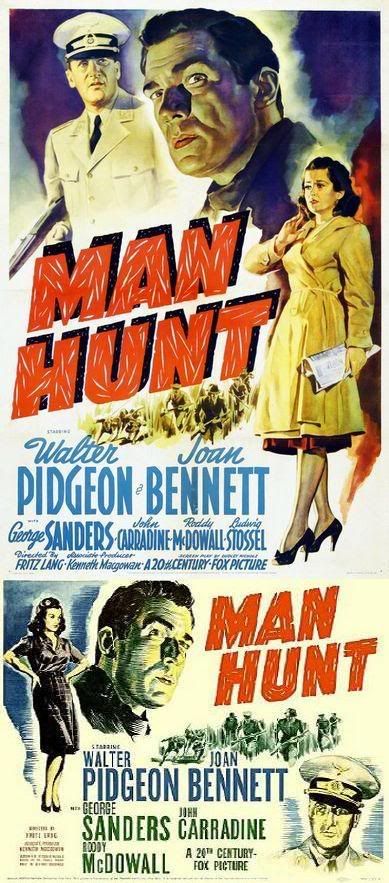
Man Hunt (1941)


Joe Simon and Jack Kirby created DC Comics' first Manhunter in 1942. According to a piece at Don Markstein's Toonopedia, Simon's inspiration was "the 1941 film Man Hunt, which starred Walter Pidgeon."

"Man Hunt" was based on the 1939 Geoffrey Household novel "Rogue Male," which was also adapted in 1976 with Peter O'Toole for the BBC. Per Wikipedia, "In a BBC Radio 4 interview on 26 January 2007, Peter O'Toole named this film as his favourite from his long career." The book also influenced David Morrell's 1972 novel "First Blood," which originated the character (John) Rambo.

"Man Hunt" was directed by the once German-based director Fritz Lang, best known for "M" and "Metropolis." It co-starred Joan Bennett, George Sanders, John Carradine and a tweenaged Roddy McDowall as Vaner.

Below is a detailed synopsis for the film, unavailable on DVD, taken from the Turner Classic Movies website.

"In July 1939, English big-game hunter Captain Alan Thorndike infiltrates Adolph Hitler's retreat Berchtesgaden in the Bavarian Alps and takes aim at Hitler with his high-powered rifle. Although Thorndike had intended to carry out a "sporting stalk" only, and does not have bullets in his gun, he loads the weapon after locating the target. A German soldier surprises him, however, and his bullet goes astray.

Thorndike is brought to Gestapo Major Quive-Smith, to whom he explains that he did not intend to kill Hitler. Quive-Smith does not believe him, however, and orders him to confess that his assassination attempt was at the request of the British government. Although Quive-Smith promises him freedom, Thorndike refuses to sign the prepared confession and is tortured by the Gestapo. When Thorndike still refuses to sign, Quive-Smith arranges for him to be thrown off a cliff in what will look like an accident, but he falls into a river and survives.

The next day, the Gestapo searches for Thorndike but he eludes his pursuers and reaches a harbor, where he boards a boat bound for Britain. An intrepid cabin boy named Vaner hides him while one of Quive-Smith's men, Mr. Jones, boards with Thorndike's passport. Vaner keeps Thorndike hidden during the journey, but once he is ashore, Thorndike realizes that Jones and other Gestapo agents are following him, and he ducks into an apartment to escape. He appeals to the apartment's resident, a young Cockney woman named Jerry Stokes, for aid, and she helps him get to his brother's house.

Thorndike's brother, Lord Gerald Risborough, is an ambassador, who warns him that the German embassy is looking for him, and that England must acquiesce if Germany demands his extradition. Thorndike vows to disappear from England, then leaves with Jerry and sleeps on her couch. The next morning, Thorndike outlines his plans and does not notice that Jerry has fallen in love with him. She pouts until he takes her to buy a pin to replace the one she lost from her tam-o'-shanter, and she chooses a large chromium arrow. Jerry then accompanies Thorndike to the office of his solicitor, Saul Farnsworthy, where he tries to give her five hundred pounds. She refuses the money, and their squabbling is cut short when an assistant announces that Quive-Smith and Jones are on their way to the office.

Thorndike and Jerry escape to the Underground, where Thorndike is chased by Jones. After a fight, Jones is electrocuted on the third rail, and, because he still carries Thorndike's passport, his corspe is identified as the hunter. Realizing that the British police are now after him as well, Thorndike instructs Jerry to write to him at Lyme Regis in three weeks with any news. After a tearful farewell, Jerry returns to her apartment, where Quive-Smith is waiting for her.

Three weeks later, Thorndike, who has been living in a cave in the woods, goes to the post office to pick up Jerry's letter. When he returns to his cave, Thorndike discovers that the letter is from Quive-Smith, who has followed him and blocked the cave's opening. Through a small opening, Quive-Smith hands Thorndike Jerry's tam-o'-shanter and says that she was found dead on the street after jumping out her window.

Enraged by Jerry's murder, Thorndike finally admits that he did intend to kill Hitler, although he did not realize it at the time. Stalling for time, Thorndike agrees to sign the confession and constructs a bow while Quive-Smith opens the entrance to the cave. As Quive-Smith reaches for the signed confession, Thorndike shoots him with the arrow from Jerry's hat. As he dies, Quive-Smith shoots Thorndike with a pistol, but before he collapses, Thorndike destroys the confession.

Months pass as Thorndike recuperates and Europe is thrown into war. Once he has recovered, Thorndike joins the RAF, and on a reconnaissance mission over Germany, bails out with a high-powered rifle, intent on fulfilling his purpose this time."

Sunday, August 17, 2008

Manhunters Around The World


"Manhunters Around The World" was a strip edited by Jack Schiff that began running in July 1949's "Star Spangled Comics #94," alongside Tomahawk, Captain Compass, and solo Robin features. "Manhunters" was just a banner used to cover unrelated police stories that ran for a couple of years. Most of the strips were drawn by Curt Swan, before he found fame as a definitive Superman artist. In those days, Swan was part of Schiff's crew, doing work on strips like "Boy Commandos," "Tommy Tomorrow" and "Gangbusters." Leonard Starr drew most of the "Manhunters" Swan missed, and he produced the art on the series that replaced it, Dr. 13, "The Ghost-Breaker." The "Manhunters" briefly moved to "World's Finest" before being dropped entirely.

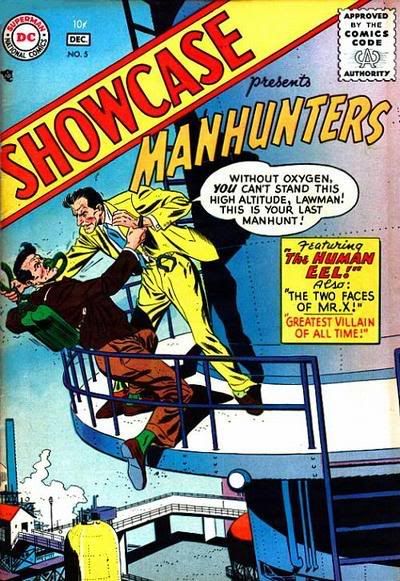
Now, my interest kicks in when Jack Schiff edited his first Showcase edition. Just a year after the launch of the "Manhunter from Mars" feature in "Detective Comics," that series' editor, as well as chief writer Jack Miller, decided to attempt a revival of "Manhunters Around The World" in Showcase #5. Talk about a vote of no confidence! Admittedly, this was the issue directly following the debut of the new Flash and the start of the Silver Age of Super-Heroes, but couldn't they have come up with another title?

Schiff followed the "Manhunters" with such properties as the "Challengers of the Unknown," "Space Ranger" and "Time Master." Julius Schwartz returned to the Flash in "Showcase," then launched "Adam Strange," "Green Lantern," and "the Atom." Even Robert Kanigher hopped onto the super-hero bandwagon with his "Metal Men." At least Schiff finally offered up "Aquaman," but no love went to the "Manhunter from Mars." Even J'onn J'onzz's appearances in "The Brave and the Bold" were under other editors.

This wasn't just a problem I have with Schiff, but DC Comics in general. Despite the "Martian Manhunter" being a noteworthy hero for decades, the company insists on watering down his "brand" by handing the "Manhunter" moniker to every Tom, Dick and Harry that comes down the pike. Sure, J'onn J'onzz was hardly the first "Manhunter," but none have been more successful for DC Comics, and virtually all of them have been treated with more care and respect than the Alien Atlas.

To explore this vein, the Idol-Head will occasionally take a look at the adventure of all these other DC Manhunters, and since I had to call it something, why not "Manhunters Around The World?" Truth is, I could have just as easily gone with "Manhunters Around The Universe," as DC has been so disloyal to the Martian Manhunter as to have extended the name to the furthest reaches of space and time. Still, the title is there, Schiff edited it, and we'll roll with it in our continued look at why Martian Manhunter has pretty much always been treated as expendable.