Tuesday, July 29, 2025

New History of the DC Universe #2 (September, 2025)

Book One of this title threw Martian Manhunter a bone by still having him precede the Silver Age generation of DC super-heroes established Post-Crisis. Now as then, you had the World War II characters sans Superman, Batman, Wonder Woman, and Aquaman, then guys like Captain Comet and J'Onn J'Onzz in a gray middle period, with a Boomer-skewing "modern age" of the excised characters and the Silver Age revival heroes like Flash, Green Lantern, Hawkman, and the Atom. The Sleuth from Outer Space can now go off in a corner and tried to suck the marrow out of that bone, because the proper meat is served to Victor Stone.

Hypertime 2025 tries to squeeze as much of the Pre-Crisis material that the writer grew up on back into the continuities of the biggest DC icons, particularly with regard to Superman and Batman. Wonder Woman suffers under the attempt, referencing a "new" Barbara Minerva version of Cheetah without having Priscilla Rich appear in the Golden Age book, making the Valerie Beaudry Silver Swan share space with green jumpsuit Angle Man, offering some sort of dapper Tony Stark x Dr. Psycho from no time ever, and squeezing it all into a quarter page to save space for Bizarro, Sinestro, and '60s Batman rogues-- obviously of equal importance to the majority of Amazing Amazon history. So basically, the same five DC characters that always get to feast get that much more to chew on, while the ones the basic boys were never as into get the leftovers. I like the Mark Waid as a person and a professional, but he's basically a war criminal on Paradise Island. All this to say, it's not just the Alien Atlas getting crumbs, but that's where I'll pour the rest of the salt today.

Here's where we get very New 52/Snyder Murderverse. The Martian Marvel remains in hiding, or at least of the public board, even as the Challengers, Adam Strange, and the boy sidekicks that would form the Teen Titans maker the scene. Next, a proto-Justice League forms around the initial incursion of Darkseid/the Fourth World, during which Victor Stone suffers crippling injuries and becomes a proto-Cyborg. After that initial encounter, Stone is placed in some sort of suspended animation "for further healing" until he's released to show a lot more skin as a New Teen Titan. DC wants the credit in foregrounding an African-American super-hero as an original Justice Leaguer, but they don't actually want to integrate him into their broader history. You might say that he's separate but equal. Sure, Jan.

That leaves Martian Manhunter and the second generation Black Canary to formally found the Justice League during the Appellaxian Invasion. So they're technically co-founders after a previous grouping was retconned in, just as happened to Hal Jordan, Wonder Woman, Superman, and Batman. Plus, this time we're leaving out the "of America," so maybe there's another formality where the "JLA" was a separate team altogether?

From there, the continuity is largely classical and chronological. J'Onn's part of the first Earth-2 seanace with the DC Trinity, though this edition is very coy about the existence of a Multiverse, so we're probably talking more about being trapped in a different vibrational plane here. The campaign against the scourge of boy sidekicks in short pants continues to be fought with retconned full leggings. Another deeply annoying choice is to have Plastic Man treated as a crappy mid-'60s DC hero only worthy of a caption box instead of one of the greatest Golden Age heroes featured in WWII-era Quality Comics publications. I guess Jack Cole fans are relieved to not have to associate his creation with decades of DC mishandling their version.

There's no mention of Martian Manhunter as the book vaguely touches on key developments of the 1970s and early '80s. To be fair, very little solo material of any heroes are offered, so I should be pleased that the mod Diana Prince and Aquaman's reign/marriage/heir/infanticide got the attention that they did. It was mostly just rattling heroic debuts in partial page pin-up shots. It's... let's go with "amusing," that all of Black peopledom go on ice with Cyborg. Until suddenly, oh my stars, there's John Stewart, Nubia, Bronze Tiger, and a little on Black Lightning is one long rip. Hey, another WW nod, too. In this context, and with a sense of perspective, Martian Manhunter's existence being solely defined by League incarnations fits. The Satellite era is bundled up into the Red Tornado blurb, but the Detroit League rate half a page. Sorta. They left out a visual of Vixen since she already had a debut blurb (representation!) plus we had a top hat & tails Zatanna, New 52 Vibe, and second suit Steel (did we even see Commander Steel in the first issue?) For all the clean up and inclusion, the ethnic slur Gypsy remains, though she looks more like her early JLTF self.

The final three pages covers a thin gruel take on Crisis on Infinite Earths. Asian female Dr. Lights will live. Supergirls will die. And can we squeeze an Infinity Incorporated profile into this? By the way, Power Girl and the Huntress still don't exist yet? The art this time was by Mike Allred, who I love and is perfect for covering this era, and Brad Walker, whose style is jarringly incompatible. I enjoyed Walker's style back when he was going to do a Martian Manhunter mini-series, but this more cartoony style is an awkward compromise.

The backmatter co-written by Dave Wielgosz offers an insane amount of retcon review from the Post-Crisis period. The 2018 Martian Manhunter maxi-series that I gave up on a few issues in, with the latest already forgotten killer of all the Martians (second or third for that decade alone?) is the only J'Onn J'Onzz one given credence. Of course Mark Waid's own JLA: Year One is wedged in there, but that's a book people actually read and loved. Things start to settle into the actual Silver Age six pages in, but it's still pretty much just a list of character debuts. It occurs to me now that Iris Allen doesn't seem to die anymore? Oh, but Sue Dibny still gets assaulted by Dr. Light, at least in the liner notes? Mongul gets a brief nod, with a Starlin panel. The Despero erasure, tho. And don't get me started on Captain Atom.

Monday, July 21, 2025

2023 Fan Expo New Orleans Martian Manhunter figure sketch inks by Tony Kordos

At 2½ years in waiting, this piece's presentation is far from my worst patron offense. I bought a Martian Manhunter figure sketch off eBay a good quarter-century ago, maybe more. I got it cheap and was never 100% sure of its legitimacy, but to quote Sean Connery's character in The Untouchables, "Who would claim to be that who was not?" If you were going to forge a Kevin Maguire drawing, surely you'd pick a more commercial character than J'Onn J'Onzz? Anyway, when I got a Professor Arnold Hugo head sketch from Maguire at Comicpalooza 2014, I asked him about it. He barely looked up from his current drawing to dismissively note words to the effect of "looks like me." Good enough, I figure.

Anyway, I pumped up the contrast on the drawing at a Xerox machine located in a gas station across the street from the comic shop I ran at the time, and used those copies as templates for dozens of Martian Manhunter redesign attempts, none as good as Jim Lee's. Yeah, I don't think that phrasing gets used much, either.

The drawing was so faint, not helped by the cheap acidic paper that it was draw on steadily browning, that I was always afraid of "losing" the image to the elements. Inking in comics is a lost art, and I have much respect for it. That said, I've had some... let's say "misadventures" in my previous inking attempts. One specific piece has been referred to as my personal "Monkey Christ". I've had lousy experiences with seasoned veterans, awesome ones with unknowns, and vice versa. I was precious with my Maguire Manhunter, but I've had opportunities to get the image immortalized by folks who had inked Maguire on Justice League International. For various reasons, I never pulled the trigger.

Finally, I tumbled upon Tony Kordos in NOLA, and I really liked his stuff. Unbeknownst to me, he's a pro who did a fair amount of work at DC during the New 52. He seems to be Paul Pelletier's inker of choice, working over him on such titles as Batman & Robin Eternal, Cyborg, and the Skybound continuation of G.I. Joe: A Real American Hero. I told Kordos that he was free to embellish, rather than slavishly reproduced, and I truly loved the modern flourishes that he added to the '80s style original linework. It gives the piece a pop that it didn't have before, and I'd hope Maguire would be as happy with the collaboration as I was. I haven't caught Kordos at any other shows, but I picked up a real inker's showcase since that I hope he'll take a hand in...

Tony Kordos

Wednesday, July 16, 2025

Superman Treasury 2025: Hero for All

Dan Jurgens draws eight pages of his second treasury format Superman comic, having written and laid-out the entirety of 1999's Superman / Fantastic Four (with deeply compromised finished art by Art Thibert.) It's inked by Brett Breeding, and while the continuity is garbled by some lousy Rebirth-period flourishes, it is mostly a testament to the 1990s "triangle number" era. Anyone who read the books in the period surrounding "Reign of the Supermen" would be forgiven for feeling nostalgic. There's been online discourse since Standards Manual's rerelease of the 1982 DC Comics Style Guide that other artists draw a version of Superman, but only José Luis García-López draws Superman. That's particularly fair if you grew up with the Christopher Reeve movies and surrounding merchandise, but García-López rarely provided complete art for Superman stories-- mostly just the early issues of DC Comics Presents. Jurgens came up in the late Bronze Age, shared influences with García-López, and produced interior and cover art for nearly a hundred Superman comics. Jurgens was likely the closest fans ever got to a more substantial García-López run, which may help to explain why he was to many the Superman artist of his generation.

At least, that's how I can best rationalize it, because man, I am never going to "get" the appeal of Dan Jurgens to those people. To me, he'll always be a technically proficient journeyman, who was never the most appealing or interesting artist drawing Superman at any given point. He succeeded Jerry Ordway on Adventures of Superman in 1989, working alongside Kerry Gammill on Superman. A few months in, George Pérez returned Superman to Action Comics, when it was reclaimed from the experimental weekly anthology format. By 1992, Jurgens had taken over the core Superman title, but Tom Grummett had replaced him on Adventures, while Jon Bogdanove had launched Superman: The Man of Steel. I would favor every one of those artists on any given book over Jurgens. I've liked a few Superman stories written by Jurgens, but on a monthly basis, I usually preferred other writers as well (though he had good runs of The Mighty Thor and Tomb Raider.) And yet, DC always runs back to Dan Jurgens when they've had a "come to Jesus" moment in screwing up the Man of Steel... like when they killed off the New 52 incarnation and replaced him with Jurgens' Superman: Lois and Clark version, which gave us their son, Jon Kent.

I thumbed through the new treasury, otherwise drawn by Bruno Redondo, out of curiosity. Obviously this was put together to exploit enthusiasm for the 2025 Superman movie, as well as readers "of a certain age" with the disposable income to pay the premium on a publication format largely abandoned since the 1970s. I do like Redondo's art, as well as the coloring of Adriano Lucas, which often digitally replaces solid blacks with more animation-style cel coloring. Having come up in the Bronze and Chromium Ages, I've been spoiled by a level of rendered detail never before or since seen in comic book art, which could make the most of being printed at near to the scale of the original art board. I'm not even confident that the art in this book has a physical manifestation beyond the printed edition, and while attractive, the colors have a better claim of making use of the treasury dimensions than the line art. So if it's not an art book, that leaves it up to the story to justify the indulgent scale. This is a Dan Jurgens script. The odds were never in its favor.

The whole reason that I was primed to write this post was because I saw a lot of Martian Manhunter action in this book during that toss. I stopped partway through, once I'd committed to reading the thing. So of course, that stopping point for me was also more or less the stopping point for the Manhunter from Mars in the story.

A giant robot attacks Metropolis, prompting an evacuation of the city. Ma and Pa Kent are tasked with taking a still-adolescent Jon Kent out of town. I assumed that meant the story took place before Brian Michael Bendis squatted down to release his "embellishments" on Superman lore, but that crap was referenced later in the all-Jurgens sections. For all I know, they've de-aged Jon Kent in recent months. I gave up on following DC continuity a year or two into the New 52, so finer points like that would be lost on me. Superman has a surprisingly easy time taking out the robot, and then we're randomly(?) presented with a Smallville flashback deploying Ben Day dots. We see Pa Kent die in a tornado, ala Snyder's Man of Steel, and it occurred to me that the guy I saw with Ma earlier had a bit of Dale Gribble about him. Maybe she caught another feller as a widow in the modern(ish?) continuity? The '90s stunt implant Kenny Braverman was present in the flashback, as was young ginger Lex Luthor, which I'm aware was a Silver Age element returned to continuity in the Birthright mini-series (bought cheap used; yet to read.) A young adult Luthor was present for another flashback.

At the in-story present, alien invaders destroy the JLA... satellite? Watchtower? I don't know what they're calling it these days. Both Superman and Batman are initially missing from the action, but fellow super-heroes step up to defend a variety of global flashpoints in the invasion. This would be "the Martian Manhunter part." The actual invaders were semi-generic anime mech troopers in pale orange and green. They're like a very boring redesign of parademons. As best as I can tell, their main advantage is taking out Earth's communication technology. The Alien Atlas appears to battle the baddies on the Golden Gate bridge, and he is treated as the key to uniting Earth's metahuman protectors, via a massive telepathic network. There's also lots of token appearances by members of the JLA, JLI, Teen Titans, etc. A big deal is made out of Aquaman delivering the U.S. President and Congress to safety underwater, as though that was a relevant and beneficial action to the world order of 2025. Positively provincial.

As anyone familiar with how Martian Manhunter appearances in Superman comics go, J'Obber J'Onzz's off-panel defeat at the invaders' hands marks the end of the world's effective resistance to the aliens. It is here that the ultimate threat is finally revealed... Lady Maxima! And... um... the Cyborg Superman? See-- Dan Jurgens created Hank Henshaw as an analog for Reed Richards, who had to watch his astronaut family slowly die from horific deformities similar to those of the Invisible Woman, Human Torch, and The Thing. Instead of elasticity, Mr. Fauxtastic merged with machinery, which is how he survived. Using genetic material from Superman, he grew a partial clone body, with compensatory cybernetic elements. I don't know that it was ever explained why he couldn't clone a whole-ass Superman body, or at least doctor-up a completely human face, instead of looking like a T-800 Terminator wearing 9/10ths of a Superman body. The Cyborg Superman has been destroyed many times, but always seems to return to this SuperMetallo form. He was of course one of the ersatz Supermen during "Reign," was in at least one of the Doomsday revival mini-series Jurgens did, and was even a big part of Superman / Fantastic Four, owing to his being a Reed Richards rip-off. In this context though, he's only here as a life-sized "marital aid" for an alien queen who could never seal the deal with her Man of Steel.

Maxima's purpose here was to punish Superman for choosing Lois Lane over her, and making a baby with her. Now, Maxima was killed off in the 2001 Superman event "Our Worlds at War," but a revamped version arrived three years into the New 52, and then more or less reverted to a more faithful version in 2017. Jon Kent debuted as a decade-old in 2015, and was up-aged to 17 to serve as Superman's replacement a few years later. All this is to say, it's a bit rich that Maxima would react this strongly to a long-elapsed, rarely/never-expressed grudge from multiple continuities ago. While powerful, Maxima never seemed to work at this scale before, and I'd guess her usage as the villain was in honor of the still-tender passing of her co-creator, George Pérez. But also, Maxima was a member of the version of the Justice League that Dan Jurgens wrote, and Cyborg Superman is one of his pet creations, so... this.

Batman shows up mostly to prevent the killing/capture of Lois Lane, and to explain who Maxima and Cyborg Superman are to Superman's life partner. Some alien albino gal named Glyanna shows up to prevent the killing/capture of Jon Kent. Except that character was created in 2023, and Jon is back to being a boy, so I don't get this continuity. I do get the Ben Day dot "flashbacks" where Clark Kent never developed powers, became editor-in-chief of The Daily Planet, but watched Lois Lane become the twice-over babymama of Lex Luthor. See, this is Jurgens ripping off "For the Man Who Has Everything," badly, and never explaining why an illusion meant to placate a captive Superman (who never actually escaped from the giant robot's trap-body) instead catalyzed his jailbreak. Just as it's never explained how a couple of second-tier Superman villains and random alien invaders defeated all the metahumans, although somehow Steel and armored Lex Luthor have among the best showings of anyone. Simply, the key explanation is that Dan Jurgens was rarely a notable writer, and got by on telling Superman fans that theirs was the bestest boy! That's what we have here, yet again.

I didn't go wild for the James Gunn Superman movie, because it was a sloppy mess of comedy bits and fan service that crowded a post-1986 version of Superman that I've never fully embraced out of his own eponymous movie. I had the opposite reaction here, of loathing the Jurgens-era SuperDuperMan who rendered the entire DC Universe as mere supporting players in his stories. I know this will always be J'Onn J'Onzz's role, especially in Superman stories, but giving the business to Wonder Woman and other God-tier DC heroes is part of why I hated Superman events during the Triangle Number Era. I don't feel like most modern writers can tell compelling Superman stories, and there's a subset that try to make up for it by elevating Superman so far above his peers that every other hero may as well be Jimmy Olsen. Any time I feel bad for the contempt I hold against Dan Jurgens, I recall lame, derivative, condescending mediocrities like this, and feel validated in my decades of disdain.

Wednesday, July 9, 2025

History of the DC Universe (1987)

The first thing that you have to remember here is that Mars does not matter in the grand scheme of DC Comics continuity. Krypton does. Gotham City does. To a much lesser extent, Themyscira does. Casting a net more broadly, as has been mentioned in a couple of my podcasts, Atlantis matters to both Marvel and DC Comics. But Mars? I don't think rates all that highly anywhere, outside of Topps Comics. The 20th Century made a lot of dismissive mention of the Red Planet, and like the moon, the popular consciousness read it as a generic location of dubious value to fantastical comic book stories.


And so, the first half of the Post-Crisis on Infinite Earths revisionist history of DC published in 1986 is mighty concerned about Oa, prehistoric Earth, World War II... all those other places I mentioned. Without a comprehensive reread though, no mention of the planet Mars, or any of its denizens. Moving into the second half, they still devote a lot of pages to WWII, and a little bit of the post-war years. The one true Earth was still a cooling mass, however, so from there we leap to Task Force X and the conception of Aquaman. That famed rocket from a doomed planet had been launched in the first volume, and finally landed in a corn field near Smallville. A nigh-adolescent Bruce Wayne saw his parents gunned down, which gets a bit hinky with the relative ages of the DC Trinity. Phantom Stranger, Captain Comet, and the creation of Princess Diana arrive next. Well, one figure does fall between Comet and clay baby Wonder Woman...

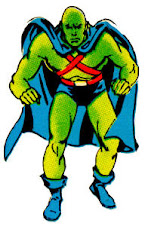
Warrior J'onn J'onzz, exiled into the parched Martian desert, was teleported accidentally to planet Earth by the famous Professor Erdel. This Manhunter from Mars knew the time of heroes had not yet come, and so remained in hiding, disguising himself as a police detective until, at last, he could allow the world to know of his existence.
There's a lot to consider there. Firstly, that was two sentences. I choose to offer long, sometimes tortured sentences as part of my personal expression, so you might call me hypocritical for pointing that out-- but dang! Next, the fact that in a rare instance of DC offering mixed caps in a canon story, only the Js are capitalized. Okay, I might be "considering" too pedantically. How about how the late Silver/early Bronze status quo begun with"...And So My World Ends!" seems to still be in place, with that "warrior" bit in particular pushed back against by the 1988 retcon? We're also in a vague pre-heroic age, with the best marker being the conception of Raven on the next page. The creative team on this book had come up with that character to be a member of the New Teen Titans, and the book's artist was presumably working out how his Wonder Woman would also debut in her late teens/early 20s in her new history. Therefore, at the time of publication, it would be fair to assume Detective John Jones was around in the late 1960s. Couldn't be much further back than that, if we want to keep Superman and Batman around 28-30 years old. While a handful of stories alluded to a further period setting, it would be another eight years before parity with his initial date of publication was established in Zero Hour: Crisis in Time #0.

In another short-lived stand for this continuity, the entire World's Finest trio launches the modern heroic age, placing Robin ahead of the latest version of Flash, Green Lantern, the Atom, the Hawks, Aquaman, Captain Atom, Green Arrow, and Blue Beetle. We see Starfire as a child, Cave Carson, the Challengers of the Unknown, Adam Strange, the Sea Devils, and Dolphin. Curious chronology ahead of their key super-team revival...
This was now the Silver Age of heroes, and some of the greatest who ever lived banded together to fight evil on Earth and throughout the stars. Inspired by the wartime exploits of the famed All-Stars and the Justice Society, these young heroes took the name the Justice League of America.
Because John Byrne's Man of Steel had already rolled out, we knew that Superman would be excluded. Pictured as the core line-up were J'onn J'onzz, Aquaman, Barry Allen, Batman, and Hal Jordan. A scale Ray Palmer Atom was placed just outside the framing of this team inside the old badge logo of the JLA, with the floating heads of Oliver Queen and Katar Hol on either side. Not a bad guess, but this line-up was never properly executed in the comics. The Caped Crusader was eventually excluded, at least as a founder, though he inevitably engaged with the JLA early and often in this retcon. DC eventually settled on a quintet in 1988, capped by Black Canary.

Jemm, Son of Saturn got a mention as a contemporary of Firestorm, Firehawk, and the Warlord Travis Morgan, oddly predating the retroactive continuity armored Gardner Grayle Atomic Knight, as well as Baron Winters of Night Force. These were mostly continuity charity cases, only getting a nod here by proximity to publication date. Jemm was originally a Son of Mars, who played heavily in the fields of post-apocalyptic Bronze Age New Mars stories, and his Saturnians were eventually retconned into literal Martian clones by Ostrander/Mandrake. It's nice for us, since none of the solo Manhunter from Mars adventures rated a mention, nor his predecessor, Roh Kar. Instead, as ever, and another gift of the zeitgeist, the Alien Atlas is solely represented in this period through his affiliation with the mid-80s Justice League (generally appended with "Detroit" to define the line-up of Batman, Elongated Man, Zatanna, Steel, Gypsy, Vibe, Vixen, and Aquaman.
From there, we get into the weeds of para-Crisis on Infinite Earths material, with a heavy emphasis on developments during and spinning out of Legends, including the line-up of the first six months or so of the Justice League relaunch (soon-to-be-International.) So that's Dr. Light II, Captains Atom and Marvel, Mr. Miracle, Guy Gardner, Black Canary, Blue Beetle, and Dr. Fate. They're followed by the Suicide Squad and, ugh, Post-Crisis Wonder Woman. It makes my skin itch when people rave about the female leg of the DC Trinity arriving after freakin' EVERYBODY, just so Perez could treat his Simonson Thor retread as though it were a brand new shiny thing. And then from there is a toboggan ride through the potential futures, most especially the Legion of Super-Heroes 30th Century, that will be ripped to pieces to wipe the butt of every reboot from here through the next five decades and counting.

Wednesday, July 2, 2025

New History of the DC Universe #1 (August, 2025)

It's a bit funny. This post is running late in part because I also ran late last week, and I didn't want to "step" on the full duration of an art post. But mostly, because I thought that I was going to quickly cover the old History of the DCU, and it just kept going. I'm going to circle back to that next week, and give this more or less deserved short shrift. You see, there are only 28 story pages in this edition, and 48 in the original debut volume, yet that one only reached the earliest days of the United States' involvement in World War II. With 20 less pages, and covering nearly double the publishing history, New History makes it well into the nebulous "post war period" of at least the 1960s.

In a key divergence, the writer incorporates elements of the mini-series Doomsday Clock, which to my horror is from nearly eight years ago (though the maxi-series took two years to complete, so its latest reveals are closer to a half-decade-plus old.) Actually, the writer is surprisingly deferential to Geoff Johns' work in general, so maybe he still has sway as the former CCO, or it's just an acknowledgement of his impact at the company. Anyway, the reference is to a government think tank meant to replace the super-heroes lost after the forced retirement on the Justice Society in the early 1950s. Dr. Niles Caulder, Will Magnus, Professor Martin Stein, and Simon Stagg are named and credentialed, so unless one of their projects involved the study of Ian Karkull, these guys would be a minimum of about 30 years old at the time. They would soon reference baby Kal-El's rocket from Krypton, and human frailty suggests these guys would be 60+ today at most, so we're talking a setting of about the same time as 1994's Zero Hour: Crisis in Time that gave us the Martian Manhunter's 35 Years Ago time frame, then meaning 1959.

J'onn J'onzz's use as an historical benchmark is almost exactly the same in execution between the "1987" and 2025 editions of History, but with wildly different relative contexts. Timeline-wise, Martian Manhunter anchors the same gap between "heroic ages" from Justices Society to League that he once did sharing a page with Captain Comet. Except now, the presumably 1950s-set Comet forms a short-lived "Justice Alliance" with other characters published (but not previously canonically set) in that decade: Prince Ra-Man, Automan, Tiger-Man, and Congorilla. What used to be about a four year difference in age between Comet and Manhunter is probably now more like forty years. It makes me wonder where and if the Justice Experience has standing in this sliding timeline, since they were a late 60s/early '70s set team, but Cameron Chase is likely not meant to be in her sixties after seeing her father murdered by Dr. Trap as a child.

With all that having been said, at the end of the day, the image yet comes down to the Alien Atlas manifesting before Erdel, now formally mashing up pre-and-post-Crisis incarnations by name and title...
"In a small laboratory in Colorado, Dr. Mark Saul Erdel tested his teleportation ray for the first time. Inadvertently, he wrenched through space and time a Martian named J'Onn J'Onzz--
Note the mixed caps, which will come up again later/earlier. This book was by writer Mark Waid and artists Todd Nauck and Jerry Ordway. I'd initially assumed that one was inking the other to various degrees, but once I actually read the book, it was clear each was providing full art on their individual pages, with Nauck drawing the Manhunter one. Dave Wielgosz is credited with researching the project with Waid, and offers copious end notes to the issue. The 1998 volume of Martian Manhunter is referenced a few times, including some Tom Mandrake art. Specifically, Ma'aleca'andra's colonization of the solar system. There's also a weirdly worded reference to Kelly/Mahnke JLA about how White Martians "arise" around the time of the Crusades on Earth. The prior Ostrander reference was from Earth's pre-history, with White Martians already competing with greens in the expansion. Even if you excuse it as a reference to the phenomenon of "Burning Martians," one of those was killed by Vandal Savage in the caveman days, so it's still needlessly anachronous. Ma'alefa'ak's plague is unleashed between the times of the Earl of Strethmere and Captain Fear in the early 18th Century of Earth. J'Onn's teleportation is listed between the inital I-Spy activities of King Faraday, and Slam Bradley's arrival in Gotham City.