Showing posts sorted by date for query SurVILEvor Island. Sort by relevance Show all posts

Thursday, April 10, 2014

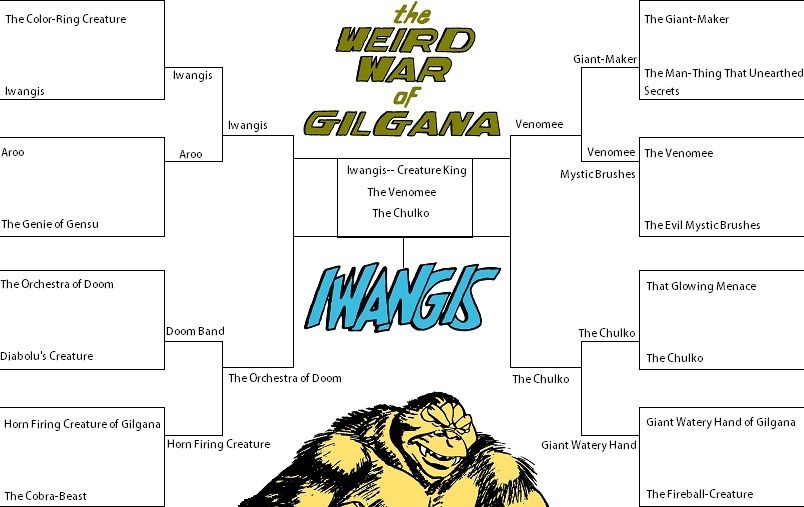
The Weird War of Gilgana: Iwangis IS The Creature King!

Click To Enlarge


The clash was tense, and initially appeared to turn against the Chulko that had already stalemated against the Venomee, who themselves found loggerheads with the Creature King. Unseen but always felt in these proceedings, the wizard cursed the prospect of using his magic to arbitrarily decide a victor, or else wearying his menagerie by drawing out the conflict still further. Briefly, surprisingly, the Doom Shadow fell in such a way that it seemed the battle might favor it. Ultimately though, the energy blasts of the Purple People striking Iwangis triggered a series of explosions that launched a rockslide. Pink sand was pushed off the beach into the waters of Gilgana, causing a far greater explosion, into which the Chulko succumbed. The additional statues that slid to shore expanded the Creature King's army, which finally overwhelmed the Venomee.

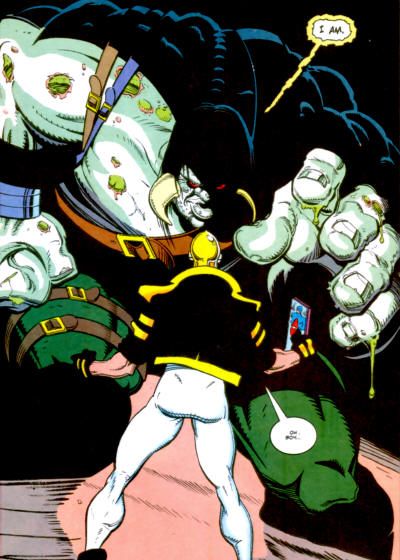
The creature commandos of Iwangis may have overcome, but as he looked out over the desolation wrought, he recognized that he would be the king of nothing in this realm but dirt, rocks, and calamitously unstable water. Could Iwangis even dare sleep this night without fear of a native watery hand drowning him, or a monster goring him? Iwangis' goldenrod paw allowed pink sands to pass through his massive fingers, and contemplated an alternative that may have been influenced by sorcerous suggestion. From a slightly safer distance as allowed for the Creature King to continue controlling his minions, Iwangis directed them to sacrifice themselves pushing a mound of meteoric sand into unstable sea, insuring a catastrophic detonation that tore a small gap in the already threadbare reality connecting Gilgana to Earth. From a hole in the sky, the monsters once collected by Diabolu in ancient times rained down to the ocean surrounding a precarious, remote isle...


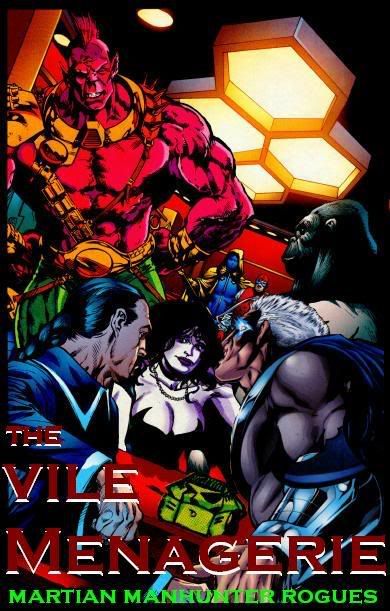
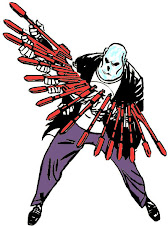
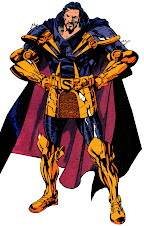
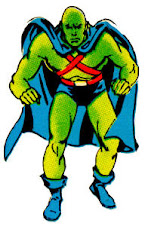
Despero had done much with his reign as champion over the vile villains of the Martian Manhunter. After outlawing interpersonal conflict among the gathered rogues, he initiated a purity test derisively referred to as SurVILEvor Island. As it turned out, the location was actually Diablo Island, a home to the true evil of Eclipso, who launched ongoing eviction proceedings enforced by the Legions of Doom. These distractions had allowed Ma'alefa'ak to instigate rounds of torture against his brother's friends and allies, but with blood and a bestiary in the water, Malefic saw an opportunity to reclaim his title as original victor over the Vile Menagerie. With The Interferer finally displaced, this supposed "Isle of Diabolu" was up for grabs...

Saturday, March 23, 2013

March Madness: "Voting Irregularities"


"Whoa....how did The Human Squirrel get zero votes? I definitely voted for Ben Stoves. And I even voted for Zook. That's really strange..."
It's really not, and I'll explain why.

I started using Google's poll option on the blog fairly early on, and can't recall having any cause for alarm. I had no qualms about using the option for the first series of March Madness posts in 2011. Toward the end of that inaugural season though, things got suspicious, and I had to run the final polls twice before calling Malefic the winner with any confidence. At the time, I thought overzealous fans were doing some ballot stuffing, called shenanigans, and moved on. Unfortunately, while Despero won 2012 with fewer questions, there were still glitches throughout that season that irked me. I continued to have problems here and there with SurVILEvor Island, but the real smoking gun was when results left over from 2012 disappeared for a while in a crash. I'd initially thought that part of the problem with the 2012 season was my leaving too many old poll results in the sidebar until I could begin recording "player stats" for posterity. Thankfully, I had done that before the crash, because when the numbers were reinstated, they were flat-out wrong. I don't think the winners of any contests were incorrect, but the numerical values/margins were totally bogus. Thankfully, I'd already gone over most/all of them to feel okay with the stats offered in The Vile Menagerie versus the Legions of Doom matches.

The truth is, the number of polls in the sidebar, and especially the number of completed ones, should not be an issue. We've never had a poll that went past even forty responses, so we're hardly taking a toll on Google's network. I watched that Zook versus Scorch match suddenly, randomly, go from 50/50 to a 2-to-1 win for Scorch, and other poll results fluctuated in an unseemly manner. Quite simply, as much as I appreciate Google hosting this blog, their poll mechanism is a consistently unreliable turd. I'll use it to finish out March Madness 2013, but I'll be employing other poll resources when "Legions of Doom" restarts in April. Recommendations would be appreciated, though I intend to test drive a few in hopes of avoiding this crap in 2014.

Friday, March 1, 2013

Ma'alefa'ak's Ma'ar'chh Ma'adn'ezz


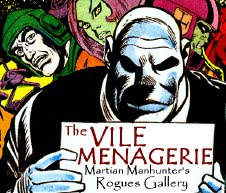
In 2012, the second annual March Madness-style single elimination contest amidst the villains of the Martian Manhunter’s rogues gallery was held. As the last monster standing, Despero decreed that the contest had ended for good. Instead, Despero instituted SurVILEvor Island (in which the merits of participants of previous Marches were weighed to determine their continued role in The Vile Menagerie) and a series of singular combat rows with The Legions of Doom (to show the Manhunter rogues’ relative strength against the broader realm of DC Comics’ super-villains.)

However, J’Onn J’Onzz’s evil twin brother Ma’alefa’ak was displeased by these changes, and petitioned the all-powerful cosmic buttinsky The Interferer for recompense. After all, it was Ma’alefa’ak who (admittedly benefiting from some “voting irregularities”) conquered all in the first Martian March Madness, and it was one of his acolytes who suggested the contest in the first place. The Interferor was initially unswayed, until Ma’alefa’ak suggested an alternative contest—one that would strike deep at the heart of the Sleuth from Outer Space. Instead of his foes, the dearest comrades of the Martian would be pitted against one another in gruesome, unrestrained fights to the death that would spill blood upon locations with special meaning to the Alien Atlas. So begins Ma’alefa’ak’s Ma’ar’rchh Ma’adnezz, and H’ronmeer help us all…

Sunday, January 20, 2013

VM vs. LoD v1.5


Ever since a reader suggestion for March Madness back in 2011, we've been having fun with elimination contests determined by popular vote. After two years of the Martian Manhunter rogues fighting one another, I figured it was time to shake things up a bit. After all, few of these characters have appeared more than once ever, and virtually none have seen any changes in the last several years, so there's a finite number of variables to play with. As part of the blog's fifth anniversary celebration, I announced The Vile Menagerie versus the Legions of Doom to allow Alien Atlas adversaries to build their reputations by battling new nefarious opponents. However, I also wanted to use SurVILEvor Island to determine who truly belonged in the Martian Manhunter's rogues gallery, before turning around and siccing them on the greater DC Universe of bad guys. Juggling both wasn't working out, and I wanted to wrap SurVILEvor Island before the end of the year, so "Legions of Doom" went on the backburner. 2013 promises to be very villain centric, and that begins this weekend, with a new season of bloodsport. Still, how about a look back at our prior clashes?

Saturday, January 12, 2013

SurVILEvor Island


In 2012, a number of villains with past histories fighting the Manhunter from Mars in various capacities were selected for a special poll of this blog's readership. Essentially, these were characters whose appropriateness to be grouped as part of the Martian Manhunter's rogues gallery was called into question, and put to a vote across thirteen day/hour/minute cycles. The conceit was that Despero, who had won that year's March Madness contest, was judging the worthiness of villains who had been treated here as Manhunter foes; with those rejected in that capacity expelled from a game show island inhabited by The Vile Menagerie. Those who remained after voting would constitute a stronger, more "pure" rogues gallery, firmly associated as anti-Alien Atlas adversaries.

Exiled parties will largely be left out of Vile Menagerie games, whether it be themed events, banners, biographical entries, further elimination contests like March Madness and Legions of Doom, or whatever else we can devise for the true, confirmed rogues gallery of the Sleuth from Outer Space.

Saturday, December 29, 2012

SurVILEvor Island: Asmodel


Doctor Trap fared better than Mister Bones, probably because of his more truncated and Manhunter-specific history. J'Onn J'Onzz did end up part of his origin, even if only in a roundabout way. Still, 60% of ten votes is a modest mandate.

As I've surely noted more times on this blog than anyone ever wanted to hear, the Vile Menagerie name was born in the late '90s on a WebTV fan page where my base of knowledge about Martian Manhunter rogues started with contemporaneous publishing and worked backward. Asmodel debuted in a 1997 JLA two-parter, and his whole history to that point was five comics, so he was one of the easiest, earliest (and therefore arguably one of the first premature) inclusions into the menagerie. I find it appropriate that we end 2012 with Asmodel as the last subject to face the trials of SurVILEvor Island.


When Justice League Task Force writer Christopher Priest took on the new assignment of Hawkman in 1996, he didn't know that he would only be allowed three issues to bring the series to a close and seal the drum on a character labelled "radioactive" to continuity by DC editorial. Priest liked his titles to be interrelated, and brought the Martian Manhunter (and 1997 Special cover and interior artists Howard Porter and Mike Collins) in to wrap things up. Similarly, he was blindsided when editorial decided to arbitrarily cancel all three current Justice League titles to set the stage for a relaunch. It was a very bad year to be on the B-list. Sixteen years later, many of the characters from those titles haven't made significant appearances anywhere else. Hawkman's being consigned to a literary limbo was kinder than the practical one where Zan and Jayna still reside.


Anyhow, Katar Hol had just been disposed of when Grant Morrison and Howard Porter (him again!) revived the Silver Age League line-up with postmodern flair for the monster hit JLA. Morrison decided that since the prior incarnation of Hawkman had become toxic, it might be time to offer a modern age interpretation of the concept as revolutionary as those overseen by Julie Schwartz when he mined 1940s trademarks for 1960s hits. Mainstream comics have no stomach for actual permanent change though, and were only putting Hawkman on ice until the stink of Hawkworld and Zero Hour left him, so Morrison's take on a Hawkman as fallen angel amidst the Lord's host was distanced from the source material to become simply Zauriel.


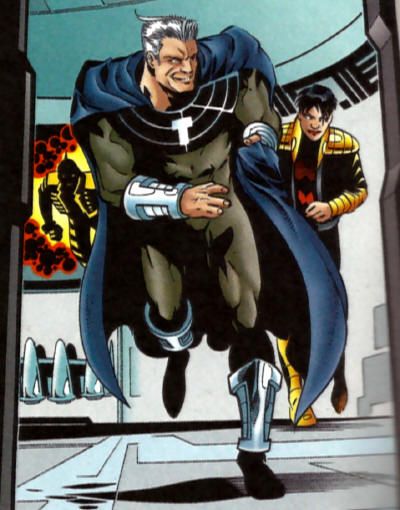
Not-Hawkman needed his own nemesis to get the ball rolling though. Zauriel had fallen from grace by falling in love with the human woman he was tasked to guardian, which conveniently made him a non-credible witness to a planned rebellion in Heaven led by the King Angel of the Bull Host. Asmodel needed to silence Zauriel all the same, and this murderous pursuit caused him to cross paths with the Justice League. The Martian Manhunter was one of the members who clashed with Asmodel's renegade angels. Memorably, and tellingly of his status in the universe, a weary and singed Alien Atlas was told to "stand down" by Superman, who proceeded to wrestle with Asmodel while Green Lantern Kyle Raynor stared in awe. Kal-El is Jacob becoming Israel; J'Onn J'Onzz merely Esau the red-tinged and rough other brother who plays his part and is then set aside.


The not-yet-infamous Mark Millar wrote a Zauriel mini-series in all but name with frequent period Martian Manhunter illustrator Ariel Olivetti called JLA: Paradise Lost that expanded the story. As part of a revenge play by Asmodel, he sucker-punched J'Onn J'Onzz to death. A major throughline of the narrative was that while his JLA buddies tried to revive J'Onn J'Onzz, his spirit was in Heaven aiding Zauriel in his conflict with Asmodel. J'Onzz returned from the hereafter at an inopportune point, leaving the final resolution up to Zauriel, the story's star. Once again, Asmodel was the heel, Martian Manhunter the jobber, and only the face changed from story to story. Of course, Zauriel himself swiftly proved to be "enhancement talent," but couldn't even die in Morrison's climactic JLA arc "World War III" with the credibility of Aztek, and subsequently served as a "green-ham-n-egger" in DC magical collectives. I guess it's a tribute of a sort that Zauriel was like the Martian Manhunter of the Shadowpact, or something.


In his first gambit, Asmodel teamed up with Neron, a demon lord with established ties to Martian lore that were never elaborated upon. The same could be said of any lasting role for Asmodel as a thorn in Martian Manhunter's side. Asmodel merged with the Spectre Force to freeze Hell over in the unloved event mini-series Day of Judgment, and continued in his role as subordinate to Neron in the similarly dismissed Reign in Hell. The lion's share of Asmodel's career was played out by 1999, and the Sleuth from Outer Space has had no role in it since. The supernatural is one of the few genres that isn't a comfortable fit for the Martian Marvel, and lots of comic readers in general would rather not play around in Judeo-Christian-Islamist lore. I'd like to see red planet theology toyed with more, but direct comparison invites controversial knee jerk reactions better suited to Vertigo (to the degree that brand is relevant anymore) than the DCU. At a conceptual level, the Martian Manhunter and Asmodel are simply incompatible, and the stunt of "killing" J'Onn J'Onzz just set the precedent for the broad net of varied culpability cast over the gang murder of the hero in Final Crisis. Maybe someday, someone will make the Alien Atlas die like they really mean it, instead of just killing the only vulnerable hero in the room because he's there.

Saturday, December 22, 2012

SurVILEvor Island: The Hyperclan


Rott was responsible for Bloodwynd appearing in all those "Death of Superman" tie-ins instead of the Martian Manhunter, but then again, J.M. DeMatteis was just trying to put him up on a shelf (or off into solo land without success) anyway. Rott (and perhaps Dreamslayer) constitutes what passes for the Bloodwynd rogues gallery, and I share misgivings about his joining J'Onn J'Onzz's, so the poll results seem to have reflected a general ambivalence with a 100% split of ten votes.

Gathered together in this time of peace and good will is a family of survivors, bonded together by the purpose of enslaving, vivisecting or outright exterminating mankind to take our planet for their own. After the 1988 Martian Manhunter mini-series essentially wiped out all Silver and Bronze Age history of the red planet, the vision of Martians remained as peaceful green tribesmen for the next decade. The racial strife that was so central to the Alien Atlas' 1970s stories and the creation of Jemm, Son of Saturn was cast aside, but no one told Grant Morrison, who built the opening arc of his Magnificent Seven JLA relaunch around it. No one had attempted to put all of DC's most powerful and successful heroes on one team since the early '80s, and simultaneously repairing their old villains while selling the public on a long abandoned approach must have seemed daunting. Instead, Morrison and artist Howard Porter introduced a new team of seeming heroes with extraterrestrial origins and powers comparable to the Justice League's.


Possibly taking a cue from the failed farmed out '90s Clive Barker superhero concept Hyperkind and the contemptible antiheroes of the Alex Ross/Mark Waid parable Kingdom Come, this "Hyperclan" embodied the visual aesthetic and vicious streak of the Chromium Age of Comics. Protex was a golden god Superman analogue along the lines of Rob Liefeld's Supreme, Jim Lee's Mister Majestic, Comics' Greatest World's Titan, and so on. The leader of the team was coupled with a female partner in Primaid, the semi-submissive Lois Lane/Wonder Woman stand-in not dissimilar from another in-house analogue, the Earth-3 Superwoman. Picking up on tropes both generic to super-hero comics and still largely paralleling the JLA, there was Züm the manic speedster, Armek the robotic hulk, A-Mortal the vengeful specter, Fluxus the elemental (rocky) guy, Zenturion the shield slinging centurion, and Tronix the sadistic alterna-chick (a more recent cliche, with origins dating back to Golden Age femme fatales but crystallized during the "bad girl" fad.) In a bit of metacommentary, the flashy cretins displaced the classic heroes in the public's hearts by dispatching criminals in brutal fashion while smirking endlessly.


The twist was that all of the Hyperclan's good deeds were faked, that they used technology to twist the minds of the general public, and that rather than being from a host of worlds, the team was composed entirely of White Martians isolating powers established as belonging to the Martian Manhunter, but rarely displayed in full spectrum. You would expect the Alien Atlas to play a major role in the arc, and you would be mistaken. J'Onn J'Onzz was shown having a secret meeting with Protex on one page, and he helped the Flash and Green Lantern beat Züm, Armek, and Zenturion off-panel as part of a gambit to enter the Hyperclan's secret base, Z'Onn Z'Orr. Admittedly, this was in part to keep the secret of the Hyperclan long enough for Batman to make the big, fan pleasing reveal, but it also sidelined the Martian Marvel for most of the tale. While the JLA were shown as hurting by the midpoint of the arc, they were never truly down, so J'Onn was at best part of a rally spearheaded by the Dark Knight.


J'Onzz's only on-panel fight was against Primaid, "the girl" of the team, who kicked his ass and was later hogtied by Wonder Woman. By comparison, Batman took down four members of the Hyperclan by himself. Sure, it was the Alien Atlas who borrowed a trick from Reed Richards by telepathically mindscrewing the White Martians into believing they were humans in professions that would inhibit their powers through fire, but only after the JLA had apprehended them. I guess J'Onzz repossessed Z'Onn Z'Orr as his own temporary base in the first year of a solo series before tossing it into the sun during Malefic's arc. Also, he got ambushed by the White Martians in a story arc four years later, but again, he never delivered the knockout punch to anyone important.


Comics have a long history of beating a dead horse. Characters are created to serve a specific function in a certain story, then should go away, but instead get brought back again and again (often without any actual demand.) Does the world really need more Squadron Supreme comics set in the core Marvel continuity involving an ersatz JLA frozen in their 1970s interpretation? Yet, while clearly designed to tap into then-popular tropes, the Hyperclan were not analogues of particular characters, simply types. Their designs were fun, and still look pretty nifty fifteen years later. Nobody cares that much about individual Skrulls, only name players like the Super-Skrull and Paibok who stand apart from the crowd. It might have been a stretch to make story sense of the White Martians retaining their humanoid Hyperclan identities, but surely some compromise could be found better than letting them all recede into the homogenic throng of their army.


Purely White Martian versions of Protex and Primaid were name-checked in "Terror Incognita," but visually they were indistinguishable aside from (human) sexual characteristics in their matching tan one-pieces. The JLA does not have the strongest collection of foes, and it seems a waste to relegate the Hyperclan to the scrap heap in favor of a few appearances from generic White Martians before the lot appeared to be exterminated by Fernus the Burning. More than being thrown under the bus, they were tied to the train tracks and obliterated as an afterthought.


That said, the Hyperclan have never functioned as Martian Manhunter foes, only JLA ones. The war between the White and Green Martians took place uncounted generations before the time of J'Onn J'Onzz, and he was raised with them as practically mythological entities. The Hyperclan planned to trick J'Onzz into working with them against the League, only to murder him after, but they were just being ruthlessly practical. There's no legitimate personal animosity between the Manhunter and any individual members of the team, nor have we seen any serious one-on-one combat. The Hyperclan as a unit seem to be too much heat to bring down on the Manhunter alone, especially since he's yet to prove his effectiveness against any one of them. Barring a New 52 revision, the ease of ultimate takedown of the Hyperclan at the end of "New World Order" neutered them before the League, or any other team with members capable of flicking a Bic. There's no glory in beating the Hyperclan, yet J'Onn J'Onzz can't believably do it, and would only be motivated by ancient obligations to try. There are ways of working around this, but as we know the Hyperclan that exists in print, they don't truly belong amidst the Vile Menagerie.


Saturday, December 15, 2012

SurVILEvor Island: Doctor Trap

Mister Bones could not negotiate entry into the Vile Menagerie, cast aside by 60% of 15 votes.

As with the outgoing Mister Bones, Larry Trapp was featured in the short-lived Chase, which was being cancelled as the 1998 Martian Manhunter ongoing series was launching. Co-creator Dan Curtis Johnson was at first flattered that John Ostrander continued to use his toys once they were taken from him, until certain liberties were taken. Larry Trapp's wife was killed during a clash between humble super-heroes and super-villains from a time after the Justice Society retired but before Superman arrived in Post-Crisis continuity. Trapp became a serial killer of capes, among whom the father of Cameron Chase could be counted. This established Dr. Trap as DEO Agent Chase's most significant foe, though I don't believe she ever faced him in her own series. Imagine Johnson's surprise when Trap instead was co-opted as a minor Martian Manhunter foe, and his confrontation with Cameron used as a throwaway plot to help wrap Ostrander's series once it was canned.

D.C. Johnson was still writing short stories with the Chase characters in issues of DC's series of Secret Files and Origins specials, and had plans for one of his forgotten period heroes, the Bronze Wraith. He was a bit miffed when the character was redesigned as a Silver Age style hero who was secretly a false identity of J'Onn J'Onzz.

Dr. Trap also guest-starred in an issue of Harley Quinn alongside John Jones, Diane Meade and Bette Noir, which is more of an afterlife than any of the Manhunter from Mars cast had when the original strip ended. Still, Doctor Trap was created to be Cameron Chase's ultimate foe, which is why he debuted in her book, killed her father, and why his only appearances in the past decade and longest stint in any one book was a storyline that ran in the Kate Spencer Manhunter series featuring Chase. Even his major appearance in Martian Manhunter revolved around trying to murder Cameron and being stopped by the Alien Atlas. Trap is a Chase nemesis who has just crossed J'Onn J'Onzz's path a few times on his way to cut limbs off the Chase family tree. Trap lacks the technical expertise to be a true threat to the Martian Manhunter, which invokes the Joker Clause of the hero being culpable for the murders of a madman so long as it is within his power to end the creep but fails to do so. Dr. Trap diminishes the Martian Manhunter by association, and if you just want mad science gadgetry, Professor Arnold Hugo has a much greater claim to the role.

Saturday, December 8, 2012

SurVILEvor Island: Rott


After spending almost all of the two weeks of voting at 100%, one contrary choice landed Triumph at 90% favorability as a Martian Manhunter villain out of ten votes. Jeez, the guy can't even catch a break at being absolutely demonized.

Rott should have made for a short and sweet entry in the SurVILEvor Island series, but there's just too many scabs to pick. Basically, antebellum negro slaves performed voodoo to make an Eclipso diamond thingy to kill their master, which created a demon that grew ever more powerful over the centuries by drawing strength from the darkness in their Black Person hearts. This was the idea of the honky that created Booster Gold. White men from Ortonville, Minnesota should not write stories like that. It's unseemly, not to mention convoluted and inane.


Let's break this down. First, why do expatriate Africans always practice voodoo? It's the same deal as Native American and Jewish mysticism. If these guys could create golems and magic gems and stuff, how come soulless white thugs still end up killing/enslaving the hell out of them? Who saves their God Mode code until after their weapons cache is down to a pocket knife so that you have to kill all your enemies in the most tedious manner possible? You don't see Japanese comic book people, who all know martial arts, doing that stuff. Every Japanese man, woman and child was a super-stealth ninja assassin who could glide on air currents until World War II, which is why we had to drop the bomb on them, and even then they just harnessed its power to grow Ultraman to combat Godzilla. Only Japanese-Americans went to internment camps, because they were technically Americans, who don't have any special powers that don't involve being such dirty cheats that we still manage to overcome magic crap like manitou spirits with smallpox blankets. Point being, if you're going to open up a big 'ol can of creepy crawly worms, you'd best have set aside the time and effort to bait fish.


Secondly, the creation of the Blood Gem was spearheaded by a priestess named Clemma. She's the one who snuck into the bedroom of slave master Jacob Whitney to kill him where he lay... as opposed to just stabbing or bludgeoning him with whatever was handy en route? Why was a Blood Gem needed if all it did was steal the guy's soul or whatever? Did it empower the gem and allow the plantation slaves their freedom? Was that the plan, but it went awry? If the Blood Gem was in Bloodwynd's family for generations, what were they doing with it all this time, and why did in take a sesquicentennial to attract the JLA's attention? It's kind of important to explain those small but crucially important details.


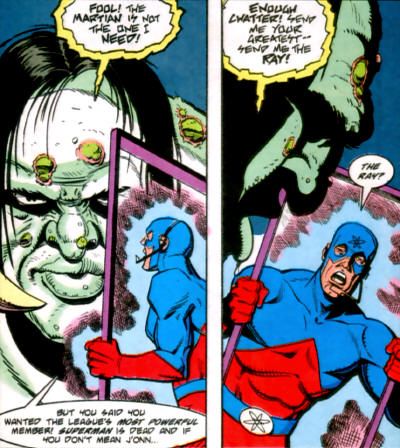
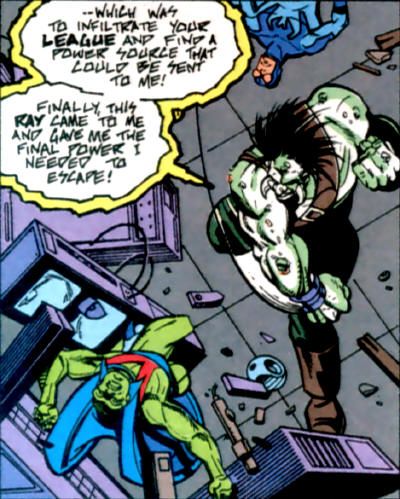
Third, Rott's plan was to use a major energy source to free himself from the Blood Gem. However, he'd already pretty much beaten Bloodwynd before Martian Manhunter stumbled along. What would have happened if it had gone another way? Would Bloodwynd and Rott have just waited in the gem for some other poor sap to come along? Why wasn't the Martian Manhunter form just included in the plot? Having taken control of Manhunter's body, why shapeshift into Bloodwynd and then try to join the Justice League? He'd be more readily trusted as J'Onn J'Onzz, but why bother if he was simply looking to wrangle a power source? Does that require a team effort? Why risk life and limb against the likes of Starbreaker and Doomsday? Why not directly engage an energy powerhouse like the Ray, instead of waiting months for one to join your team after a completely unforeseeable event like the death of Superman? Hell, pass immaterially into a S.T.A.R. Lab and commandeer experimental technology to feed the Blood Gem. There are so many ways a geek could spitball a more effective and sensible plan than Rott's that wouldn't involve inviting super-heroes into your home domain at a vulnerable point in your master plan. The only way it could halfway work at all is by force of a bad writer's will.


Fourth, did Dan Jurgens consider that by making Rott control the Manhunter/Bloodwynd, he invalidated the first year of Bloodwynd appearances and rendered him merely "the Black Martian Manhunter clone?" Was it his idea to diversify the League, or perhaps to recast Martian Manhunter with a black alter ego? Was Bloodwynd initially intended to be a standalone character, or just a device that became a separate character by semi-popular demand? Was the whole thing dreamed up by editorial and forced on him? Was Bloodwynd's origin so full of plot holes and political incorrectness because it was hacked together as an afterthought, or perhaps outright authorial sabotage?

Fifth, like his counterpart Bloodwynd, we never really find out what the hell this guy can do. This story made a point of explaining away everything Bloodwynd had done as creative applications of the Martian Manhunter's powers, and the character wasn't redefined to a substantial degree afterward. Rott brought heroes into the Blood Gem where they either had no powers or were neutralized by his situational partner, Weapons Master. When Rott escaped, he wielded the power of the Blood Gem against non-powered humans and a notably diminished Martian Marvel. He's big, he's probably strong, and what? All we know is that whatever power Rott did have was taken back by Bloodwynd, which I guess establishes that Bloodwynd has the power to keep undefined power from Rott, so he's got that going for him.


Finally, Rott has no personal enmity toward J'Onn J'Onzz, nor does he contrast all that well conceptually. He doesn't appear to have any plans beyond getting loose from the Blood Gem, which is a bad thing only because he's an ass and goes about it in a rude way. Rott is apparently some vague combination of the restless soul of an especially nasty slave owner and the dark parts of the souls of the descendants of his killer. He's mostly white, but has some African features, which could have been a subtle twist in a Milestone book but just confuses things in DC black & white. He also looks like a mythical ogre. Jacob Whitney probably didn't have to deal a lot with immigrants, and J'Onn J'Onzz wasn't part of an oppressed/slave race like Jemm. I guess there's the supernatural versus science fiction aspect, in which case Rott can go to the back of a long line of better candidates (Korge, Diabolu, etc.) and that's more of a Superman thing besides. It didn't help that Rott is the generational foe of Bloodwynd who targeted the Ray and tussled with a bunch of other Leaguers. Rott screwed-up J'Onn's intended sabbatical and kept him out of comics for a period of time in which the Alien Atlas was supposed to be out of sight anyway. He feels very tangential to the Sleuth from Outer Space narrative, and as such, seems unsuitable for the Vile Menagerie.

Saturday, December 1, 2012

SurVILEvor Island: Mister Bones


Folks seemed to agree with my point about Weapons Master being a JLA/Bloodwynd villain more than a Martian Manhunter one, though by a narrow margin, 58% of 12 votes.

Coming up with one decent character at a time is difficult enough for comic book creators. One of the banes of writing a team book is the prospect of conceiving a whole group of adversaries at once knowing full well their appearances will be sporadic and that they're made to fall before your heroes. DC sped this problem to its nth degree by "luring away" disgruntled Marvel writers with the promise that they could edit their own work as they doggedly rode the coattails of the X-Men by throwing together deeply awful configurations of super-teams. The perplexing excesses of Mike W. Barr, Gerry Conway and Marv Wolfman have been well documented in the blogosphere, but the literary crimes of Roy Thomas haven't been illuminated near enough to my mind.


Roy Thomas was the heir apparent to Stan Lee in the '60s, and a central chemist behind the super-team formula that defines the genre to this day. Yet by the late '70s Thomas seemed most committed to churning out World War II fanfic involving Thor and Frankenstein teaming up with Hitler. Once Marvel turned inhospitable to that indulgence under Jim Shooter, Thomas packed up his kit bag and applied the same schtick at DC. Never better than mediocre, All-Star Squadron at least served the historic legacy of the Justice Society and DC's lesser/later acquired Golden Age lights. On the other hand, the spin-off Infinity Incorporated could only have lasted as long as it did thanks to the booming direct market's insatiable lust for obligatory collecting material. Readers had to replace the JSA title lost to the late '70s DC Implosion, and they were compelled to support the book about their descendants operating a paid super-service in 1980s Los Angeles (or else communism would win, I guess.) Never mind that these kids were so generic and inoffensive, it would seem inappropriate to single any one of them out for criticism, like complaining about individual grains of overcooked, tasteless rice. Things only got worse as Thomas' raison d'être, being the Earth-2 guru, came undone during the Crisis. Infinity Inc. seemed to operate on dream logic as it borrowed plot points from Chris Claremont without any established foundation for the developments. The book ended with a killing spree against Infinitors that would have been explained away as the deaths of magical clones, had DC not canned the damned thing before the deaths could be reversed. That's how, for instance the daughter of Earth-2 Wonder Woman and Steve Trevor the second generation Fury and a Silver Streak knock-off the undead son of the Hawks (who had somehow become Kirby's Sandman) conceived Morpheus' replacement Daniel in the Dreaming. Jeebus, I could do multiple essays taking apart that last sentence alone.


This brings us to Helix. Deep breath. Okay, Dr. Amos Love ran around injecting pregnant women with a mutagenic drug that warped their offspring, whom he would then kidnap and home school. Isolated and educated solely by the media, these kids formed a super-team after Doctor Love died. Despite patterning themselves after the JSA, Helix's first solution to their lack of sustaining funds was to kidnap an Infinitor for ransom. When that approach failed, Helix loitered in the background before turning on one another. Mr. Bones was the leader of this group, so the rudderlessness comes down to him.

Mister Bones was born with transparent skin and developed a lethal cyanide touch. Not especially useful abilities for a hero, but that didn't stop him from cosplaying as the Black Terror and being enlisted as a member of Infinity Inc. based on his looking cool, a sorely needed trait for that crew. One of Bones' legs was bitten off by a land-shark brethren, and was replaced with a cybernetic one. Then he accidentally killed the Star-Spangled Kid (redubbed Skyman) with a touch. Did I mention that Bones was secretly black and spoke only in a rhyming doggerel crap rap? That happened.


Infinity Inc. survived for as long as it did thanks to nepotism and art from the likes of Jerry Ordway, Michael Bair and Todd McFarlane. When it was put down in 1988, Mister Bones went away with it for a decade. He resurfaced as part of the ensemble cast of D.C. Johnson & J.H. Williams III's short-lived Chase series. We've recently seen an acclaimed late middle-aged clean cut Caucasian war hero lose his job as boss of the C.I.A. because his penis allegedly found sanctuary in a vagina that was not his wife's, so it was something of a stretch that a felonious screwball twentysomething African-American with a "speech impediment" and no formal education should be appointed as regional director in the highly sensitive Department of Extranormal Operations. However, he looked good in a suit, and artists will always prefer to draw a cigar smoking skull over a nondescript bureaucrat. Johnson even managed to subtly work in the rhyming as Bones gave marching orders to Agent Cameron Chase in the F.B.I. for metahumans. Technically though, he should have been Director Robert Todd, not "Director Bones."


Chase was something of a spiritual successor to Suicide Squad, which seemed to give license for John Ostrander to cannibalize its fresh corpse for his Martian Manhunter series. Cameron Chase was sent to investigate the murder of John Jones' partner in private investigations, and stumbled upon a list of the Alien Atlas' many international assumed identities. Director Bones tried to leverage this information to draft the Martian Manhunter into working with the DEO, or at least stop him from spying on the department. J'Onzz balked, so Bones released the list to the media, only to catch blowback when people took umbrage over their local hero being unnecessarily compromised. J'Onzz continued to cross paths with Cameron Chase, since he'd been grafted onto her origin story, but Bones seemed to fall off his radar.


Established as a creepier and more adversarial desk bound Nick Fury, Director Bones started having cameos all across the DC Universe. This led to a recurring role in another Manhunter series, in which vigilante prosecutor Kate Spencer was successfully brought into the DEO under Bones' supervision. After that book ended, J.H. Williams III carried Bones and Agent Chase over to his Batwoman series. This protected Bones from the arbitrary revisions of the New 52, although his Infinity Inc. backstory surely, and perhaps blessedly, did not survive.


When Director Bones started turning up in Martian Manhunter, he was a minor character from a trivial '80s team who'd lost his supporting role in a critically regarded but popularly ignored series. Under those terms, it made sense to absorb him into the Vile Menagerie. Nearly fifteen years later, Mister Bones is his own distinct entity appearing regularly in series involving entirely different manhunters, but most importantly, not having much of anything to do with J'Onn J'Onzz in the years since.

Saturday, November 24, 2012

SurVILEvor Island: Triumph


Mindboggling as it is to me, major villains veteran to numerous run-ins with the Sleuth from Outer Space lack poll support. Meanwhile, the poor man's Sinestro, who could be considered a lesser Green Lantern Kyle Rayner foe (behind the lightweight likes of Fatality, the sons of Darkseid, the junior Mongul, an evil version of Hal Jordan and Captain Atom loaner Major Force) who only ever fought J'Onn J'Onzz as part of a Love Boat collection of bad guy guest stars (Salvation Run, Final Crisis) has a reasonably strong mandate. Effigy took 62% of 13 votes, but consider yourselves chastised.

Zero Hour was conceived as a soft reboot of the DC Universe that would explain away problematic chunks of continuity that hung on after their more pronounced but staggered and divisive new beginning point, Crisis On Infinite Earths. The history of the Justice League of America was pretty screwed-up by this approach, since Superman, Batman, and Wonder Woman were all retroactively removed from membership, Hawkman was turned into two different guys from the one that had served in the comics, Black Canary was made a founder, and the Martian Manhunter never once left the group. They could, and eventually did, devote an entire maxi-series just to handling the team dynamic that came out of those changes. In the meantime, Zero Hour was a weekly event mini-series that demanded all DC Comics have a tie-in issue one month, and a reader friendly entry point #0 issue the following month.


The three JLA titles had just done a self-contained event story, "Judgment Day," that was intended to finally bring a blessed end to the International era of branches governed by the United Nations in America, Europe, and the special missions Task Force of temporary recruits. "Zero Month" saw the core U.S. team continue to be led by Wonder Woman as a halfway home for revised heroes like Hawkman, '80s leftovers from Infinity Inc., and female JLI members with nowhere else to go. By design, it was the inclusionist, namby-pamby liberal League. Captain Atom would lead Extreme Justice, the Chromium Age militant unit complete with bad art involving lots of screaming and shiny metal. The Task Force was reworked as classic X-Men/New Mutants, with a reserved mentalist guiding young charges in the art of heroing-up. The new approaches would launch with #0, while "Judgment Day" was already done, so the editors had to come up with a gimmick to float the titles for the lag month that also had to invent a continuity glitch to tie into Zero Hour without touching on any of the heroes who had issues to work through in their own books.


Hence Triumph, a hero invented by committee to solve a temporary problem before lingering indefinitely. In the early days of DC's Modern Heroic Age, William MacIntyre was a young turk on the costume scene who put together a team of heroes nearly identical to the founding Justice League line-up(s). While battling the big alien menace, Triumph and the extraterrestrial invaders became dislodged in time, forgotten by history, only to resurface during the "Crisis in Time." Triumph tried to rally the heroes of the fractured League, but had to overcome his suspicious history and off-putting personality. The introduction and set-up meant that the alien menace was rather lame and easily dispatched in one issue, minimizing Triumph's ordeal. Finally, what could have been a well-loved dabbling in one-off pathos that won Kurt Busiek awards for his Astro City story "The Nearness Of You" and keeps the memory of Tomorrow Woman alive was undone by William MacIntyre sticking around as a permanent addition to the DC Universe. Rather than a hero who sacrificed himself to the greater good, Triumph was a griper who screwed up continuity and acted as an equal to the founding Leaguers without earning that regard in hundreds of stories, as they had.


Triumph was never believable as as Silver Age implant, with a costume that was much too simple and of a hue likely impossible to replicate via the old school four color process. Electromagnetic abilities are passé now, but who rolled that way under Eisenhower, at least not without throwing in some quaint pseudoscientific jargon? Nobody had all those random hunks of pointy metal on their unitards back in the day, while Triumph's overwrought story and overheated attitude were pure Bronze Age.

Fans and creators took an immediate and intense dislike of the character, which writer Christopher Priest smartly turned to his advantage by making him the "mixer" of the JLTF: conniving, arrogant and outspoken. Where that was played successfully for comedic value with the fan favorite Guy Gardner, readers instead were irritated by Triumph, and relished his headbutting and eventual beating at the hands of the Martian Manhunter.


J'Onn J'Onzz fired Triumph from the League that he sorta-kinda created, refused to allow Will back once rejoining became Triumph's sole mission in life, and contributed to Will losing his soul to the demon Neron, turning full-on League villain as part of Morrison's JLA. When looked at objectively, the Martian Manhunter was an antagonist who ruined Triumph's chances for redemption and drove him to ruin. Despite being driven more by narcissism/self-actualization than altruism, Triumph was still a good enough guy who was stymied by an uncharacteristically intractable Alien Atlas and eventually corrupted by his inability to recover from the consequences of that insult. In Triumph's story, the Martian Manhunter is the bad guy, which is a great starting point for a grand conflict.


J'Onn J'Onzz's story is that of the quiet, grateful but still somewhat critical immigrant who assimilates dutifully and contributes to society. William MacIntyre's story is of an entitled a-type who is simultaneously more and less than human, whose best works are more of a side effect than a true concern. At the same time, both are men with deep, dark secrets that set them apart from their peers. Triumph, for instance, was born from villainy and a closeted homosexual. Despite Marvel's running wild with the exact same character template under the guise of the Sentry, Triumph's back story and relationship to the League keep him unique and viable as more than an editorial construct. If the Martian Manhunter was the heart and soul of the Justice League for decades, Triumph was the prostate cancer that surfaced after years of self-abuse. Triumph was the quasi-righteous anger of Pete Best and Stuart Sutcliffe. In some ways, he's a perfect match for the Martian Marvel, a worthy, not-quite-sympathetic member of the one collective he wholeheartedly deserves, the Vile Menagerie...


Saturday, November 17, 2012

SurVILEvor Island: Weapons Master


While bringing in New Gods lore is not something I look favorably upon when it comes to building J'Onn J'Onzz's own mythos, the master assassin Kanto has been an exclusive enough thorn in the Martian Manhunter's side to be reasonable. The Apokolips contingent has fared especially poorly on SurVILEvor Island, but Kanto took a narrow loss at 46% of 13 votes, a light response that suggests ambivalence in the readership. How that relates to Effigy's surprisingly positive showing to date is a mystery to me, but I think we'll offer a sacrificial turkey this week that we can all get behind with nice long knives.

Back in 1960, the second guy to fight the Justice League of America was named Xotar, the Weapons Master. Not unlike Karl Rove during the 2012 presidential election, Xotar put a lot of stock in a prediction of victory based on scurrilous evidence and willful ignorance, only to lose big and embarrassingly public. As part of the founding five members of the JLA, right there on the cover, the Alien Atlas was the only hero with the raw power to straight up punch the knee off the giant yellow robot Xotar thought would be his chariot to greatness. Aquaman, on his second ever cover and in the clutches of an oversized foe once again, wailed on it with a completely random sledgehammer. He's still a JLA founder in the New 52. Go figure. Anyway, Xotar turned up a few more times here and there, but never amounted to much.


In 1992, Dan Jurgens tried to shift the funny Justice League International back to classic super-heroics, and decided to recycle the Weapons Master name in a more Chromium Age vein. Instead of being a geek anticipating a Japanese fad, this guy would be a stubbly mercenary badass in form fitting gold body armor. His gimmick was that he had an extraordinarily large and diverse arsenal that he could bring to bear with a thought via teleportation. While otherwise being utterly generic in his time, that mobility of firepower made him a far more credible foe for the Justice League than many other Taskmaster wannabes (who is himself just evil Captain America.) Regardless, because Dan Jurgens' run is without regard, Weapons Master became that '90s guy who turned up in super-villain crowd scenes in the general vicinity of Deadline, Chiller, Merlyn, Bloodsport, and countless other ruthless guns for hire who combined a noun and a verb or adjective to form a commercial brand name marketable to early Image collectors.


What qualifies Weapons Master for consideration in the Vile Menagerie is that he was involved in the conspiracy that temporarily merged Bloodwynd and the Manhunter from Mars, who were then manipulated by the demonic Rott. What I feel disqualifies Weapons Master is that he was the first person to combat Bloodwynd in a comic book (whether or not that was really Bloodwynd, the Martian Manhunter's body shapeshifted to appear as Bloodwynd, or Rott pretending to be Bloodwynd is subject to debate and a separate issue from the specific comic as a singular unit released in a moment in time.) His only interaction with the Martian Manhunter was through his short-lived connection to Bloodwynd. Essentially, if you treat Bloodwynd as a property with any value, Weapons Master joins Rott and (if you really want to stretch) Dreamslayer as the sum total of Bloodwynd's primary rogues gallery. By employing the broadest net possible, Eclipso, Count Viper, Sonar, Doomsday, Starbreaker, and the Diablos could maybe get nods, but only in the same sense that "Sweet Dreams (Are Made of This)," "Tainted Love," and "Personal Jesus" would technically be Marilyn Manson songs. He didn't build that!


Finally, Weapons Master brings nothing to the table as a foe of the Sleuth from Outer Space. What made him "kewl" was that he was an individual, modestly powered threat who matched the League with forethought and access to the right counter measure at the right time. When faced with Bloodwynd, an unknown quantity, he cut and ran and got caught anyway. See also: Prometheus' "ironic" defeats by the likes of Huntress and Catwoman (sorry ladies.) Here's every Weapons Master versus Martian Manhunter fight:
  1. Flamethrower 
  2. Martian Manhunter "perishes." 
  3. "Hemocaine" or "Plasmastorm" or "Irving the Wonder Weiner" ambushes Weapons Master with extraordinary yet vaguely familiar powers. 
  4. "It was J'Onn J'Onzz the whole time!"
Weapons Master doesn't have a particularly strong visual, nor any built-in subtext/themes that helps him contrast against the Martian Marvel better than any of dozens of similar villains, many already embedded in the Vile Menagerie. Weapons Master could be an awesome Hawkman foil, and there's a guy who both needs a rogues gallery expansion with a respectable CVA and is defined in part by an obsession with melee arms. If J'Onn wants to go anywhere near there, better to do so with a Tybalt Bak'sar or Glenn Gammeron who bring other character-specific elements to bear. When you're already a One Man Justice League, a One Man Anti-JLA Ex Machinator seems a tad too on the nose.

Saturday, November 10, 2012

SurVILEvor Island: Effigy


Vandal Savage was an early entry into the Vile Menagerie, as I worked my way backward through history, of which the immortal and J'Onn J'Onzz shared much in the '90s. Still, that was the decade before last, with no sign of a renewal in the New 52. Vandal Savage belongs to the greater DC Universe, but he's a personal favorite, and a great foil for the Manhunter from Mars. 53% of 19 votes isn't much of a mandate, but he'll be around when I think of interesting things to do with him on the blog.


Effigy was one of those horrid prefabricated nemeses that comic book creators order out of a Swedish catalog, build into one story, but they can't be moved beyond it without falling apart. One of the easiest telltale signs of this in the modern era is when a character debuts in a reference book, working under the hubristic assumption that they will be significant enough to rate a biographical entry before they've even been in a story. Martyn Van Wyck's first appearance was on such a page in 1998's Green Lantern Secret Files & Origins #1, where it was revealed that he sampled "Under Pressure" and somehow rode a fad of whiteboy rap into his own feature film and the soundtrack of Teenage Mutant Ninja Turtles II: The Secret of the Ooze.


After musical fame died hard and fast, Van Wyck (who led a life of tragedy and destitution common for young white males named "Van Wyck") was kidnapped by the Controllers, who were the tall pink cousins of the Guardians of the Universe who never bothered pretending not to be jerks. They had their own rent-a-cop parallel to the Green Lantern Corps called the Darkstars, who got killeded by Darkseid's possible illegitimate son who sucked so hard that they just drowned him in the river without bothering with a paternity test. Martyn Van Wyck was supposed to be the vanguard of a replacement for the Darkstars, and there was in fact very briefly a loser Effigy Corps, but that swiftly fell by the wayside.


If you hadn't figured it out, Effigy was supposed to be Kyle Rayner's Sinestro. He could create flaming constructs, but like Rayner he had it all handed to him, and unlike Rayner never proved worthy of it. Effigy was a weasel who figured that once he had the strength to poop all over the world, why not? Well, because it makes for weak character motivation, which in turn makes for a poor adversary and a tepid story. Once it was clear that he couldn't headline, Effigy became a novelty act as half of an elementary romantic duo with the Firestorm villainess Killer Frost. After that, Effigy developed multiple personality disorder that was manifested by constructs named Blaze, Ember and Torch. Blinky, Inky, and Pinky were taken, I suppose. Effigy was so used up so quickly, the "team" were one issues foes for Kyle's girlfriend Jade. A successive writer created very nearly an exact replica of Effigy named Nero, who despite being a Villain Sue who took down the JLA still wasn't as interesting or well designed as, well, Effigy.


Once he underperformed against Green Lantern, Effigy bopped around the fringes of lesser crossovers like Joker's Last Laugh when he wasn't an outright throwaway villain. It was in that latter capacity that Effigy ended up on the salvation planet where the U.S. government tried to strand hordes of super-villains. There, Effigy helped to capture and contain the Martian Manhunter, until Libra decided to make an example of him in Final Crisis. There, Effigy helped to capture and contain the Martian Manhunter, until Libra killed him. Effigy was then executed by the Spectre for his crime of accessory to the murder, as was Doctor Light. There were at least half a dozen guys just as culpable, but apparently not as expendable.


When Bullseye murdered Elektra, it was one of the most important events in comic book history. It was hard to miss the subtext of the woman's throat being slit and her own sai piercing her abdomen, elevated splay-legged while her killer held her at his lower torso. In The Killing Joke, the effete Joker took out his big gun and crippled Batgirl with a blast through the pelvis. There was something to that. Comparatively, Effigy and Martian Manhunter being tangentially involved in one another's deaths was more equivalent to an embarrassing drunken blackout hook-up that neither party much remembers, or cares to. When Effigy returns in the New 52, he'll either still be that guy in a crowd scene of nogoodniks, or he'll get reassigned to a lower tier hero that he could potentially trouble. Martian Manhunter never died in the new continuity, so no harm, no foul, no foe.