Showing posts sorted by relevance for query SurVILEvor Island. Sort by date Show all posts

Saturday, June 2, 2012

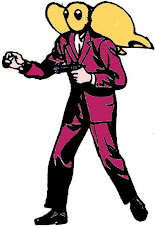
SurVILEvor Island: Despero


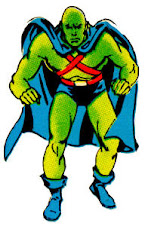
When I started my first Martian Manhunter fan page back in the '90s, I wanted to have a rogues gallery section without using the generic "rogues gallery" handle. Thus: Vile Menagerie. I stocked it up with the villains I knew of that had fought the Manhunter, which is to say a bunch of Justice League adversaries from the '80s & '90s. As I became better informed about the Alien Atlas' history as a solo hero, I was embarrassed by the more tenuous inclusions, not to mention keeping out villains I had personal biases against. While the results will not necessarily be binding, I wanted to open up a series of polls to get reader responses to which individuals popular opinion favors keeping or ditching as representative of the evils devoted to bringing down the Sleuth from Outer Space. While comments are welcome, the main concern is, if you put all the guys who ever fought J'Onn J'Onzz on a Survivor style island, who would you cast out as not belonging to the group? Who is too much of a [BLANK] villain? Who is the weakest link? That sort of thing.


Our first candidate is a fellow who would likely enjoy such a game, Despero. The alien tyrant was created to battle the Justice League of America in their first eponymous comic book. While the Martian Manhunter was on that team in their first two battles against Despero, he was in no way a "spotlight" member, with the Flash specifically being the primary hero of their first encounter. J'Onn J'Onzz wasn't around at all for Despero's third appearance, either. However, Despero next kidnapped J'Onzz and forced him to play a game imperiling his former teammates, threatening the lives of everyone on Mars II to extort cooperation. One might take that personally. His fourth defeat and imprisonment (by Martians!) led Despero to cast himself into the Flame of Py'tar, disintegrating and reintegrating into a new, more deadly form. The Martian Manhunter was one of three members present who had faced Despero before, and was the only member still around during Despero's most famous rampage against the JLI in 1990. The Alien Atlas and the JLI fought Despero again a couple of years later, enslaving him to the will of the robot L-Ron, and forced Despero to physically serve as a member of the Justice League Task Force for two years. Following that group's dissolution, L-Ron struggled to contain the psyche of Despero, who fought Supergirl and Young Justice. Despero actually possessed Martian Manhunter briefly during one of those episodes.


Most of Despero's appearances in the new millennium have not involved the Manhunter. J'Onn J'Onzz was tied up in a story arc in Superman/Batman that involved a Despero scheme, and the Kalanorian seemed particularly intent on lashing out at the Alien Atlas during one of the last JLA arcs. That said, the Martian Manhunter has only ever beaten Despero once through his own power, has otherwise tended to be a punching bag for the Kalanorian, and hasn't faced the despot in six years. It has been argued that Despero is a Justice League villain who just happens to face Martian Manhunter as part of that unit, and it is true that J'Onzz has never faced Despero outside of the direct influence of the League. Given his increased visibility in recent years, Despero could also be argued as being a greater DCU villain, popping in books as diverse as Booster Gold and Trinity.


Cast your own vote on the matter in the sidebar. Results will be noted in the comments, and perhaps mentioned when the next candidate comes up on... SurVILEvor Island!

Sunday, July 1, 2012

SurVILEvor Island: Doomsday


Despero grinned as the Last Czarnian left SurVILEvor Island. Lobo was immediately disliked, and spent half of the voting period without any support. I mild rally offered 22% favorability out of a total of 23 votes.

Doomsday is a Superman villain. We all know that. He "killed" Superman in the comics, which were adapted to a rather shoddy direct-to-DVD cartoon, and a live action match was an ongoing thread for a full season of Smallville. Acknowledging all of this, let me ask a question: who has fought Doomsday the second most often?


The big fight that everyone remember was the first Doomsday arc, which sprawled across numerous titles. Superman, some supporting Metropolis heroes, and the Justice League were in that mix, but the last rounds really came down to Maxima, Guy Gardner, Bloodwynd, and the Man of Steel. Around that time, everybody wondered who that Bloodwynd guy was and why he was turning up in all those Death of Superman comics. The least complicated answer is that it was a mind-controlled Martian Manhunter. So J'Onn J'Onzz, while not in his right mind, was one of Doomsday's first and most steadfast opponents (relatively speaking, since Bloodwynd bugged out before the final two-man brawl, like everybody else.) Plus, this battle has been referenced God knows how many times in later comics, and "Bloodwynd" is still right there.


Doomsday fought other folks on the way, of course. He dealt Darkseid some damage, another villain who seems to have spent a little extra time against the Manhunter while hassling the greater DC Universe. The whole Superman family has had its turns, though Steel especially seems to have gotten the worst of his swift, brutal batterings from Doomsday. Wonder Woman fought a simulacrum in her own book, then some inferior clones in Superman/Batman. He's plowed through a lesser line-up of the Justice League, and a decent set of Outsiders. These were all pretty darned sporadic, though, and some exemptions apply.


During Joker's Last Laugh, in an anniversary issue of Superman, it was Martian Manhunter that Doomsday had to go through before Superman stopped him. In an Action Comics arc involving three major (for the time) villains including Doomsday, only J'Onn J'Onzz had a significant presence outside of the Last Son of Krypton. In his alternate universe Justice Lords incarnation, the Manhunter fought Doomsday on the animate Justice League TV show. J'Onn J'Onzz may not be able to take Doomsday in any kind of fight, but he's fairly consistent in showing up to help try, which is all most anyone can do. Doomsday may not rank high amongst the Manhunter from Mars most common foes, but I'm pretty sure J'Onzz would rank in Doomsday's top ten, and that ought to be worth something.

Sunday, January 20, 2013

VM vs. LoD v1.5


Ever since a reader suggestion for March Madness back in 2011, we've been having fun with elimination contests determined by popular vote. After two years of the Martian Manhunter rogues fighting one another, I figured it was time to shake things up a bit. After all, few of these characters have appeared more than once ever, and virtually none have seen any changes in the last several years, so there's a finite number of variables to play with. As part of the blog's fifth anniversary celebration, I announced The Vile Menagerie versus the Legions of Doom to allow Alien Atlas adversaries to build their reputations by battling new nefarious opponents. However, I also wanted to use SurVILEvor Island to determine who truly belonged in the Martian Manhunter's rogues gallery, before turning around and siccing them on the greater DC Universe of bad guys. Juggling both wasn't working out, and I wanted to wrap SurVILEvor Island before the end of the year, so "Legions of Doom" went on the backburner. 2013 promises to be very villain centric, and that begins this weekend, with a new season of bloodsport. Still, how about a look back at our prior clashes?

Saturday, June 9, 2012

SurVILEvor Island: Professor Amos Fortune


Years ago, I compiled a master list of all of the Martian Manhunter rogues that I could think of, supplemented heavily by the internet. I left a lot of monsters out, but I think I also overreached by letting too many other people in. For instance, Amos Fortune. Here was an early Justice League of America villain, debuting in the sixth issue, who happened to be defeated by the Martian Manhunter. Fortune's whole schtick was that he discovered a luck gland in human beings that he could remotely effect to cause them to have either good or ill fortune. As a Martian, J'onn J'onzz did not possess this gland, and was therefore immune to Fortune's gadgets. That's it. That's how he's ended up in two years worth of Menagerie March Madness contests.


In his third appearance, Fortune founded the Royal Flush Gang, one of the few villain teams to fight the JLA with any kind of regularity. However, the gang really flushed any royalty they could have laid claim to by being beaten repeatedly by the League and heroes far beneath their standard. Heck, the notoriously underwhelming Detroit League; prone to being battered by such non-luminaries as The Cadre, random Ivo robots, an Esimo-Amazo and a giant amoeba; involuntarily manslaughtered some Royal Flush gangsters. It's worth noting that the Gang debuted after the Martian Manhunter more or less stopped appearing with the JLA in the '60s, and his encounter with the group alongside the JLD was a retcon from a couple of decades after that team's dissolution.


Amos Fortune is a crumby, undesirable villain to begin with, but he's especially unnecessary in the Vile Menagerie. That lot is already filled with professors who specialize in gadgets and have hi-tech but lo-yield henchmen. His one trick gimmick specifically doesn't work on Martians, and he's had little to do with the Alien Atlas in the years since his initial defeat. Heck, it isn't even novel that he has an uncommon (for comics) overweight body type, given that Mr. V was an actual archnemesis representing for the plus set. I regret ever bringing the guy up, and with your permission, I'll deal him a bum hand so that he can crap out on a gambling yacht sailing far away from SurVILEvor Island...

Monday, October 1, 2012

...on the 31st day, we rested...


It's been five years and one month of The Idol-Head of Diabolu, and I don't know about you, but I'm pretty tired. Actually, I strongly suspect you're pooped, too. As of this Monday, I haven't gotten a comment on a post since last Monday's. While I'm proud of the quality and heft of the individual posts that made up our anniversary month, it took a lot out of me to write. I've visited sites and blogs whose output eventually swelled to the point that I didn't have the stamina to read them anymore, and I'd rather that didn't happen here. We'll probably launch into Halloween on the Menagerie Isle tomorrow, but for today, take a breather and maybe peruse the previous month's links...

Saturday, June 16, 2012

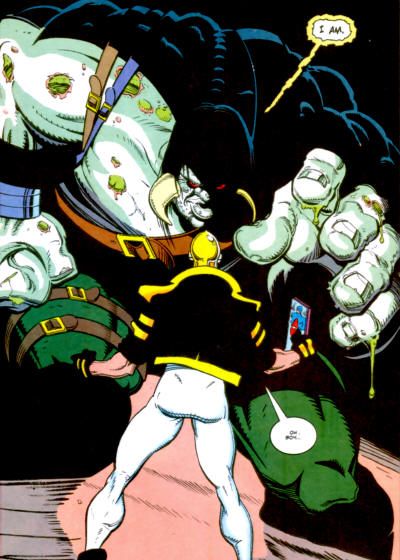
SurVILEvor Island: Lobo


Despero had won The Vile Menagerie March Madness 2012 by popular vote, and has been considered the The Fifth Most Important Martian Manhunter Adversary. Ever the gamesman, he had put his own head first on the chopping block to determine who might be ejected from his present company, but a 92% mandate out of 25 votes affirmed his place among the rogues on SurVILEvor Island. His gamble had paid off, and now Despero could begin weeding out unwanted competition and the truly unworthy...


The Last Czarnian is perhaps also the last person to rate inclusion among the Vile Menagerie. As an anti-hero with his own relatively long running solo series and countless minis/specials, he isn't likely to ever be under any one hero's domain. If any, it would certainly be Superman's, and not the Alien Atlas'.


While Lobo was created in 1983 for The Omega Men, he only began to come into his own after he was overhauled and reintroduced in a 1988 issue of Justice League International. While the Martian Manhunter was one of his primary opponents in that encounter, the Main Man more famously sparred with Green Lantern Guy Gardner. Lobo would continue to play a major role in Gardner's life, facilitating his acquisition of a yellow power ring and continuing to have rows into the Warrior years. After his forced induction into L.E.G.I.O.N. in 1989, Lobo gained a monthly venue for appearances, butting heads with the likes of Captain Marvel, Green Lantern Hal Jordan, and his boss Vril Dox. Lobo even turned up in the 30th Century, a time period Martian Manhunter also lived to see, but their paths never crossed during their separate appearances in Legion of Super-Heroes.


In the 1990s, the Main Man began to routinely battle Superman and the Demon. Lobo returned to Justice League International, but as an ally against Despero. After numerous successful try-outs, 'Bo got his own ongoing. Martian Manhunter appeared in its fiftieth issue, as part of a shared dream in which he and other heroes were murdered by Lobo.


Lobo and Martian Manhunter were both in the short-lived, altered reality Justice League of Aliens team, but otherwise, they've had only brushing contact over a great many years. It's been nearly a quarter century since their one real fight, and there are scores of other heroes who could lay greater claim to Lobo as a villain than that. Even Miss Martian fought Lobo more recenly, and she's only six years old! Including the Last Czarnian in the Vile Menagerie was an overreach in 1999, and it's outright laughable today. He'd be a great foil for the Sleuth from Outer Space, but too many years have passed for that to occur organically. Time to sit Lobo down on that enormous space bike of his and let him ride off into the sunset...

Friday, October 12, 2012

SurVILEvor Island: Kanto

Darkseid appeared in several issues of the 1998 Martian Manhunter series, and was heavily integrated into the origins of the Martian Manhunter and Malefic as a result. Given that the series never so much as mentioned a legitimate prior Vile Menagerie rogue by name, lasting three years on new and borrowed villains, I really resented that. Still, Darkseid is a popular character, Ostrander/Mandrake fans seemed to embrace the relationship, and I even acknowledged Darkseid as the 10th Most Important Martian Manhunter Adversary as a result. Now, in a poll with 22 respondents, Darkseid was voted off SurVILEvor Island by a better than 2-to-1 margin of 68%. I shall surely cry myself to sleep over that. Surely....

With Brimstone similarly dismissed by blog readers, I thought that we might as well complete the Apokolips suite by putting Kanto on the chopping block. I must confess though that outside of his Martian Manhunter appearances, I'm really not that familiar with the character. I read a collection of Jack Kirby's New Gods years back, before they started packaging all of his "Fourth World Saga" together, so I managed to miss most of his work on Mister Miracle. Kanto debuted in its seventh issue, in a story where Scott Free and Big Barda returned to Apokolips so that they could prove their ability to escape it again. Kanto got off on souping-up medieval weaponry with hi-tech tricks and pitted his craftsmanship against Scott's escape artistry. Mister Miracle kept managing to not get caught and killed by Kanto, which impressed the master assassin so much that he eventually waved the couple on to continue their screwy mission of self-aggrandizement. Kanto returned a year later as part of a troop sent by Free's craggy father to capture Scott and Barda, which turned into a wedding party for the pair, in Kirby's eighteenth and final issue of the title. Three years later, the series was briefly revived with the original numbering by Steve Engleheart and Marshall Rogers as part of the ill-fated "DC Explosion." This was the dawning of the age of the fan-pros, so rather than continue the Kirby tradition of innovation, the revival faithfully cycled through appearances by characters established in the Kirby run. Kanto showed up in more than half of their seven issue run before line wide cuts saw the book join a cavalcade of cancellations.

A minor presence in the Fourth World Saga, Kanto only made a few small appearances across the next two decades, including a Who's Who entry and John Ostrander's use of him in a Suicide Squad two-parter. Kanto was overlooked in the late '80s New Gods series, not to mention the mid-90s one, but he was at least present for John Byrne's continuation of Jack Kirby's Fourth World. Mister Miracle had two series come and go in the same time span without any significant involvement from Kanto. A mentor/pupil affair with the Wonder Woman frienemy Artemis was retconned into the Genesis crossover, but never went past it. A convoluted new origin had slightly more traction. "Kanto" was turned into a title. A kid from Apokolips named Iluthin traveled to Earth during the Renaissance, but was hounded by an assassin with the "Kanto" name, who murdered Iluthin's new bride and was killed in retaliation, only for Darkseid to make Iluthin the new Kanto. God, that sentence was longer than my attention span for its contents.

Martian Manhunter is tied with the first Mister Miracle volume for containing the most Kanto appearances. When Ma'alefa'ak made contact with Apokolips, Kanto was among the representatives to visit Mars. Kanto befriended and mentored J'Onn J'Onzz, only to betray the young Manhunter and visit atrocity upon his people. Malefic being rendered a proxy for Darkseid in the genocide of the Martian people was highly problematic, but tweaking that bit of continuity wouldn't necessarily impact on Kanto's history with the Martian Manhunter. While there's a part of me that would prefer Martian and New God mythology to be wholly segregated, I feel sort of bad for Kanto, since he's been abandoned as a Mister Miracle foe with no other major role to play in the DC Universe. If the Alien Atlas won't have him, who will? Then again, Kanto did appear on Superman: The Animated Series and the Justice League cartoon, so he might be just fine as a minion of Darkseid on the periphery. Does the Sleuth from Outer Space really need to be associated with another villain of such questionable sartorial inclination?

Saturday, November 17, 2012

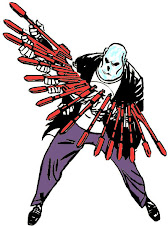
SurVILEvor Island: Weapons Master


While bringing in New Gods lore is not something I look favorably upon when it comes to building J'Onn J'Onzz's own mythos, the master assassin Kanto has been an exclusive enough thorn in the Martian Manhunter's side to be reasonable. The Apokolips contingent has fared especially poorly on SurVILEvor Island, but Kanto took a narrow loss at 46% of 13 votes, a light response that suggests ambivalence in the readership. How that relates to Effigy's surprisingly positive showing to date is a mystery to me, but I think we'll offer a sacrificial turkey this week that we can all get behind with nice long knives.

Back in 1960, the second guy to fight the Justice League of America was named Xotar, the Weapons Master. Not unlike Karl Rove during the 2012 presidential election, Xotar put a lot of stock in a prediction of victory based on scurrilous evidence and willful ignorance, only to lose big and embarrassingly public. As part of the founding five members of the JLA, right there on the cover, the Alien Atlas was the only hero with the raw power to straight up punch the knee off the giant yellow robot Xotar thought would be his chariot to greatness. Aquaman, on his second ever cover and in the clutches of an oversized foe once again, wailed on it with a completely random sledgehammer. He's still a JLA founder in the New 52. Go figure. Anyway, Xotar turned up a few more times here and there, but never amounted to much.


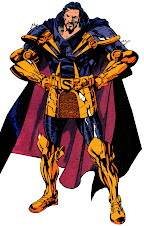
In 1992, Dan Jurgens tried to shift the funny Justice League International back to classic super-heroics, and decided to recycle the Weapons Master name in a more Chromium Age vein. Instead of being a geek anticipating a Japanese fad, this guy would be a stubbly mercenary badass in form fitting gold body armor. His gimmick was that he had an extraordinarily large and diverse arsenal that he could bring to bear with a thought via teleportation. While otherwise being utterly generic in his time, that mobility of firepower made him a far more credible foe for the Justice League than many other Taskmaster wannabes (who is himself just evil Captain America.) Regardless, because Dan Jurgens' run is without regard, Weapons Master became that '90s guy who turned up in super-villain crowd scenes in the general vicinity of Deadline, Chiller, Merlyn, Bloodsport, and countless other ruthless guns for hire who combined a noun and a verb or adjective to form a commercial brand name marketable to early Image collectors.


What qualifies Weapons Master for consideration in the Vile Menagerie is that he was involved in the conspiracy that temporarily merged Bloodwynd and the Manhunter from Mars, who were then manipulated by the demonic Rott. What I feel disqualifies Weapons Master is that he was the first person to combat Bloodwynd in a comic book (whether or not that was really Bloodwynd, the Martian Manhunter's body shapeshifted to appear as Bloodwynd, or Rott pretending to be Bloodwynd is subject to debate and a separate issue from the specific comic as a singular unit released in a moment in time.) His only interaction with the Martian Manhunter was through his short-lived connection to Bloodwynd. Essentially, if you treat Bloodwynd as a property with any value, Weapons Master joins Rott and (if you really want to stretch) Dreamslayer as the sum total of Bloodwynd's primary rogues gallery. By employing the broadest net possible, Eclipso, Count Viper, Sonar, Doomsday, Starbreaker, and the Diablos could maybe get nods, but only in the same sense that "Sweet Dreams (Are Made of This)," "Tainted Love," and "Personal Jesus" would technically be Marilyn Manson songs. He didn't build that!


Finally, Weapons Master brings nothing to the table as a foe of the Sleuth from Outer Space. What made him "kewl" was that he was an individual, modestly powered threat who matched the League with forethought and access to the right counter measure at the right time. When faced with Bloodwynd, an unknown quantity, he cut and ran and got caught anyway. See also: Prometheus' "ironic" defeats by the likes of Huntress and Catwoman (sorry ladies.) Here's every Weapons Master versus Martian Manhunter fight:
  1. Flamethrower 
  2. Martian Manhunter "perishes." 
  3. "Hemocaine" or "Plasmastorm" or "Irving the Wonder Weiner" ambushes Weapons Master with extraordinary yet vaguely familiar powers. 
  4. "It was J'Onn J'Onzz the whole time!"
Weapons Master doesn't have a particularly strong visual, nor any built-in subtext/themes that helps him contrast against the Martian Marvel better than any of dozens of similar villains, many already embedded in the Vile Menagerie. Weapons Master could be an awesome Hawkman foil, and there's a guy who both needs a rogues gallery expansion with a respectable CVA and is defined in part by an obsession with melee arms. If J'Onn wants to go anywhere near there, better to do so with a Tybalt Bak'sar or Glenn Gammeron who bring other character-specific elements to bear. When you're already a One Man Justice League, a One Man Anti-JLA Ex Machinator seems a tad too on the nose.

Sunday, July 29, 2012

SurVILEvor Island: Gorilla Grodd


Professor Arnold Hugo smirked as he strutted past all the also-rans and pretenders. For the first time ever on SurVILEvor Island, Hugo received 100% support from 19 voters. Not only was he among the great Martian Manhunter foes, but he could claim the likes of Batman, Superman, Aquaman and Robin as "lesser foes." It was a good day to be the Wizard of 1,000 Menaces...

The first and most obvious problem with Gorilla Grodd being a Martian Manhunter villain is that he's already, inarguably a Flash rogue. After Barry Allen took up the classic mantle and started the Silver Age of Comics in 1956, he headlined four issues of Showcase before graduating to his own ongoing series. The book picked up the numbering of the Golden Age series where it left off years earlier, beginning with #105. The menace of Super-Gorilla Grodd began with #106, spanning three consecutive issues, and resurfacing in more than a dozen issues thereafter. It took more than three years for Grodd to confront Allen's successor Wally West, but that encounter spanned three issues, and resulted in several dozen more. Since Barry's return, another half dozen comics have chronicled their enmity. Grodd even went after Allen's grandson Bart quite a few times.


During a fallow period in the 1970s, Grodd helped form and lead the Secret Society of Super-Villains, which initially included fellow Flash rogues Mirror Master, Captain Boomerang, and Captain Cold. Several other key DC nemeses were also part of the original group, and this line-up likely informed the 1978 creation of The Legion of Doom for the Challenge of the Super Friends cartoon show. The Legion were all devoted villains of the Super Friends Aquaman (Black Manta,) Green Lantern (Sinestro,) Wonder Woman (Cheetah & Giganta) Batman (Riddler & Scarecrow) and Superman (four foes.) Captain Cold joined Grodd in representing the Flash rogues, plus there was the random inclusion of Solomon Grundy. Typical for the Bronze Age, there were no Martian Manhunter villains to be seen, as the hero himself was not a concern.


Looking over Gorilla Grodd's half century of publishing, these two courses tie into the vast majority of his appearances. Grodd is either a Flash fiend, or part of a team like the Secret Society. His string of appearances in Titans-related comics were tied into his membership to the short-lived group Tartarus, which in turn played into Birds of Prey and Nightwing guest spots. His three turns in Green Lantern were part of a team-up with Hector Hammond against the Emerald Gladiator and Scarlet Speedster. Grodd's "Gorilla Fighters" mixed up with the Outsiders as part of a plot that also involved Dr. Sivana, the Joker, and Lex Luthor. Extreme Justice closed out their series with a four issue battle against a comic book version of the Legion of Doom that included Grodd. A new Society have been active and involved Grodd prominently since 2005's run up to Infinite Crisis.


The concept of Gorilla Grodd as a Martian Manhunter villain relies on a small handful of comics dating back to just 1999. In the "JLApe" annual event, Grodd turned the team into simians. The plot launched in the JLA Annual, continued into those of each of the "Magnificent Seven" Leaguers' and concluded with Grodd's defeat by Martian Manhunter in his second annual. The Alien Atlas retroactively overwhelmed the Super-Gorilla in 2001's JLA: Incarnations #2, meant to take place in roughly the second year of the League's existence. Both times, J'Onn J'Onzz used his extraterrestrial telepathy to overwhelm the gorilla's psychic prowess. J'Onzz was part of the team countering Grodd in JLA: Classified #1-3 from 2005, but there was no significant one-on-one action. Perhaps their most memorable encounter was in the painted mini-series Justice, in which Alex Ross played out his childhood love of the Super Friends with fanfic writ large incorporating the Legion of Doom. Since Ross had respect for the Silver Age and appreciation of the '80s, Ross made use of the Martian Manhunter, and repurposed Grodd as his specialty enemy (while Flash tangled with Captain Cold.) That book came out bimonthly for two years, concluding in 2007. Grodd was also among the crooks in the bar where J'Onzz was murdered the following year to launch the Final Crisis.


I've played devil's advocate on many of these SurVILEvors; prosecuting characters I like, hard selling characters I'm not particularly concerned about, and so forth. Of the lot, I'm most ambivalent about Gorilla Grodd. He's one of my favorite villains, and there's solid material for the characters to play off. Both characters are non-human telepaths from hidden societies far more advanced than science would ever believe. Both were born early in the Silver Age, and went on to help found and sustain large teams of exalted super-associates. They've had some strong interactions in the past thirteen years, and I look forward to reading more. On the other hand, Grodd will always be a Flash foe foremost, and he managed to go through forty years of relatively regular appearances without having anything to do with J'Onn J'Onzz. I'm glad this goes up for popular vote, because I don't particularly want to wrestle with the decision on this one.

Saturday, December 29, 2012

SurVILEvor Island: Asmodel


Doctor Trap fared better than Mister Bones, probably because of his more truncated and Manhunter-specific history. J'Onn J'Onzz did end up part of his origin, even if only in a roundabout way. Still, 60% of ten votes is a modest mandate.

As I've surely noted more times on this blog than anyone ever wanted to hear, the Vile Menagerie name was born in the late '90s on a WebTV fan page where my base of knowledge about Martian Manhunter rogues started with contemporaneous publishing and worked backward. Asmodel debuted in a 1997 JLA two-parter, and his whole history to that point was five comics, so he was one of the easiest, earliest (and therefore arguably one of the first premature) inclusions into the menagerie. I find it appropriate that we end 2012 with Asmodel as the last subject to face the trials of SurVILEvor Island.


When Justice League Task Force writer Christopher Priest took on the new assignment of Hawkman in 1996, he didn't know that he would only be allowed three issues to bring the series to a close and seal the drum on a character labelled "radioactive" to continuity by DC editorial. Priest liked his titles to be interrelated, and brought the Martian Manhunter (and 1997 Special cover and interior artists Howard Porter and Mike Collins) in to wrap things up. Similarly, he was blindsided when editorial decided to arbitrarily cancel all three current Justice League titles to set the stage for a relaunch. It was a very bad year to be on the B-list. Sixteen years later, many of the characters from those titles haven't made significant appearances anywhere else. Hawkman's being consigned to a literary limbo was kinder than the practical one where Zan and Jayna still reside.


Anyhow, Katar Hol had just been disposed of when Grant Morrison and Howard Porter (him again!) revived the Silver Age League line-up with postmodern flair for the monster hit JLA. Morrison decided that since the prior incarnation of Hawkman had become toxic, it might be time to offer a modern age interpretation of the concept as revolutionary as those overseen by Julie Schwartz when he mined 1940s trademarks for 1960s hits. Mainstream comics have no stomach for actual permanent change though, and were only putting Hawkman on ice until the stink of Hawkworld and Zero Hour left him, so Morrison's take on a Hawkman as fallen angel amidst the Lord's host was distanced from the source material to become simply Zauriel.


Not-Hawkman needed his own nemesis to get the ball rolling though. Zauriel had fallen from grace by falling in love with the human woman he was tasked to guardian, which conveniently made him a non-credible witness to a planned rebellion in Heaven led by the King Angel of the Bull Host. Asmodel needed to silence Zauriel all the same, and this murderous pursuit caused him to cross paths with the Justice League. The Martian Manhunter was one of the members who clashed with Asmodel's renegade angels. Memorably, and tellingly of his status in the universe, a weary and singed Alien Atlas was told to "stand down" by Superman, who proceeded to wrestle with Asmodel while Green Lantern Kyle Raynor stared in awe. Kal-El is Jacob becoming Israel; J'Onn J'Onzz merely Esau the red-tinged and rough other brother who plays his part and is then set aside.


The not-yet-infamous Mark Millar wrote a Zauriel mini-series in all but name with frequent period Martian Manhunter illustrator Ariel Olivetti called JLA: Paradise Lost that expanded the story. As part of a revenge play by Asmodel, he sucker-punched J'Onn J'Onzz to death. A major throughline of the narrative was that while his JLA buddies tried to revive J'Onn J'Onzz, his spirit was in Heaven aiding Zauriel in his conflict with Asmodel. J'Onzz returned from the hereafter at an inopportune point, leaving the final resolution up to Zauriel, the story's star. Once again, Asmodel was the heel, Martian Manhunter the jobber, and only the face changed from story to story. Of course, Zauriel himself swiftly proved to be "enhancement talent," but couldn't even die in Morrison's climactic JLA arc "World War III" with the credibility of Aztek, and subsequently served as a "green-ham-n-egger" in DC magical collectives. I guess it's a tribute of a sort that Zauriel was like the Martian Manhunter of the Shadowpact, or something.


In his first gambit, Asmodel teamed up with Neron, a demon lord with established ties to Martian lore that were never elaborated upon. The same could be said of any lasting role for Asmodel as a thorn in Martian Manhunter's side. Asmodel merged with the Spectre Force to freeze Hell over in the unloved event mini-series Day of Judgment, and continued in his role as subordinate to Neron in the similarly dismissed Reign in Hell. The lion's share of Asmodel's career was played out by 1999, and the Sleuth from Outer Space has had no role in it since. The supernatural is one of the few genres that isn't a comfortable fit for the Martian Marvel, and lots of comic readers in general would rather not play around in Judeo-Christian-Islamist lore. I'd like to see red planet theology toyed with more, but direct comparison invites controversial knee jerk reactions better suited to Vertigo (to the degree that brand is relevant anymore) than the DCU. At a conceptual level, the Martian Manhunter and Asmodel are simply incompatible, and the stunt of "killing" J'Onn J'Onzz just set the precedent for the broad net of varied culpability cast over the gang murder of the hero in Final Crisis. Maybe someday, someone will make the Alien Atlas die like they really mean it, instead of just killing the only vulnerable hero in the room because he's there.

Saturday, September 29, 2012

SurVILEvor Island: Vandal Savage


Fernus was created to be an evil Martian Manhunter who fought the JLA in a JLA comic before meeting his defeat at the hands of the Martian Manhunter. He's the apotheosis of the concept of J'Onn J'Onzz as the "Heart and Soul of the Justice League," the most essential team member being the genesis of a most spectacular villain who could wipe the floor with The World's Greatest Super-Heroes and one of their arch-rivals besides. 81% of 16 votes validated The Burning here.


Speaking of that rival though, what of Vandal Savage? Created in 1943 for a Green Lantern story, the immortal caveman returned in 1947 to co-found one of the first great super-villain teams, the Injustice Society of the World. Savage was revived in 1963 for a Flash story that paired the Golden and Silver Age versions of the speedster legacy, and was defined as a foe of the pair through his occasional reappearances into the Bronze Age. The 1970s were when Vandar Adg finally came into his own, battling the Justice Society in a short-lived new run of All-Star Comics, and the Justice League in the newspaper strip The World's Greatest Superheroes. Savage was pitted against Superman a number of times in the early '80s, helping to inspire the formation of the Forgotten Heroes. Mid-decade, Savage was mostly involved with the JSA and their spin-off teams. Post-Crisis, Vandal Savage returned to plague the Scarlet Speedster in the first issues of Wally West's relaunch of Flash, and made numerous reappearances throughout the volume.


The 1990s marked an explosion of Vandal Savage appearances. An increased presence of the Justice Society invited further clashes with the team. His longevity made him a player in period books like the 1920s set Guns of the Dragon mini-series, and he plagued temporally-enhanced heroes in titles like Time Masters and Resurrection Man. Savage also targeted younger heroes like Damage and Arsenal. Writer Christopher Priest embraced the villain as a favorite in most every book he wrote for a time, including Hawkman, The Ray and Justice League Task Force. Despite some similarities in career progression and common circles, it was only at this late point that the immortal became a prominent figure in Martian Manhunter comics.


Mark Waid brought Vandal Savage into JLTF around the time of Zero Hour, a mini-series which inspired a number of cameos for the fiend. Priest continued to use him throughout his year and a half run, in conjunction with other titles he scripted as an overall mastermind for various plots. As the leader of the Task Force and a mentor to the Ray, J'Onn J'Onzz often stared down Savage. The shapeshifter impersonated a daughter of Savage to help the woman and her child escape plans to harvest their organs to sustain the immortal. Retroactive continuity made Savage a central foe of Martian Manhunter's "new" five member super-team in JLA: Year One, including a conspiracy that had painful impact on the Martian. The event DC One Million predicted that this struggle from the early days of the Alien Atlas' public career would continue for hundreds of centuries, as J'Onn J'Onzz was integral to a strategy meant to finally end the threat of the immortal. The Martian Manhunter also had a contemporary battle with Savage that cost the caveman an eye, a handicap that the mini-series inferred would plague him for millions of years.


Moving into the 2000s meant moving away from all of that. Vandal Savage's missing eye returned, and he formed the team Tartarus to fight the Titans. The introduction of a lesbian villainess daughter called Scandal attracted an errant father's attention in Secret Six. Inclusion in The Society led to cameos aplenty, and Vandal Savage even found time to co-author the overarching conspiracy against the replacement Aquaman that wrapped up Sword of Atlantis. The only nods to a past enmity with the Martian Manhunter were his participation in the hero's gang murder at the start of Final Crisis, and a similar but more intimate fatality dealt in the Elseworld Flashpoint. However, Vandal Savage was established as the person who killed Fernus the Burning during his reign of terror on prehistoric Earth, and when J'Onzz unlocked Fernus in the present, the evil Martian cut a bloody swath through Savage's forces. The caveman is without a doubt essential to at least one Martian's history, at least prior to that other far more famous Flashpoint mini-series.


The New 52 seems inclined to treat Vandal Savage as more of an anti-hero, making him a lusty barbarian member of the medieval Demon Knights (which connected to the Manhunter's own Stormwatch,) and giving him a solo serial in DC Universe Presents where he was treated as a quasi-Hannibal Lecter. When Zero Hour solidified J'Onn J'Onzz as having arrived on Earth in 1955, it made perfect sense that one of the few recognizable villains he would encounter between then and the modern age of super-heroes would be Vandal Savage. That connection was never made though, and most of the Martian Manhunter's encounters with the immortal have been filtered through his membership to Justice League teams. As with many other SurVILEvor Island detainees, Vandal Savage cannot truly be "owned" by any one franchise (as evidenced by the sour note of having him begin to fixate on Green Lantern Alan Scott in 2006, after decades with no special acrimony against his debut adversary.)


There was a sweet spot in the late '90s that made Savage's inclusion in the contemporaneous inaugural incarnation of the Vile Menagerie obvious, but the dry spell in the decade since has weathered this position. I could never eject Vandal Savage entirely, but there's little indication that he'll have any further feuding with the Sleuth from Outer Space, so I have to question any need to spotlight him prominently amidst the Martian's rogues gallery. Then again, he did form the first version of the Legion of Doom to include an unquestioned Manhunter villain, Ma'alefa'ak, and did so in the broad medium of animation while voiced by an actor who portrayed John Jones on the live action television show Smallville. Heck, didn't he even battle Young Justice on the cartoon version of the team that included Miss Martian? Who's to say what the next official past or future hold? There remains a poetry in pitting the earliest and most avaricious living human against the last of a neighboring alien species that often demonstrates greater humanity than anyone on his host planet.

Saturday, December 8, 2012

SurVILEvor Island: Rott


After spending almost all of the two weeks of voting at 100%, one contrary choice landed Triumph at 90% favorability as a Martian Manhunter villain out of ten votes. Jeez, the guy can't even catch a break at being absolutely demonized.

Rott should have made for a short and sweet entry in the SurVILEvor Island series, but there's just too many scabs to pick. Basically, antebellum negro slaves performed voodoo to make an Eclipso diamond thingy to kill their master, which created a demon that grew ever more powerful over the centuries by drawing strength from the darkness in their Black Person hearts. This was the idea of the honky that created Booster Gold. White men from Ortonville, Minnesota should not write stories like that. It's unseemly, not to mention convoluted and inane.
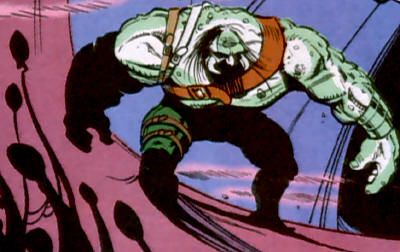


Let's break this down. First, why do expatriate Africans always practice voodoo? It's the same deal as Native American and Jewish mysticism. If these guys could create golems and magic gems and stuff, how come soulless white thugs still end up killing/enslaving the hell out of them? Who saves their God Mode code until after their weapons cache is down to a pocket knife so that you have to kill all your enemies in the most tedious manner possible? You don't see Japanese comic book people, who all know martial arts, doing that stuff. Every Japanese man, woman and child was a super-stealth ninja assassin who could glide on air currents until World War II, which is why we had to drop the bomb on them, and even then they just harnessed its power to grow Ultraman to combat Godzilla. Only Japanese-Americans went to internment camps, because they were technically Americans, who don't have any special powers that don't involve being such dirty cheats that we still manage to overcome magic crap like manitou spirits with smallpox blankets. Point being, if you're going to open up a big 'ol can of creepy crawly worms, you'd best have set aside the time and effort to bait fish.


Secondly, the creation of the Blood Gem was spearheaded by a priestess named Clemma. She's the one who snuck into the bedroom of slave master Jacob Whitney to kill him where he lay... as opposed to just stabbing or bludgeoning him with whatever was handy en route? Why was a Blood Gem needed if all it did was steal the guy's soul or whatever? Did it empower the gem and allow the plantation slaves their freedom? Was that the plan, but it went awry? If the Blood Gem was in Bloodwynd's family for generations, what were they doing with it all this time, and why did in take a sesquicentennial to attract the JLA's attention? It's kind of important to explain those small but crucially important details.


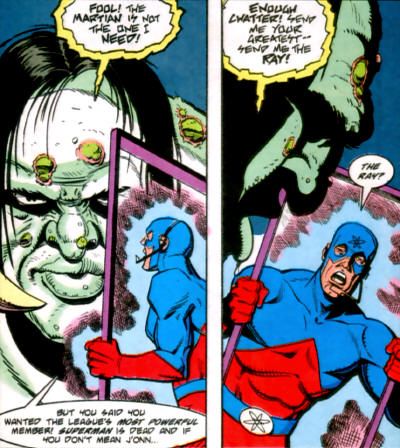
Third, Rott's plan was to use a major energy source to free himself from the Blood Gem. However, he'd already pretty much beaten Bloodwynd before Martian Manhunter stumbled along. What would have happened if it had gone another way? Would Bloodwynd and Rott have just waited in the gem for some other poor sap to come along? Why wasn't the Martian Manhunter form just included in the plot? Having taken control of Manhunter's body, why shapeshift into Bloodwynd and then try to join the Justice League? He'd be more readily trusted as J'Onn J'Onzz, but why bother if he was simply looking to wrangle a power source? Does that require a team effort? Why risk life and limb against the likes of Starbreaker and Doomsday? Why not directly engage an energy powerhouse like the Ray, instead of waiting months for one to join your team after a completely unforeseeable event like the death of Superman? Hell, pass immaterially into a S.T.A.R. Lab and commandeer experimental technology to feed the Blood Gem. There are so many ways a geek could spitball a more effective and sensible plan than Rott's that wouldn't involve inviting super-heroes into your home domain at a vulnerable point in your master plan. The only way it could halfway work at all is by force of a bad writer's will.


Fourth, did Dan Jurgens consider that by making Rott control the Manhunter/Bloodwynd, he invalidated the first year of Bloodwynd appearances and rendered him merely "the Black Martian Manhunter clone?" Was it his idea to diversify the League, or perhaps to recast Martian Manhunter with a black alter ego? Was Bloodwynd initially intended to be a standalone character, or just a device that became a separate character by semi-popular demand? Was the whole thing dreamed up by editorial and forced on him? Was Bloodwynd's origin so full of plot holes and political incorrectness because it was hacked together as an afterthought, or perhaps outright authorial sabotage?

Fifth, like his counterpart Bloodwynd, we never really find out what the hell this guy can do. This story made a point of explaining away everything Bloodwynd had done as creative applications of the Martian Manhunter's powers, and the character wasn't redefined to a substantial degree afterward. Rott brought heroes into the Blood Gem where they either had no powers or were neutralized by his situational partner, Weapons Master. When Rott escaped, he wielded the power of the Blood Gem against non-powered humans and a notably diminished Martian Marvel. He's big, he's probably strong, and what? All we know is that whatever power Rott did have was taken back by Bloodwynd, which I guess establishes that Bloodwynd has the power to keep undefined power from Rott, so he's got that going for him.
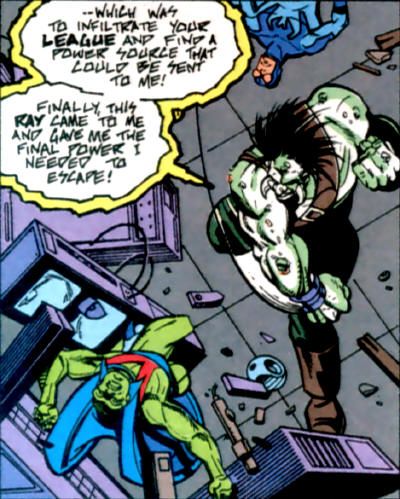


Finally, Rott has no personal enmity toward J'Onn J'Onzz, nor does he contrast all that well conceptually. He doesn't appear to have any plans beyond getting loose from the Blood Gem, which is a bad thing only because he's an ass and goes about it in a rude way. Rott is apparently some vague combination of the restless soul of an especially nasty slave owner and the dark parts of the souls of the descendants of his killer. He's mostly white, but has some African features, which could have been a subtle twist in a Milestone book but just confuses things in DC black & white. He also looks like a mythical ogre. Jacob Whitney probably didn't have to deal a lot with immigrants, and J'Onn J'Onzz wasn't part of an oppressed/slave race like Jemm. I guess there's the supernatural versus science fiction aspect, in which case Rott can go to the back of a long line of better candidates (Korge, Diabolu, etc.) and that's more of a Superman thing besides. It didn't help that Rott is the generational foe of Bloodwynd who targeted the Ray and tussled with a bunch of other Leaguers. Rott screwed-up J'Onn's intended sabbatical and kept him out of comics for a period of time in which the Alien Atlas was supposed to be out of sight anyway. He feels very tangential to the Sleuth from Outer Space narrative, and as such, seems unsuitable for the Vile Menagerie.

Saturday, September 15, 2012

SurVILEvor Island: Darkseid


Some might have considered it bad form to involve Firestorm Fans in the exile of Brimstone from SurVILEvor Island by 64% of 25 votes. A counterargument would be that Idol-Head readers could get a poll up to that many votes on their own, so if they wanted to save Brimstone, the opportunity was there. Either way, the defeat of a minion of Apokolips drew the attention of its lord and master, Darkseid.


Darkseid was Jack Kirby's first major creation for DC since his departure from the company, ushering in of the Marvel age of comics, and return to the fold. Arguably, it was also his greatest contribution to DC Comics. The Fourth World Saga was Kirby's stab at creating a new pantheon of gods representing modern times, and while it was not the commercial success everyone involved had hoped for, it was still hugely influential within comics and beyond. It has long been believed that George Lucas took more than a little from the franchise to create his own Star Wars. Darkseid certainly appeared to be a template for Darth Vader-- an ebon deity committed to universal fascism under his rule. Vader was the lieutenant of an emperor though, whereas Darkseid was a chief and less hands-on with regard to actual conflict. The Lord of Apokolips had a whole host of underlings to do his bidding, and saved his strength for occasional clashes with his own son, Orion.


People will point to characters like Thanos and Mongul as knock-offs of Darkseid, lacking the historical perspective to recognize that Darkseid was not himself the villain as we know him today at the time of their creation. Despite being introduced in an issue of Superman's Pal, Jimmy Olsen, Jack Kirby intended his New Gods to exist in their own continuum. While he was the main threat in books like Mr. Miracle and Forever People, it was in a role akin to Adolph Hitler in World War II. There was no shortage of evil Nazi masterminds for heroes to struggle against without Hitler being directly involved with a given adventure. If Thanos wanted a Cosmic Cube, he had to go punch his way through a bunch of Avengers. For Mongul to get Warworld, he had to extort the services of Superman by threatening his friends' lives. Darkseid already had Apokolips from the beginning, and guys like Kalibak, Baron Bedlam, the Deep Six, Mantis, Virman Vundabar and Granny Goodness did all the dirty work. Darkseid and the Fourth World didn't really take part in the greater DC Universe until Apokolips hosted one of the annual JLA/JSA team-ups in 1980, followed a couple of years later by the Legion of Super-Heroes' use of Darkseid for the classic story arc "The Great Darkness Saga."


The major turning point came in 1984, when Jack Kirby was brought in to produce a tie-in comic for Kenner's The Super Powers Collection toy line. Kirby used his own Darkseid as the mini-series' overarching villain, which led to the creation of a Darkseid action figure in 1985, and Apokolips figuring heavily into the final years of the long-running Super Friends cartoon show. All this exposure saw Darkseid take center stage in DC's follow-up to the Crisis on Infinite Earths mega-event, Legends. At this point, nearly two decades after his creation, Darkseid became the cosmic comic threat familiar today.


As it happened, the Martian Manhunter was reintroduced to comic book fans after a lengthy absence in 1984, taking part in most of the same mini-series as Darkseid, and being rendered in action figure form as part of the same "wave" assortment. I bought both as a kid, and played out matches between the two before they tangled in comics like Legends and Cosmic Odyssey. The truth is though, Martian Manhunter appeared in such books as a member of the Justice League, Darkseid was there as a villain or uneasy ally, but the two characters rarely had any direct interaction.


It came as some surprise then when Darkseid turned up in 1998's Martian Manhunter #1,000,000, and the book testified that it would be the Alien Atlas who finally defeated the Lord of Apokolips once and for all. Probably not what Jack Kirby had in mind, any more than Samachson and Certa ever intended J'Onzz to become the living planet of Mars. Later, Darkseid served as a catalyst for a Manhunter/JSA team-up. Further yet, Darkseid was meant to inspire J'Onzz's brother Ma'alefa'ak to nearly eradicate the Martian people through plague, while torture by Darkseid's minion DeSaad more directly caused the death of their father.


The Sleuth from Outer Space stopped appearing regularly in comics a couple of years before Darkseid's debut, but even if you start the clock at 1984, how likely would it be to take a decade and a half before J'Onn J'Onzz acknowledged to someone-- anyone-- that Darkseid was his longest standing and most implacable nemesis, the mastermind of all his greatest tragedies? "Say Mr. Miracle, did I ever mention the months I spent with your mentor Himon acting as the instigator of an insurgency in the Armagetto? Never? Gee, I guess that's why we're just passing acquaintances. Enjoy your latest short-lived solo series. Toodles."


While I've never had the same emotional connection to Darkseid that I do to Jim Starlin's take on archetypal villainy, and I really do think the character has been overly, poorly used, I do like and respect the villain. It's just that unlike many modern fans, I've actual read the Kirby original, and that guy wouldn't be getting into slugfests with the Martian Manhunter. If handled as Kirby intended, any given New God would be a struggle for Superman, rather than goons scattered like tenpins in the path of "Stalemate with Darkseid XXIV."


Even within the confines of DC's common usage of the Lord of Apokolips, Martian Manhunter is way out of his weight class and expecting the loan of a villain that will always be far more associated with the Man of Steel, the entirety of the Fourth World, and even the entire DC Universe as a whole. The insertion of Darkseid into the Martian Manhunter origin story at best weakens the integrity of J'Onn J'Onzz's entire life, and at worst diminishes the Fourth World by bringing it down to the level of a Martian being a credible threat on a world dotted by Flame Pits. Boiled down, that makes J'Onzz a secret agent in an extraterrestrial Berlin during a black and white war, doing his patriotic duty for the good of all. That is the exact opposite of noir, where men with ambiguous, regrettable backgrounds try to hold on to their souls in a compromised world. The green man is meant to negotiate shades of gray, not the absolute darkness of a rhetorical metaphor. The Martian Manhunter does not fit in the Fourth World, nor does Darkseid function properly on Mars. There's no spark here, no great clash of polar personalities. This is pure, ill-considered fan fiction that drew a paycheck somehow. Nobody wants to see the Martian Manhunter pitted against Mr. Freeze, either. It's oil and water, where both of these withdrawn, solemn figures need gasoline and a match to maintain audience interest.