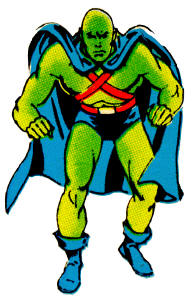
Showing posts with label Who Is The Martian Manhunter?. Show all posts

Monday, March 7, 2022

35 Years Ago


I don't believe I owned or read "The Origin of the Justice League-- Minus One!" until after I started this blog, but it swiftly became one of my favorite Martian Manhunter related stories. That statement is thick with disclaimers, among them being that the Manhunter is at best a supporting player in the overall narrative, and I'm not all that enamored with the actual script. It's down to the conceit. Retroactive continuity grounded firmly in established lore, supplying an untold story of how most of the original Justice Leaguers first met, researched to the month of proposed publication, referencing exactly where the players in DC hero comics would have been at that exact moment in time. Obscure characters and continuity minutia are my kink, so a story working in the little seen original Robotman (All-Star Squadron wasn't even a twinkle in Roy's eye yet) and contextualizing where vanguard teams like the Challengers and Blackhawks would have been relative to one another? *Ecstatic shudder* It was obviously a primary influence on Darwyn Cook's The New Frontier, made rare direct nods to actual Manhunter from Mars strip elements, and grounded John Jones so firmly in one of the most fascinating periods in United States history that he was still acknowledged as a 1950s hero as canon during Zero Hour? The event series designed to euthanize surviving 1940s heroes? It's positively miraculous that this thing still has a toe-hold of relevancy, much less an actual artistic legacy.

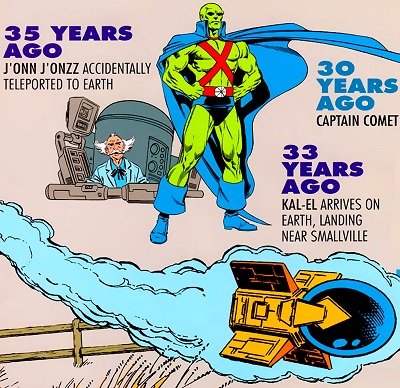
That mid-century, postwar, paranoiac, conformist, xenophobic period is such a perfect milieu for the Sleuth from Outer Space. It's also the overlooked middle child between the roaring 20s/Depression/WWII and the revolutionary 60s/Me Decade/80s excess that it speaks to a Gen-Xer like me. Eternally, horrifically tainted creative ped(-o-)gree aside, Martian Manhunter: American Secrets remains a top contender for my actual favorite story that not only unquestionably stars the Alien Atlas, but is also about exploring the same themes as the character himself. In 1994, J'onn J'onzz was explicitly stated as arriving "35 years ago," which supported that 1977 Steve Englehart's setting for only the year Zero Hour #0 was published. I'm sure the intent was Marvel method, where Reed & Ben went from serving in World War II to Korea to... jeez, didn't they end up in the Persian Gulf at some point? And yes, J'onn J'onzz did have a bunch of '60s & '70s set stories published in the '90s & '00s, but he never felt unmoored from the 1950s. The Justice Society exited, and the Manhunter from Mars quietly, covertly entered. I big part of his appeal, certainly to myself and in my experience others, was that he was a rare super-hero "holding the line" before the likes of Clark Kent was (functionally) born, much less "The New Heroic Age" begins. Even when my fandom exploded in the late '90s, it was hard to swallow 40+ years of no one else appearing in the JSA's stead. It was even harder when I finally read "Minus One" another decade (and century) removed. Today, it's too great a logistical hurdle.


It should surprise no one that after decades of writing about the Martian Marvel, I have oodles of stories conceived for the hero swimming around my head. Every comic fan carries some fan fiction within them, whether they express it or not. A lot of mine involve continuity patches. When DC Comics bought Wildstorm, they had a fair amount of continuity set in the '40s and '60s that could have been absorbed by DC to fill those "lost decades" before Batman had his Year One. My feeling was that a lot of DC's properties really only worked for the time period in which they were conceived, so why not just leave the Sea Devils or the Metal Men in the 1960s? DC so radically altered the Charlton heroes when reintroducing them post-Crisis that there could have just as easily been a real "Watchmen" made up of their inspirations who had come and gone in times past. If I wanted to keep some vestige of "Minus One" in continuity, why not recast the Barry Allen Flash as Johnny Quick, or really lean into a want of mine, Superman replaced by Captain Comet for even more fifties team-ups?

The "why not" is pretty obvious. DC's love-hate relationship with the JSA for sure, and those historical ties to the Golden Age are often considered an albatross. All that continuity that I wanted to patch was cast aside in 2011 by Flashpoint and "The New 52." Even after Rebirth and Dark Nights debuted an all-inclusive Hypertime omniverse, there's little editorial appetite for deep dive continuity implants. With 89% of DC's current output being Batman Family titles, where would you even put one? Frankly, dear as the generational legacy aspect is to my heart, World War II was nearly a century ago. Do we really want to be conjuring up Nazis and straight patriarchal Caucasian heroic hegemony into infinity? That's rhetorical. No rando partisan gater comment bombs are being solicited here. You guys are a little too into Kylo Ren, right? "Let the past die. Kill it, if you have to."

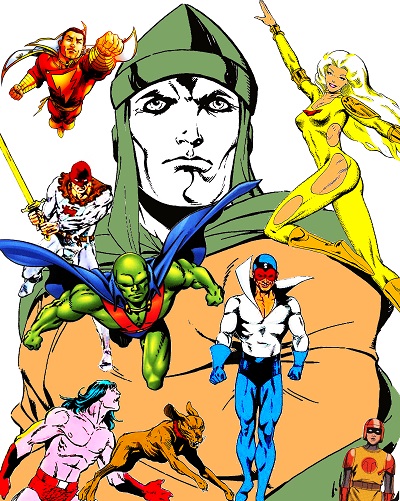
Speaking of solicitations, for two years next month, I've devoted entirely too much time to obsessively crafting fake ad copy for a line of books in an alternate DC Universe as part of Siskoid's Who's Editing. "Why" is an excellent question. I have a number of answers of varying degrees of quality and desperate raving madness that I vaguely allude to in a companion podcast, The DK Encyclopedia Diaries: The Drunken Guide To The Characters Of The DC Universe. Hopefully I can slur out a semblance of a satisfying response before my liver gives out. But one of them is to serve as my personal island of misfit ideas, aborted concepts lost to space and time and lack of ambition... tears in the rain streaking down little seen comments. This entire post was a ploy to fill a week of blogging with a visual aid I roughly threw together of a final alternate draft for the DC You Moi "Minus One." I had Captain Marvel still active in the 1950s in my "DC Comments Challenge," while Captain Comet is otherwise engaged, so he got the Superman spot. Knight & Squire, the Fury, Max Mercury, and Neptune Perkins stand in for the rest of the proto-JLA. Rex the Wonder Dog from the original story is rendered Thor the Thunderdog here, and a non-pictured Tommy Tomorrow takes pre-GL Hal Jordan's place. Variations of this substitute League have swirled in my subconscious for at least three presidencies. It's never to be, and acknowledging it here as a pure fan fiction is cathartic for me. Thanks for indulging my eleven-hundred word blogging therapy session.

Monday, September 19, 2016

Podcast- Comics Bulletin & Alex Ross on the Cusp of J’onn J’onzz’s 61st Anniversary

Episode #29

Look for us on iTunes, ShoutEngine or directly download an art-tagged MP3 from the Internet Archive


On October 8, 2014, the website Comics Bulletin published a discussion between Bryan Stroud and the famous painter of Marvels and Kingdom Come in the article Alex Ross Talks About the Martian Manhunter on the Cusp of J’onn J’onzz’s 60th Anniversary. Nearly two years later, with the Alien Atlas' next birthday imminent and with the help of an online text-to-audio program, Diabolu Frank joins their conversation...


We enjoy dialogue on the red planet, so here are our non-telepathic contact options:

Monday, September 5, 2016

Podcast- Adjudicating J'Onn J'Onzz (ComicsVerse v Martian Manhunter)

Episode #28

Look for us on iTunes, ShoutEngine or directly download an art-tagged MP3 from the Internet Archive


The website Comicsverse, "your source for in-depth comics analysis" very very briefly ran a series of podcasts (exactly two to date, the last one in January) under the banner "Best Underrated Characters in Comics." Mind, this is out of 80 shows in total, and there've been 19 since, so perhaps they just abandoned the premise. I tend to think that's for the best, since I find the title misleads one into thinking they're going to select a character they find deserving of attention they haven't received and tell you why they're boss.

Unfortunately, in the episodes shining a white hot interrogation lamp on two heroes I'm very fond of, the shows instead felt like inquisitions to determine whether they are in fact underrated, or just poo (with the moderator's thumb on the scale weighing toward poo in both cases.) One was Doctor Strange, and you should know by the subject of this blog who the other was...

Join me for a special feature length episode with Diabolu Frank for the defense in the case of ComicsVerseS the Manhunter from Mars, but you should lead with the prosecution's case before you allow me to retort! Superman, Batman, Aquaman, and the rest of the Justice League will be called into question and occasionally treated as hostile witnesses as part of The Trial of the Incredible Hulk Sleuth from Outer Space!


We enjoy dialogue on the red planet, so here are our non-telepathic contact options:

Monday, April 25, 2016

Secret Origins Podcast: Martian Manhunter & Friends


Click to hear podcast!

Secret Origin #35: Booster Gold, Martian Manhunter, and Maxwell Lord


I'm proud to have taken part in this episode of Ryan "Count Drunkula" Daly's Secret Origins Podcast, and I frankly think I did a better service to J'Onn J'Onzz there than on any episodes of our home grown show devoted to the character. You can read a more detailed recap of Secret Origins #35 (1988) or check out the show's sample pages gallery.
The (epic? sure!) finale of the Justice League International trilogy kicks off with Ryan Daly and Andy Kapellusch reviewing the story of Booster Gold from Secret Origins #35. Then, Diabolu Frank schools Ryan on the history and legend of the Martian Manhunter. And finally, Doug Zawisza returns to help Ryan cover the origin of Maxwell Lord.
Plus, details on a new listener incentive contest. You can win a signed copy of a Secret Origins comic for FREE! Listen to the episode to find out how!
Secret Origins Podcast Facebook page: https://www.facebook.com/secretoriginspodcast
Secret Origins Podcast on Stitcher: http://www.stitcher.com/podcast/httpsecretoriginspodcastlibsyncom/secret-origins-podcast?refid=stpr
Let us know what you think! Leave a comment or send an email to: RDalyPodcast@gmail.com.

This podcast is a proud member of the FIRE AND WATER PODCAST NETWORK.

Subscribe via iTunes as part of the FIRE AND WATER PODCAST: http://itunes.apple.com/podcast/the-fire-and-water-podcast/id463855630
“Premonition” (Theme for Secret Origins Podcast) written and performed by Neil Daly.
Additional music: “Alien” by Bush; “Oh Yeah” by Yello; “Moneytalks” by AC/DC.
Thanks for listening!

Wednesday, October 2, 2013

Master Characters: Martian Manhunter as The Recluse Hades


A while back, I purchased 45 Master Characters: Mythic Models for Creating Original Characters [Revised Edition] by Victoria Lynn Schmidt. It's an interesting book that takes eight essential archetypes, divides them into male and female parallel interpretations, then pairs them with ancient deities to expound upon the parameters of each variation through traits and fictional representatives. I'm not at all fond of the Robert McKee writing with training wheels school of thought that advises creators to embrace rules of formula, but at the same time, there's so much media being produced by people of varying degrees of talent that there are worse approaches. For instance, Dexter and Breaking Bad had their series finales a week apart. Dexter threw out the rule book, and came up with a final chapter that made its audience want to throw up out of revulsion at the inconceivable stupidity in execution. Meanwhile, I was a bit bummed with how safe and conventional Breaking Bad's resolution played out, and I think it wimped out on some core themes, but it was fine and played marvelously to its audience. Dexter was more "daring," but so is driving 100mph off a cliff. Some folks need to find a lane and make steady progress down a road.

I think that this is especially true with super-heroes, which deal explicitly with iconography and morality, rather than more ambiguous characters and storytelling. Since super-heroes overwhelmed the comic book medium, it's understandable that creators in the industry would try to expand the scope of what super-heroes could be, to allow themselves more storytelling avenues. However, universes built on power fantasies involving men in skintight costumes delivering justice with their fists is inherently limited, so pushing at their boundaries leads to conceptual breaks that turns juvenile ethics into violent pornography. Cognitive dissonance and realistic action/consequence is the province of Vertigo, Avatar, and the like, not spandex slugfests in shared universes created for children. There are some gifted writers who can find the line and work from that extreme, like Grant Morrison, Mark Waid and J.M. DeMatteis. Too many others lack a firm grasp on what they're doing in mainstream super-hero comics, and corrupt the characters and the medium with their ignorance. In such cases, a rule book would come in handy, so that your comic book protagonists are consistent and respected, like Walter White, rather than maligned and abandoned, like Dexter Morgan.


The Martian Manhunter routinely ranks among the top 50 DC characters and top 100 comic book characters of all time in polls and articles, and usually more like top 25 & 50 respectively. Yet, his solo series are a catalog of failure, because creators write around the character rather than through him. Most writers seem to know how to handle J'Onn J'Onzz in a team setting, essentially a cross between Mr. Spock & Bones McCoy with more powers than Superman who either falls in the first round to build stakes or produces the deus ex machina that saves the day against all odds. In solo stories, the Alien Atlas is often taciturn, offering expository statements and relying on supporting cast members for personality. His villains (when not figments of his own fevered mind, as in his 1988 mini-series, "Ghosts of Mars" and "Trial by Fire") are often a hodgepodge of "cool" ideas without regard for how they function against the concept of a Sleuth from Outer Space. Everyone knows that he's part of the DC Comics "pantheon," one of the founders of the Silver Age and the Justice League of America, but few seem to grasp how to portray that outside of lip service. If comics are a modern American mythology, what role does J'Onn J'Onzz serve in this folklore?

Per the standards set by Victoria Lynn Schmidt, the Manhunter from Mars appears to be best associated with the positive, heroic aspect of Hades, Greek god of the underworld. Company J'Onn J'Onzz would keep in this realm includes Fox Mulder, Rick Blaine, Hamlet, Victor Frankenstein and Philip Marlowe. He is described as intellectual and philosophical, perhaps obsessive, and definitely averse to crowds. "He may be a sensitive man who can see other realms, a sort of psychic, and is in danger of totally withdrawing from reality altogether." As a loner, it would take a special, driven woman to draw him out, and he could perhaps invest himself in a small family for companionship. "He feels alien to everyone else and may want to move on to the next world, welcoming death." Due to his telepathy, he would be protective of his psyche and repressed in personality due to emotional fragility. He's an investigator/explorer, but from a detached reserve, retreating to solitude to process his findings. His preoccupations cause him to slip socially, wearing the same boring costume for half a century and being looked on with suspicion for his quirks.


Schmidt suggests considering what in J'Onzz's history motivated him to isolate himself, and to confront him with his fears and anxieties. She suggests Hestia the Mystic/Betrayer as an ideal romantic partner, a role M'yri'ah likely filled. "The Fool" could help him loosen up and rejoin humanity, which recalls Gypsy. "The Dictator" could impose rules that destroy J'Onzz's inner peace, as Commander Blanx might have done. "The Maiden" could offer carefree innocence, which curiously would most closely approximate the role played by his pet/sidekick Zook. "The Scorned Woman" would reflect J'Onzz's darkest inclinations and repel him toward the light and connectedness, as Cay'an once did during his tour of abuse in "The Others Among Us," or as in D'Kay's sick fixation on a lost Mars.

Looking over his past comics, the eponymous 1988 mini-series introduced a new status quo, but effectively detached J'Onn J'Onzz further from his friends, and offered no actual adversary to motivate him externally (rather, "it" led him inward.) American Secrets was more successful, offering Perkins Preston as Fool, Patty Marie as Maiden, and men in black as Dictators, all drawing John Jones out. The 1998 series kept him emotionally isolated while constantly surrounded by guest stars, and made a plot point out of his maintaining hundreds of identities/relationships around the globe, all at odds with the authorial goals regarding the Recluse. DeMatteis introduced a rationale for the recluse, and Ostrander reinforced it, but neither progressed from there. Malefic was the same character type as J'Onn J'Onzz without a compelling motivation. Mr. Bones threatened J'Onzz with isolation related to the revelation of his identities, which negates any conflict related to a recluse. "Revelations" and "The Renegades of Mars" hinged on J'Onzz being proactive in uncharacteristic and wrongheaded ways. "Rings of Saturn," one of the most successful arcs of the 1998 solo series, relied on J'Onzz being confronted with a conspiracy due to the social obligations owed to Jemm and his emotional entanglement with Princess Cha'rissa, in line with the archetype.

Looking back, poorly reasoned motivation has been the bane of the character from the very beginning. He's supposed to be a scientist accidentally stranded on Earth, but he becomes a policeman under an assumed identity by the end of his original tale. It's no wonder that readers embraced Darwyn Cooke's New Frontier, whose John Jones used his police connections to investigate unusual happenings and government initiatives that almost land him on a rocket back to Mars. A super-powered alien doing good for goodness' sake is Superman's shtick, and even the Man of Steel struggles with modern audiences under that simplistic method of operation. Schmidt suggests more compelling drives for the Manhunter from Mars, and future scripters should heed her advise.

Friday, April 19, 2013

Martian Manhunter: New 52/Old Story


J'onn J'onzz was a scientist from Mars who was teleported to Earth and stranded. He couldn't very well practice Martian science while secretly on another world, and anyway, there's not much indication that Martian science was any great shakes. They may have had some nifty architecture and a few ray guns, but they were also just about the only alien race that didn't have interplanetary travel worked out. I mean, it was Mark Erdel who came up with the robot brain that brought J'onzz to Earth, and it took J'onzz over a decade to figure out how to throw it in reverse, assuming he didn't have help. One of the only science experiments we ever saw him involved with was TOR, the robot that was accidentally turned into an unstoppable rampaging criminal. Not something you want on your resume.

While J'onn J'onzz was stuck on Earth, he decided to pretend to be a police detective and fight crime with his awesome concealed Martian powers. For quite a while, he just fought gangsters and mad scientists, who he still struggled with despite his overwhelming extraterrestrial talents. His parents and kid brother were alive and well, and they visited one another on occasion. John Jones may not have had a proper girlfriend, but his relationship with sometimes partner Diane Meade wasn't entirely professional, either. In short, as created and portrayed in most of his original series, J'onn J'onzz was a dude. He was a seemingly unexceptional Martian who made the most of becoming a reverse John Carter, except not really, because John Carter became the revered warrior of his adoptive world and the recipient of sweet princess lovin'. John just had a decent apartment where he kept his dog while serving as the least popular member of the Justice League of America until he was quietly pushed aside.


John Jones was created in a time when characters didn't have to be terribly involved. His motivation could be chalked up to a guy needing a hobby while stuck in (literally) Middletown, U.S.A. Later, his scene got messed up by John Jones' apparent demise, and his secret existence as the Manhunter from Mars had already been revealed. As a result, J'onn J'onzz just tooled around as himself with his imp buddy Zook in tow as they looked for a strange magical artifact that kept spitting out monsters for them to fight. By that point, the Marvel revolution was beginning, with Spider-Man specifically changing everyone's game. John Jones came from a time between the Golden and Silver Ages, and was exceptionally simplistic for his times in comparison to the Julius Schwartz heroes, much less Stan Lee's. Floundering in the market and no longer buoyed by being hosted in a Batman comic, J'onn J'onzz needed to make a change.

The main creators of J'onn J'onzz's solo adventures were Jack Miller and Joe Certa. In their title's final years, they chose to update the initial alien cop angle to embrace the 1960s spy craze. The basic premise was still the same, but J'onn J'onzz would adopt the more suave and conniving role of Marco Xavier, international playboy. Most of his final adventures involved the criminal organization VULTURE, who played fast and loose with human life. The Manhunter met them halfway, facilitating the dispatching of evil agents without any sign of remorse, marking J'onn J'onzz as perhaps the first true "grim n' gritty" revised super-hero. The Manhunter's stories were increasingly brutal, with his final tale ending in the explosive demise of his arch-foe Mister V. The Manhunter briefly returned to the pages of Justice League of America, where he became the poster child for retroactive continuity. It was revealed that J'onzz was Mars' "science leader," living in exile after the racial conflict between two nations had seen the Pale Martians gain the upper hand. In his absence, a hitherto unknown nemesis named Commander Blanx sold out the entire planet of Mars and rendered it uninhabitable through global genocide. J'onn J'onzz killed Blanx for his heinous act, then took a spaceship to parts unknown in search of the few survivors of his home planet.


At this point, J'onn J'onzz was clearly no longer a dude. This guy was a muckity-muck in a dirty conflict that made World War II look like a tea party. This J'onn J'onzz was a hardened soldier concealing essential information from his Justice League confederates. In the end, whatever gambits J'onzz was running failed, his planet died, and none of those supporting players or villains seen in the old stories survived J'onzz's hubris. That's some heavy, dark stuff for a super-hero to carry around. Superman's grief over a Krypton dead while he was in diapers, fated to be destroyed no matter how many times he traveled back in time to save it, was juvenile compared to J'onzz's weight of personal adult culpability for an incalculable catastrophe.

The Manhunter from Mars continued down this harrowing path. A girl he'd known back home turned out to be willing to see every other Martian enslaved to save her own skin. J'onn J'onzz's best friend faked his death, framed him for treason, and attempted to slaughter a peaceful native race for spoils with a naive Martian army behind him. A genetically engineered Martian "hero" overthrew the government and again conned his people into invading a world that meant them no harm. A former lover of J'onn J'onzz was among those forces, and made repeated attempts on J'onzz's life. The Manhunter himself was consistently played as a paranoid thug willing to assault his former friends with the thinnest of provocations.


That began to change in 1984, when the Alien Atlas rejoined the Justice League of America as a minor player but helpful powerhouse while new heroes Vibe, Vixen, Gypsy and Steel took center stage (alongside veteran leaders Aquaman and Batman.) The revision of J'Onn J'Onzz accelerated in Justice League International, where the Martian Manhunter became a leader and role model of the old school contrasted against dysfunctional Bronze/Modern Age punks like Guy Gardner. J'onn received his first mini-series, which erased the lion's share of his solo stories. He was retroactively made a husband and father whose family perished in a global plague over which he had no control beyond simply managing to survive through the twist of fate that brought him to Earth. There was no Commander Blanx, and J'Onn J'Onzz was now a blameless victim of tragedy. Even his long time vulnerability to fire was revealed as a psychosomatic response that he could work through with therapy.

At a time when super-heroes were becoming increasingly unstable and complex, J'Onn J'Onzz was simplified and grounded... spiritual and meditative. He was a sound, steady mentor who refused to abuse his considerable powers. He was sad and deep, but not conflicted like other deconstructed heroes. He stood out through his serenity at best, or his understandable irritability in the face of shenanigans at worst. This approach made him a well liked, essential aspect of an ensemble, but did not allow him to find purchase as a solo character. An eponymous mini-series and Justice League ongoing spin-off with Martian Manhunter as the lynchpin failed to make waves. Dan Jurgens teased a return to the colder J'Onn J'Onzz in his extended Bloodwynd subplot, and Christopher Priest set him up as a manipulative instructor in Justice League Task Force, but neither take played out for long.


The Alien Atlas enjoyed a huge spike in interest during the late 1990s thanks to his association with the "Magnificent Seven" JLA and popular recognition of his extraordinary power levels within the DC Universe. The longstanding stoic last survivor of Mars interpretation carried over into J'Onn J'Onzz's first major appearance in outside media as a member of the animated Justice League, and guided him into his first ever ongoing self-titled comic book. His origin was revised so that he was again partially responsible for the destruction of Mars thanks to his protection of a heretofore unmentioned evil twin brother, Ma'alefa'ak. "Malefic" was killed by the Martian Manhunter at the end of his debut story arc, and J'Onzz showed an increased willingness to use his powers in a manner that was ethically questionable. However, J'Onn J'Onzz remained essentially the same reliable, even-tempered hero he had been for the previous decade and change. As the solo series progressed, more and more time was spent on untold tales from the past, usually involving team-ups with other heroes. The creators did not seem to know what to do with J'Onn J'Onzz, or weren't allowed to do what they wished, and so they wrote stories around the character instead of for him. Similarly, JLA threw trashy odd couple girlfriends and bizarre retcon villains at the Alien Atlas, in order to make him less "boring" without changing the character as preferred by fans.

Martian Manhunter got another mini-series in the mid-00s that was in spirit very much a revival of the 1970s approach to the character; changing his appearance, alienating him violently from other heroes, and honing in on the racial conflict amongst Martians. The mini-series was broadly rejected, and J'Onn J'Onzz was soon sacrificed as part of a stunt to start off an unspectacular event mini-series. J'Onzz's body was barely cold when he was resurrected alongside other heroes as part of a stunt to cap off a well-received event mini-series. The Alien Atlas was back to recognizable form in the follow-up maxi-series Brightest Day, which is to say all of the interesting actions were performed by a newly created villainess whose existence demanded another retcon to J'Onzz's origin, and it all amounted to a mean-spirited, underwhelming arc for the Sleuth from Outer Space.

Aside from short-lived and creatively anemic evil Green Martians popping up sporadically, J'Onzz's people remained dead. When Fernus slaughtered the White Martians, the prospect of J'Onzz trying to learn and teach racial tolerance fell by the wayside. His acquaintance with Miss Martian was in passing and platonic. Most every character from older Alien Atlas tales remained deceased or retroactively aborted. His most famous foe, Malefic, died in his first arc and made return visits only in flashbacks or as a psychic fragment. J'Onn J'Onzz was a static character from a lost culture with no place to go but ever backwards.


The New 52 Martian Manhunter has seen the return of an adversarial J'Onn J'Onzz with vague motivations acting from a place of moral ambiguity while advancing machinations of unclear ends. It's a jarring change for fans who know the character from cartoons or happier times in the comics, but their pushback has been met by other fans who are embracing this Alien Atlas as an empowered, effective super-hero in his own right. As a guy who has probably spent more time thinking about J'Onn J'Onzz over the past fifteen years than most anyone on the planet, I can see both sides' argument. However, I find myself ultimately siding with embracing the New 52 take.

You see, I was one of those people who were screaming for blood when the Ostrander/Mandrake series was being published because they weren't getting the character "right." In retrospect, I can see that they were hamstrung by the expectations of editors and readers like myself to maintain the Grandfather Super-Hero approach, but the fact is, that doesn't work for a solo character. J.M. DeMatteis took the Martian Manhunter to a place where he was nearly complete as an entity. His J'Onn J'Onzz longed to ascend spiritually and to take hold of a higher truth that precluded running around in a costume and punching bad guys. It was a heartfelt reaction to the tide of deconstructionist super-hero comics of the late '80s, but it also stalled out the character's ability to progress, since he could barely function within the genre due to the restrictions placed on him by being above it. The Green Guru was like a monk; rigidly disciplined, lacking libido, unimpeachable in his actions. Such a character can function in an ensemble, but someone evolved beyond his own creators is bound to end up spouting pseudo-profundities and being an insufferable read until his inevitable cancellation.


Despite being two years into the New 52, the Martian Manhunter hasn't been properly introduced yet. He was purely a background figure in Stormwatch, has had a few teasing moments in Justice League, and has only just begun to take part in Justice League of America. What we do know is that he's on a clandestine mission to save civilization from an unknown, overwhelming threat that the Earth is not yet ready for. He has used his powers quite offensively, both literally on the page and against the sensitivities of some readers, but has not committed any indefensible acts depending on the circumstances he's confronting. This is clearly not the JLA's lovable pappy, but he is recognizable in his deeds as carrying on traditions from both the Silver and Bronze Ages, and by extension has not contradicted the intent of his creators in his conception and long term execution.

This is the same character who lied/psychically nudged his way onto a police force, and allowed them to believe their hero officer John Jones had died in the line of duty. This is the same character who kept the secret struggles of Mars to himself while serving alongside the Justice League, until that ploy blew up in his face. This is the same character who battered Superman, Hawkman, and Firestorm when they crossed his path.


J'Onn J'Onzz isn't safe and predictable anymore, and while that can be off-putting in some regards or feel like a betrayal of individual readers' trusts, it also allows the Manhunter to be intriguing and gives him directions to develop in as a solo hero. In a role reversal, elder readers like myself are now the paternal figures, and J'Onn J'Onzz is the adolescent entering adulthood. Do we really want this character to forever remain encased in amber as the grumbling Oreo-loving den mother overseeing green recruits? Shouldn't he be allowed to do things we don't necessarily agree with but are right for his life in these times, retaining hope and expectations that enough of "our" J'Onn remains to see him through?

What I keep going back to is that I read Martian Manhunter appearances in comics for over a decade without truly being a "fan." I liked him well enough, but he wasn't on my radar in the same way as other characters. Two moments stand out though: his angry eye-blasting of super-villains trying to take advantage of the Crisis on Infinite Earths, and the righteous fury in A Midsummer's Nightmare that saw him shut down the minds of an entire super-team with a thought. I wasn't thinking about the ethics of his actions, but how his powers and the force of his emotions swept me up in his story. I haven't read any Martian Manhunter moments like those in a long time, but I feel like the New 52 offers the potential to revive the passion lost since my indoctrination into the Friends of Our Martian in 1996. The creators still have to do good quality work, but we have to give them the breathing room to get enthused enough about J'Onn J'Onzz to deliver on his promise. It's the difference between a compelling concept reaching its potential, and a comforting cypher Cookie Martian forever loitering in the background behind heroic icons.

Sunday, January 6, 2013

Martian Manhunter Prototype: Radar the International Policeman?


Never underestimate synchronicity.

For instance, I was reading a post at Supergirl Comic Box Commentary about an Amazing Heroes article on the early years of the Maid of Might. Supergirl was co-created by Otto Binder, who was one of the primary writers on Captain Marvel comics back when Shazam routinely outsold Superman. Binder had been brought over to the Superman line when Fawcett finally folded shop due to a shrinking market and DC's decade-plus-long lawsuit over the similarities between the Man of Tomorrow and World's Mightiest Man. The Superman titles were edited by the monolithic Mort Weisinger at the time, and while he often disparaged the Fawcett books, it's pretty obvious that those rival comics inspired huge swaths of Superman's Silver Age adventures, including the development of a whole "family" of similar heroes. In a 1974 interview, Binder said of Weisinger, "He was really an idea man. Most editors aren't, you know." Binder said that it was Weisinger's idea to create Supergirl and hand the assignment to Binder, despite his past as co-creator and writer of Mary Marvel.


History has not been kind to the memory of Mort Weisinger, who was later revealed to be anything but an idea man, and rather a manipulative abuser of talent and associates. Most of the creations unofficially ascribed to Weisinger (as DC has a policy of not crediting their editors as creators in most instances) were blatant swipes of proven successes. Weisinger was noted for the dire habit of hearing a pitch from one writer, lambasting it, then turning around and giving the "rejected" idea to another writer to develop as though it were Weisinger's own.


At the same time I was reading the Supergirl blog, I was also playing a bit of catch-up on the infotainment site Comics Alliance, including an article titled Bizarro Back Issues: Boxing Day With Captain Marvel! (1944). Discussing the lead story from Captain Marvel Adventures #35, we're introduced to U.S. Army Private Pep Pepper, whose background as the child of circus performers led him to an impromptu performance at a U.S.O. show alongside Bob Hope and Billy Batson. Pepper ends up in a boxing match with Captain Marvel, and displays extraordinary abilities before knocking out a Nazi spy impersonating a major. Pepper is revealed to have inherited super-powers from his parents, and the Big Red Cheese is so impressed that Pepper is taken before President Franklin Delano Roosevelt and a secret collective of world powers to compel Pepper to become a covert International Policeman under the alias "Radar." The story was clearly a backdoor pilot for a new strip, which debuted in Master Comics #50, and ran for a couple of years.


Here's where things get interesting. Radar was a brown-haired Caucasian male with an athletic build who wore a white trenchcoat and fedora while conducting clandestine investigations using telepathy, heightened strength, and enhanced vision. Sound familiar? After spending many years considering the origins of John Jones, it's hard not to see this character as a missing link. Radar got a heavy push early on, but never caught on, though it seems the sort of property right up Mort Weisinger's alley. Radar was a back-up feature in the comic Captain Marvel Junior starred in, and Radar was also the subject of an illustrated "Comics Novel" called Anarcho, Dictator of Death written by Otto Binder. As a spy hunter, it isn't hard to see why Radar would have failed in the closing days of World War II, much too late to a crowded party that was rapidly winding down. I think it's very likely Weisinger could have been exposed to the property, seen its potential, and married it to the extremely popular crime drama and science fiction material of the mid-50s. It's not such a great leap from international to interstellar policeman.


Of course, the strong similarities between John Jones and Radar faded fairly quickly. Jones ditched the coat and hat, and artist Joe Certa began altering the character's features to that of a lantern jawed Irishman from the more WASPish look of the early stories. As the series progressed under editor Jack Schiff, the telepathy was soon forgotten, and when the super-hero trend was embraced, a fantastic alien appearance and more physical powers were emphasized. Still, the Sleuth from Outer Space came from somewhere, and creatively, it wasn't necessarily Mars.


Some Radar sample stories for your perusal... Captain Marvel Adventures #35/Master Comics #50
"Arsenal of Hate"
Master Comics #64

Saturday, July 16, 2011

New Beginning, Again


I've tried to be a dutiful fanboy and take umbrage with the Martian Manhunter's exclusion from any Justice League team in the DCnĂś, potentially retroactively to the dawn of the super-hero. I even went off on a rambling tangential thought from this post, trying to sell the outrage. The truth is, I simply do not care. DC continuity never really recovered from the Crisis on Infinite Earths twenty-five years ago. The people I really feel bad for are the Justice Society fans who have once again been thrown under the bus to try and make the DC Trinity both contemporary and the "first ever" super-heroes. It doesn't really matter though, because I think this initiative will ultimately bleed fans and lead to another much needed DC Implosion. As for J'Onn J'Onzz, this is business as usual, because he's never really been much for maintaining a status quo.

Let's set the Wayback Machine to 1955. The Martian Manhunter's creative origins are shrouded in mystery to the point where it's anyone's guess Who Created the Martian Manhunter? What we can plainly see is that the John Jones, Manhunter from Mars strip started out as a crime series with a sci-fi twist starring a police detective who secretly was an alien. It's one of the reasons nobody talks about the Martian Manhunter starting the Silver Age anymore, because it was super-hero fans who defined those arbitrary "ages," and John Jones was not a super-hero. Like a number of DC back-up strips, it was trying to jump on the popular crime bandwagon, but since National was a family company, they couldn't trade in the lurid details that made EC Comics and Lev Gleason money. Following the imposition of the Comics Code Authority in 1954, National employed kid-friendly gimmicks where once an injury to the eye motif would have been the hook.


What happened was Julie Schwartz jump-started the super-hero market with new versions of the Flash and Green Lantern. Detective Comics was selling poorly, and fans were more inclined to watch detectives on their brand new televisions rather than read tepid comics like "Roy Raymond, TV Detective." Since cops and aliens weren't getting the job done, John Jones began spending a lot more time as the Manhunter from Mars. It was only when Schwartz looked to other editors' stables to round out a revival of the Justice Society of America (but trading out the high falutin' "Society" for the more Americana-like-baseball "League,") that the super-heroic Martian Manhunter was truly born.

It was an easy transition to make, because nobody cared much about the Martian Manhunter or his continuity back then. His alien name was alternately "J'onn J'onzz," "J'onn J'onz," "J'on J'onz" or "J'on J'onzz." His powers were whatever the writer said they were in a given story, and the book changed writers by the fourth strip. The character went through ten variances of physical appearance within a three year span. His only supporting cast was Captain Harding, who was pretty much just an exposition machine assigning John Jones' cases. Harding had morphed out of Jones' original commander officer, Lieutenant Saunders, with whom he was interchangeable in the first year's worth of stories.


As J'onn J'onzz made more appearances, he shifted from a scrawny creature with a Matt Groening overbite into a lantern jawed Wayne Boring type into a leaner, more graceful Everett style hero. He acquired super-villains after a while, but only two made repeat appearance through into the first half of the 1960s. Jones picked up a Lois Lane style girl helper in Policewoman Diane Meade, but without the romantic tension. When that didn't work, J'onzz gained a impish sidekick in Zook, not unlike Green Lantern's Itty, Aquaman's Quisp, and Bat-Mite. Just after the town John Jones had been patrolling for the better part of a decade finally received a name, Middletown, the biggest shake-up occurred. Detective John Jones was killed off, and stayed that way for over twenty years. Captain Harding has only made one appearance in the nearly fifty years since, Diane Meade vanished for about thirty-five years, and I don't believe Middletown has been mentioned in a DC Comics since 1977.


J'onn J'onzz moved from Detective Comics to the lead feature in House of Mystery, a corny creature feature comic. In a bid to keep old readers and hopeful gain new super-hero ones, the Martian Manhunter and Zook were given the mission of finding the Diabolu Idol-Head, a monster-of-the-month manufacturing artifact. That didn't pan out, so after about a year, the Idol-Head was destroyed, Zook's appearances became sporadic, and the Martian Manhunter abandoned his secret mountain headquarters. Instead, he was directed by a government agent named Mr. Steele to move to the Mediterranean in pursuit of the international criminal organization Vulture. Assuming the identity of deceased former associate Marco Xavier, J'onn J'onzz's personality became grim and violence prone in his relentless pursuit of Vulture's faceless leader, Mister V. Once that villain was killed in an explosion, J'onn J'onzz ended thirteen years of solo adventures.


By that point, the Martian Manhunter had already made his de facto resignation from the Justice League, but it became official when his entire origin was heavily retconned. Instead of a humble scientist on a utopic Mars accidentally whisked away to Earth, J'Onzz was a military leader in mortal conflict with the heretofore unheard of Pale Martians, specifically Commander Blanx. Defeated through treachery, J'Onzz was sent into political exile, which he spent on Earth. In the meantime, Blanx destroyed all of Martian civilization, presumably including J'onzz's mother, father, and younger brother T'omm, who'd never made more than a couple of appearances anyway. The sixties ended with J'onzz traveling the galaxy in search of the ark bearing the last survivors of Mars. This was also chronologically the last time a Pale Martian would ever be seen again. While I'm thinking about it, there was exactly one Yellow Martian, B'rett, but he only showed up for one story.


In the 1970s, J'onn J'onzz liberated the last of his people and helped them forge a new civilization. This might have been on the planet Vonn, or it might have been Mars II, because there's conflicting stories about both. The beetle-brow, possibly J'onn J'onzz's most memorable visual trait, was reestablished in 1977 after having been dropped for the previous twenty years. This period was actually the longest lasting status quo for J'onn J'onzz, since he only appeared a handful of times between 1969 (when Mars was first destroyed,) and 1984 (when the Martian Manhunter returned to Earth.) There was a popular militant uprising led by The Marshal that overthrew Mars II's government (including J'onn J'onzz) and attempted to conquer Earth. Bel Juz returned for the epic after a twelve year absence, and a new girlfriend of J'onn's named J'en was introduced. None of the three have appeared since the invasion was routed, and J'onn J'onzz stayed on Earth to co-found a new Justice League of America with lesser known/loved characters. During that run, the John Jones identity returned as a private investigator, a grandmother was mentioned for the first and last time, and the Martian deity H'ronmeer was created. Aquaman quit the team and Batman took over briefly, with Martian Manhunter getting his first stint as team leader between their terms.

By the way, somewhere in there, the kindly old scientist named Mark Erdel who died from a heart attack at the sight of the Martian he'd transported to Earth was revealed to have actually been murdered by his computer in a Hawkman story. Also, Commander Blanx and the Pale Martians had one more story in them, the extra-secret origin of the Justice League of America that revealed it had actually be founded in 1957 by Martian Manhunter, Wonder Woman, the Flash, Aquaman and Roy Raymond, with Superman, Batman and Robin abstaining until further consideration. See why I don't worry about retcons?


In 1987, the Martian Manhunter co-founded his second Justice League in three years, which saw both major roster and status changes almost immediately. J'Onn J'Onzz was a morose figure for about a year, but as the comedy of Justice League International ratcheted up, his sardonic humor and love of sandwich cookies became defining traits. This was even after his 1988 mini-series, which revealed that pretty much every Martian Manhunter story prior to 1985 was a figment of his imagination, especially if it related to fellow Martians. You see, all the other Martians were simple natives who lived hundreds of thousands of years ago, but died out in a plague. He'd been transported through space and time by a still living Saul Erdel, who cured J'Onzz of the plague and fed him the false memories to protect him from the trauma of having lost a wife and daughter. J'Onzz may have been visited by the deity H'ronmeer, or it may have been a delusion brought on by a resurgence of his illness, but the end result was the restoration of his "true" memories. Of course, Saul Erdel never turned up again after the mini-series ended. Finally, there was no Middletown, so Jones had now been in a cop in Middleton, Colorado. Oh, did I mention that it was decided in 1989 that the Justice League was actually formed by Black Canary, the Flash, Aquaman, Green Lantern and the Martian Manhunter, with Superman and Wonder Woman having never become members? No really, see why I don't worry about retcons? Also, there was a bounty hunter named Glenn Gammeron around when Mars died that hasn't been mentioned in fifteen years. Just saying.


The Martian Manhunter left the Justice League International when it temporarily disbanded, except he got possessed by Bloodwynd and joined the reformed Justice League America in that identity. Eventually, J'Onzz got his freedom, and formed the Justice League Task Force, joined by his "surrogate daughter" Gypsy, as well as his mortal enemy of the '90s (whom he rarely fights anymore) Despero, and his Justice League of America co-founder Triumph. What, another retcon? Perish the thought. See, Triumph's initial membership was retconned within his first few appearances, and a deal with Neron retconned the entire JLTF series, and Triumph is dead now (if he ever existed) anyway. Oh hey, did I mention the Martian Manhunter's devastating kryptonite of over thirty years, fire, had been revealed to be solely a psychosomatic disorder that simply triggered PTSD, but could totally be overcome?


Well, forget that. Ancient White Martians (not Pale) were released from what was essentially the Phantom Zone, tried to conquer Earth, and were defeated by lighters and gasoline. A couple of years later, it was revealed that the Martians had a telepathically transmitted virus that caused them to kinda sorta spontaneously combust after prolonged exposure to open flames. It had been engineered by J'Onn J'Onzz's newly introduced evil twin brother Ma'alefa'ak, who was still alive and killing. He captured and tortured Jemm, Son of Saturn, whose race were actually clones of Martians, created when the White and Green Martians were locked in an interstellar war. Did you know that in the original stories, J'onn J'onzz was trapped on Earth because Mars didn't have a single ship capable of interplanetary travel? So remember, the Martians were technologically comparable to Earth in 1955, but socially advanced, then socially regressed in 1969, but technologically advanced. Then they were all dead, but noble savages, and now were galactic conquerors. Speaking of the earliest J'onn J'onzz stories, he had telepathy back then. For a few stories. Then that power was forgotten for thirty years or so. Telepathy. The one power everybody knows the Martian Manhunter for being useful with. Since about 1986, give or take. P.S., J'Onn's whole family got names, and he's at least a second generation cop, not a scientist. The only scientist was Mark Erdel. Yes, Mark. Oh, and John Jones was a real dude that got killed and replaced by J'onn J'onzz (how convenient) to testify against "his" own killer. And there were Martians worshiped in Ancient Egypt still living in human bodies. And tons of other retcons from the solo series nobody remembers now, like new powers involving absorbing mass to become a giant and crap.


J'Onn J'Onzz co-founded another JLA in 1996, and after his solo series ended, it turned out that the Martian weakness to fire was actually encoded into them by the Guardians of the Universe because they were originally demonic fire creatures as seen in Fernus the Burning Martian, whom J'Onn J'Onzz regressed into after conquering his fear of fire with the help of his short-lived girlfriend, the redneck villainess Scorch, who has been in a coma since the early '00s. That was all one sentence, ya'll. Don't sweat it, as everything in that sentence got completely blown off pretty much immediately.

Surprise, the JLA disbanded, the entire universe rebooted, Wonder Woman helped found the team again, but J'Onn was booted off its latest incarnation (and ever since.) His head turned into a pickle wrapped in blue latex, and he was a really, really sour pickle, for no reason that ever made much sense. He starred in a comically inept mini-series, and then got forked to death by a random one-shot JLA villain from the 1970s. Then he became a evil zombie, and then he was alive again, but sometimes turned back into an zombie in a subplot that totally got dropped a few issues into Brightest Day... because the writers were totally winging it... as if you couldn't tell... duh. Also: pants. Also Also: Cabochon. I mention that last one just to point out that I'll never use the word cabochon again, which I only learned because they gave the Martian Manhunter a cabochon.


I might mention "cabochon" again. I kind of wing it, too. Like how I just remembered to mention J'Onn J'Onzz was briefly an Earth elemental. I'm sure that doesn't make Alan Moore want to swallow the business end of a pistol.

John Jones, right? Somehow, J'Onn J'Onzz was definitely police detective John Jones in the 1950s, and was still so until the early days of the Justice League, and intermittently since. I don't know how that works. Occasionally, he's also Black John Jones, Angry White John Jones, and Fox Mulder, just to keep up plausible deniability. He's been an undercover double agent in the Department of Extranormal Operations a few times, but I think their screening got beefed up by the Patriot Act.

Who is Batman? Rich kid traumatized by his parents' murder who trained for years to become a well-equipped vigilante battling routinely recidivist gangsters and psychopaths in Gotham City with the help of a "family." Has a month gone by since 1940 when that statement wasn't true?

Who is Superman? Survivor of the destruction of the planet Krypton who uses his fantastic powers to battle a small group of decent regular villains and a lot of crap ones while working in his secret identity as reporter Clark Kent alongside his lady love/rival Lois Lane. Has a month gone by since 1938 or so when that statement wasn't true?


Who is the Martian Manhunter? A green-skinned alien with a blue cape transported to Earth from his home planet by a scientist named Erdel who uses his powers for good. That's the constant. He wasn't transported on accident by either Saul Erdel, and the second one specifically recruited J'Onzz to battle another Martian named D'Kay. He's been a cop at times, and a private investigator at others, so you could maybe say he's been a detective of some sort a fair amount of his career. He usually has some kind of flight, super-strength, widely varying degrees of shape-shifting and invisibility, but the rest of his powers come and go. The basics of his costume were stable for most of his career, but almost everybody who ever drew it offered noticeable tweaks. He's had at least five distinctly different personalities. The percentage of villains he's fought more than once should be in the low single digits, and I think you could count the ones he's fought ten or more times on the fingers of one hand. With the sole exception of Captain Harding, J'onn J'onzz has never had a supporting cast member last for five consecutive years. He's often a member of some form of Justice League, but usually some sort of weird "off brand," and with enormous gaps in service (mid '60s until mid '80s + 2006-present = > half the existence of the team.) The "Magnificent Seven" League would be the longest lasting quasi-supporting cast, lasting about thirteen years if you combine the '60s and '90s series. Second place would go to the JLI, at six years (if you count Bloodwynd,) yet he has abstained from four revivals to date (two Superbuddies mini-series, "Generation Lost," and now the DCnĂś incarnation.) Even that "heart and soul of the Justice League" business doesn't hold up if you crunch the numbers.


This brings me to the point of this history lesson. J'Onn J'Onzz did not serve in every incarnation of the JLA, just a lot of little ones. He has few non-super friends with any longevity (including "daughter" Gypsy, with whom he served two three-year runs nearly a decade apart,) and even fewer reoccurring foes. He is not "owed" a slot in any version of the Justice League, and in fact has a history of blowing off reunions of past groupings. His fidelity to both the "Magnificent Seven" and JLI is certainly up for scrutiny. Should his having been on Earth since the 1950s remain true, but acting in secret decades before the arrival of "super-heroes," the new continuity would be the closest the character has come to his original conception in our definition of "ages." It would also vastly elevate his status as an elder titan, since he would now be out of the JSA's shadow, and clearly senior to newbies like Superman. Working with a super-spy group on an international scale, up to and including a more lethal "edge," would be a return to the days of Marco Xavier vs. Vulture. Just as when J'Onzz helped welcome the Charlton heroes into the DC Universe through the JLI, J'Onn is once again an ambassador, this time to the Wildstorm properties.


Frankly, I think it's about time the Martian Manhunter stopped being "best buddies" with the JLA, stuck in the "friend zone" as the safe, non-competitive team mascot amongst multimedia icons. The current mainstream DC readership is uncertain and mistrustful of Wildstorm, which to them makes the Martian Manhunter the star of Stormwatch. Not being a boring "mom and apple pie" American super-hero has likely already endeared him to international and nonconformist DC/WS readers. Hopefully, this will not only be a return to the character's roots, but will allow him to take root and grow after so very long as having such "potential." Heck, maybe he could even help diversify the new team, the way Cyborg's supplanting of J'Onzz adds a drop of color to the League. The Authority had a Latina and an Asian, so maybe a new John Jones can finally be like all the black dudes that end up voice/live acting the character. Also, the new team like to wear normal clothes, so maybe we'll see a John Jones in a neat blue suit with a fedora after too many years of strict adherence to spandex? I'm excited, because maybe he can finally stop being an obligatory, neglected seventh among the "magnificent," and instead become something truly sublime in a new sphere of influence.

Monday, November 8, 2010

Does the Martian Manhunter Belong in Science Fiction?


I've had a post brewing in the back of my mind for ages, and finally decided to knock some of it out after reading Can Mars just go away now?

H.G. Wells has been called "The Father of Science Fiction." Within five years of 1900, he produced novels that popularized time travel (The Time Machine) and the concept of genetic engineering and related rights issues (The Island of Doctor Moreau,) the inherent immorality of the super powerful (The Invisible Man,) global warfare (The War of the Worlds,) and space exploration (The First Men in the Moon.) Since then, these novels have been turned into the basis for "period" episodes of sitcoms, vehicles for Marlon Brandon to look like a demented whale, direct-to-DVD voyeuristic horror series, Smashing Pumpkins music videos, and that Tom Cruise movie where Dakota Fanning screamed for like, 90 minutes straight. Point being, as soon as there was enthralling speculative fiction, there were penny novel knock-offs that married surface elements to run of the mill adventure nonsense. It's the difference between science fiction and Syfy ("Sharktopus Weekend starts now!")

John Jones was never high minded material, but it did start out as a detective strip with a twist, not so much pulp sci-fi. Even when various Martian invaders and other aliens started popping up, it still felt like a series about humans (one with a super-secret) struggling to maintain the status quo against these weird creatures. The paradigm didn't shift until John Jones "died," and the Martian Manhunter began chasing the Diabolu Idol-Head with his pal Zook through one monotonous, uninspired, illogical and clearly juvenile-targeted monster battle after another. That track failed to catch on, and a shift toward the then hot super-spy fad was insufficient to save the Alien Atlas' solo career.

The Martian Manhunter was shuffled off to obscurity in a Justice League of America story that contradicted much of the previously established history of J'onn J'onzz, and grounded him in a haphazardly written pulp sci-fi mileau. Suddenly he's a military leader in a civil/race war with an opposite number in pursuit of a power source, all of which he conveniently never mentioned in thirteen years comics of publication. For the next decade, the Martian bounced across hostile worlds, battling weird menaces (usually with Super Friends that diminished him greatly,) acted as a savior to his nomadic people, and tried not to miss any opportunities to fly spaceships/spelunk crystal mountains/other genre schlock. I've often spoken of these years because of their contribution to the Manhunter's artistic legacy (Mike Nasser, Dick Dillon, Jim Starlin) and rogues gallery (Commander Blanx, Bel Juz, Mongul,) but they remain some of the worst stories ever written about the character.

Here's the problem with the Martian Manhunter in sci-fi stories: Where's the hook? That he's a particularly silly looking alien with super-powers that generally outstrip his nobody foes? That he's bound by years of goofy Silver Age stories and a membership to the Justice League of America? It's an alien fighting aliens in outer space. Isn't having the Martian Manhunter in pulp sci-fi tales as on-the-nose as Aquaman in undersea action or Wonder Woman always defending that damned island?

Being a Martian super-hero isn't what makes J'onn J'onzz special so much as being a Martian amongst Earthlings. Looked at that way, it's no surprise the one objectively good '70s Manhunter story was the one in which he rarely appears outside human guise in a buttoned-down period setting. No DC super-hero can play in the McCarthy era like John Jones, and Commander Blanx was infinitely more interesting as the instigator who united the players of the 1950s against him than as the random jerk that destroyed Mars.

There were a lot of things that drove me nuts about the Ostrander/Mandrake series, but one was its seeming to turn the Martian Manhunter's world into Batman's by way of Superman's sci-fi metahuman trappings. Most of the stories revolved around Martians or other aliens showing up and getting pounded by the Marsman of Steel, but they would be all Gotham City creepy about it. Alternately, you had stories about people going after the Martian Manhunter because he was the Martian Manhunter, not because they had an existence or motivations of their own.

That tradition has continued through to Brightest Day, where D'kay plays Malefic with a uterus, another Martian psychopath who tussles with J'Onn J'Onzz because what else was she going to do? The Alien Atlas is once again putzing around his dead world getting into ancient arguments, and I have to wonder where one goes from here? Aquaman is out of the water, back with his wife, rebuilding his mythology and ties to the surface world-- all while showcasing how nasty his arch-foe is before a mass audience. Firestorm is becoming more powerful, resolving old issues and creating new conflicts, trying to take from the best bits of past incarnations to make something new. Deadman is alive and shifted away from '90s macabre toward his more cosmic '60s roots. Hawkman is... well, doing what Hawkman has always done, but that's his thing. Martian Manhunter is only doing that thing he's done since the '90s, that took him most of the decade to gain a series he couldn't sustain under said terms.

One of these days, I hope someone figures out that what makes the Martian Manhunter interesting is the ways in which he's not Superman or Batman, and that he's supposed to be the uniquely alien element in his stories, not just another tired pulp sci-fi hero.

Wednesday, September 8, 2010

2008 The Canadian Defender Hero Tune-Up: Martian Manhunter.


Stacy Dooks is a self-described "thirtysomething wage slave living in Calgary, Alberta and an aspiring writer." She's been blogging since 2008 as "an experiment in creating a public forum for my discussions about comics, pop culture, and writing and what they mean to me." One such avenue is her "Hero Tune-Up" feature, where she tries to address perceived inadequacies in characters that could stand correcting. Shortly after his death at the beginning of Final Crisis, Dooks turned her eye toward a posthumous evaluation of the Martian Manhunter. In light of J'Onn J'Onzz's recent resurrection, I'd like to take a moment to compare her observations to the course taken since the end of Blackest Night.

Dooks states, "He's a Superman/Batman hybrid via Edgar Rice Burroughs Martian Epics, who's easily got the coolest abilities on the block. So why aren't copies of MM comics flying off the shelves?" Her reply to her rhetorical question, "I think it breaks down to the three As: Appearance, Accessibility, and the Alien." Dooks felt that the '50s costume was well past its prime, and that the One Year Later design was cool, but too dark. "He's one of the last creations of the Silver Age of comics, and while he shouldn't be wearing some weird bathing-suit/suspenders combo with Captain America booties, he should be rocking something a bit more traditionally superheroic."

Now, I have to correct one statement there. Assigning a generous breadth to the Golden Age might consider the Manhunter from Mars one of its last creations, but by most accounts, J'onn J'onzz was among the first Silver Age heroes. Personally, I like to think of him as simply a McCarthy era creation. The golden age of super-heroes ended by 1948, the silver truly began with the reworking of the Flash, and John Jones was more a part of the pre-code middle period dominated by crime comics. It took a few years for the Alien Atlas to emerge as a costumed super-hero, and in many ways the long underwear treatment (or in this case, the disturbing lack thereof) chronically compromised the character's basic concept.

The older I get, the more I'd prefer John Jones to simply wear a nice business suit. The Martian's human guise could re-don the fedora, and when it was time to go xenomorph, the only difference would be the traditional green beetle-browed head displacing the hat. How awesome would it be for J'Onn J'Onzz to engage some celestial menace as part of the Justice League, and when it was over, he'd stand upright and straighten his tie? How about a spiffy vest for his "time to take off the jacket" moments? No one would ever accuse him of being a Superman rip off again, as he'd more closely resemble the Question, but with Laser Vision. Practical is the new black, and a return to more street saavy threads did wonders for Zatanna and Black Canary. Of course, both of those ladies bypassed a strictly tradition turn and updated the more antiquated aspects of their wardrobe. Phil Morris' wardrobe as the last Martian on Smallville wouldn't hurt my feelings. It isn't an iconic costume J'Onn J'Onzz needs, but a smooth style to match his attitude.

Unfortunately, the current Martian Manhunter costumes on display (including his White Lantern uniform) emphasize super-heroics and flamboyant pulp sci-fi, two of the weakest and least distinctive areas the character can play in. I love J'Onn's green skin, but he's a civilized detective dressed like a barbarian, so he continues to invite unfavorable comparisons to everyone from Tars Tarkas to the Hulk.

Dooks continued by address the issue of accessibility. "Having a superintelligent shapeshifting alien as your lead character can be a bit detrimental if you're hoping to gain your reader's emotional involvement and sustain it over a long period of time. Consider Spider-Man. He's easily one of the most popular superheroes around, because we can relate to him."

I have developed a knee jerk reaction to anyone referencing Peter Parker or "relatability" in heroic fiction. I enjoyed Spider-Man as a child, but was frustrated by the character's limitations before entering junior high, specifically because he was "the hero who could be you" at a time when I didn't much want to be me. In my teens, I embraced the anti-heroic badass because that was how I wished to relate to society. As an adult I prefer aspirational heroes and intriguing concepts, because I want to read about things greater than the world as it stands. I've never been able to appreciate the overabundance of Peter Parkers in heroic fiction because I feel there's an inherent immaturity to the adeloscent wish fulfillment of following a character that is essentially a generic white middle class proxy for the reader.

Thankfully, Dooks shifted her example of a refining role model to Doctor Who. "The Doctor is an alien, the last of his kind, and incredibly intelligent and clever. He walks among us, looking like us, but isn't really a human being. Over the years we've had the odd story where he's on his own, but most often he's accompanied by a number of human companions. These serve two functions; to provide the audience a vicarious place to put our expectations and observations serving as someone we can relate to, and to also ground the character of the Doctor a bit further into human concerns. I think J'onn needs that in order to be a more successful character."

Not only do I agree with this, but I feel that the absence was one of the obvious failings of the Ostrander ongoing series. Beginning toward the end of the Conway years on Justice League of America and emphasized later by DeMatteis, Gypsy became J'Onn's surrogate daughter. This led to J'Onn and Gypsy being paired off as the constants in the Mission: Impossible style situational team book Justice League Task Force. However, the real star of that title in its first year was stunt casting, as it cycled through heroes, writers, crossover events, and fill-in artists during Sal Velluto's regular months off. By the time the book was revised as a "young heroes" group, no one was reading it. Still, a highlight of the series's remaining two years was the interplay between the aloof, manipulative guardian Martian Manhunter and the critically sarcastic and danger prone Gypsy

To my dismay, Ostrander dropped that angle to try and milk the prospect of the JLA serving as Martian Manhunter's "supporting cast." In between guest appearances motivated by dollars more than character, Ostrander also tried to shoehorn DEO Agent Cameron Chase into the sidekick role. This betrayed the characterization of her creators, and quite frankly, Chase and J'Onn never really related to or needed one another, except in a sexist "damsel in distress" forced closing to the series. I think Chase could make an excellent "Commissioner Gordon" type law enforcement contact, but her personality is too dry to compliment J'Onn J'Onzz, which needs a sassy contrast like Gypsy (who managed two cameo appearances over Ostrander's 38 issues.)

So far, the closest thing the current post-posthumous Martian Manhunter has had to a supporting player has been Miss Martian. While I approve of the long overdue connection between the characters, this again reinforces the sci-fi super-hero angle, not to mention drawing parallels to the Superman-Supergirl relationship. Finally, Miss Martian is too capable and amiable to offer a strong dynamic with J'Onn J'Onzz over the long haul.

Dooks' finally asserted the necessity of the alien in the atlas, "For by and large the real appeal of the Martian Manhunter lies in the third element." In her assessment, Dooks propagates the popular but faulty assumption that "it is painfully easy to see J'onn as a knockoff of Superman(because, y'know, he is exactly that.)" My belief is that while an existing character may rip off aspects of another, the character cannot themselves be classified as a rip-off unless they were created as such. The first several years of John Jones stories are quite far removed from anything popularly associated with Superman, so it wasn't until the strip moved toward straightforward super-heroics that the plagiarism began.

Continuing the comparison to Superman, Dooks points out the usual modern parallel that Superman was an infant raised on Earth, while J'Onzz came here as an unwilling immigrant adult. I'd never made the connection before, but I just realized this actually makes them more similar. Kal-El was a baby rocketed to Earth instants before Krypton exploded, while DeMatteis had the last Martian teleported to Earth right before he would have died from the same plague as his people. A less recent realization was that since the Silver Age Superman was constantly time-traveling for doomed attempts to save Krypton, he shared with the Modern Age Martian Manhunter fresh adult memories of his people's tragic fate. It's something of a damned if you do, damned if you don't consideration. The pathos of a dead Mars has defined J'Onn J'Onzz since 1969, but it's borrowed from Superman, whether the Man of Steel was actively wallowing in it or not.

Personally, I wish DC would either cease to be so self-conscious about reality and restore Mars as a living planet, or recall that there should still be a Mars II out there somewhere inhabited by Re's Eda, Bel Juz, and the Marshal. The one area most other iconic heroes cannot compete with the Martian Manhunter in is the deaths of his wife, daughter, and extended family/tribe. If everyone in my life & city dried up and blew away, I don't think it would be any more traumatic than the entire planet dying, seeing as we will never be 100% free of other survivors or sentient lifeforms with which to socialize. Krypton inevitably must die again and again, but Mars need not be trapped in the same cycle, and much could be made of J'Onn J'Onzz as a detective amongst equals in his natural environment. Barring his taking on a sidekick and operating as a Dynamic Duo analogue, J'Onzz need not be the Green Superman forever.

Dooks continues, "That said, he does have the unique vantage point of being Earth's protector, as well as an immigrant who's come to this planet and become quite comfortable with it. He's a booster for humanity as well as a stalwart guardian... Simply put, in my opinion he's often cast as sort of DC's take on the Silver Surfer, and that isn't the best fit. He's more Doctor than Surfer in my opinion." I must again agree. Norrin Radd is a posturing, Shakespearean figure who puts the "pathetic" in "pathos." What most fans love about Martian Manhunter is that he speaks in contractions, is a bit grouchy, is possessed of a sardonic wit, and is an excellent straight man who can still unexpectedly zing the most sacred of cows as a wry equal. Yes, he's sad guy, and that's another endearing aspect, but it's his dimensions and versatility that makes him an under appreciated great. Use the alien-- the foreign-- the downright creepy, but peculiar humor and uncommon insight are other potentially unearthly charms. Perhaps J'Onn doesn't need to be more extraterrestrial to stand out, but just the opportunity to be more, period. Mr. Spock in a speedo can only take him so far...

For more duking with Dooks, check out Hero Tune-Up: Aquaman.

Thursday, August 26, 2010

2010 When Words Collide: THE SUPERHERO PANTHEON: PART TWO


When Worlds Collide is a general "thinkin' about comics" column at Comic Book Resources written by Timothy Callahan. In his December 7th, 2009 column, Callahan discussed his theory of "recoil," or WHEN CHARACTERS DON'T STICK. The basic premise was that comic book universes, whether big guys like DC & Marvel, or smaller spheres like the Kirkmanverse, inevitably form their own pantheons of archetypal characters. Once solidified, new characters must offer something entirely new or previously lacking in the universe in order to join the pantheon of successful, sustainable, respected heroes. Since between the Golden and Silver Ages, virtually every super-character type was attempted, it's nearly impossible for someone to break into the big leagues. For instance, there have long been driven vigilantes in comics, but the Punisher was such a simple, iconic presentation of the type, he ascended to archetypal status. The Hulk was already the rampaging berserker in the Marvel Universe, but he was defined by his strength and his childlike misunderstanding of the threat he posed. Wolverine usurped the Hulk in some respects by being a very guilty, knowledgeable personification of a sort of justifiable sociopathy popular with the disenfranchised. Meanwhile, Invincible is basically a Superman/Spider-Man mash-up that works far better divorced from the universes of either of his progenitors than he ever could within.

A follow-up column debuted on January 11th, 2010, in which Callahan was joined by "poet, comics writer, and author of six books for visual artists, Mr. Steven Withrow." The pair discussed "The Superhero Pantheon," taking the view that sociological and theological inclinations throughout history define the forms of "gods" we embrace, which trickles down into our comic book icons. Withrow elaborated in the second part of the series on the primary attributes the archetypes share:

The iconic-dramatic spectrum is my own variation on a set of concepts that are widely discussed in literary criticism. Alexander Danner and I explore these concepts in our book "Character Design for Graphic Novels."

I often divide the archetype into two essential parts: (1) the character as icon and (2) the character as actor. To enter the pantheon, a character must succeed in both aspects at once.

An "iconic" character is instantly identifiable and aesthetically powerful. The character's visual surface or the name alone elicits a strong response. To one person at one moment, that response might be informational: "That guy with the cape is Superman, and he can fly." Or the response might be more emotional: A flash of childhood memory or a burst of excitement.

To be iconic, or used as a corporate brand, the image must remain (relatively) static for the sake of both instant recognition and positive association. To apply this to the superhero pantheon, two characters shouldn't, as a rule of thumb, have too similar a name, costume, or abilities, for if we can't even identify them, how can we possibly identify with them?

Moreover, a character's consistent visual representation should be functional and not just decorative, immediately communicating something significant about purpose, powers, and personality.

Applying these principles to the Martian Manhunter, it's clear that the name is evocative. You know he's a not-too-distant alien being, and you know he's some sort of policeman, bounty hunter, or perhaps an assassin. Nothing wrong there, aside perhaps for the length. Unfortunately, "Martian Manhunter" indicates a real bad ass type, where J'Onn J'Onzz is introspective and of moderate temperament. What the name sells is not the actual product. Further, DC consistently dilutes the brand by constantly foisting other "Manhunters" on a disinterested public. If you're not pulling people in with the somewhat famous Manhunter from Mars, what makes you think the succession of also-ran terrestrial and robotic Manhunters will break through?

The image is the failing point. J'Onn J'Onzz looks like a well built human with a large brow and green skin. Speaking from experience, he can easily be confused with characters like the Hulk and Dragonball's Piccolo. However, even though Piccolo started out as a demon, he was retconned into being an alien because his antennae and pointy ears made him look extraterrestrial in a way Martian Manhunter does not. Further, there's nothing particularly distinctive about the Alien Atlas' costume. Worn sans body paint, a cosplayer would likely be confused for a luchador or generic super-hero. Finally, there is no real indication from the visuals of the Manhunter from Mars what he can do. The bald head and brow could indicate mental abilities, but that's negated by his brawn and near nudity. Muscles mean strong, cape means flight. Where do shape-shifting, intangibility, and J'Onn's other distinctive powers come into his design?

Combining the two, we've got a character whose visuals are too vague and recalls only the most common powers, while constantly wrestling with other unrelated "Manhunters" within his own company who actually better personify the name. That amounts to terrible marketing on DC's part.

Timothy Callahan wondered, "Do some characters lack the iconic "gene," and have no chance at iconic status? Like, for example, Red Tornado or Martian Manhunter? Or Nova? None of those characters seem to have hit the culture at large, even if they have stuck around in comics for a long time. So is this notion of the iconic-dramatic spectrum relevant to characters who last in the comic book world, or is it mostly relevant for characters who break through into the world at large?" Steven Withrow replied:

Let me take a step back and say that, in trying to connect this spectrum with archetypes and the pantheon, I've been conflating (and possibly confusing) two common meanings of the word "icon": (1) a sign or representation that stands for its object by virtue of a resemblance or analogy to it; and (2) one who is the object of great attention and devotion; an idol... Red Tornado (android elemental hero), Martian Manhunter (alien hero), and Nova (cosmic hero) meet the first definition of "icon" pretty well, but they fall short of the second definition, perhaps because their objective or symbolic intent is unclear to the mass of people who are not intimately familiar with science fiction and superhero fantasy conventions, in the sense both of genre norms and of geeky get-togethers. Or maybe these guys are just too silly-looking to inspire hero worship (though I could see the Richard Rider version of Nova making a good pitch for this under the right dramatic conditions).

What is the Martian Manhunter's point? In the '50s he was stranded on Earth, so he decided to clean up the place while he was stuck here. That's a good starting place, but he had no clear motivation for becoming a police detective outside of it being a hobby/pastime. Even taking retcons into account, becoming a cop for social acceptance is somewhat pathetic. In the '60s, he chased the Diabolu Idol-Head, but that was more a scavenger than manhunt. J'Onzz also pursued Mr. V and the criminals of Vulture, but through plodding and duplicitous means that don't register as a "manhunt." Plus, what does either have to do with his being a Martian?

In the '70s, the Martian Manhunter did next to nothing outside bringing in fellow heroes to solve the problems of himself and his people. In the '80s and '90s, he was a hybrid stand-in for Superman and Batman amongst lesser lights, often acting as their father figure. Since when do the masses want to read about super-space-daddy, lacking the Man of Steel's omnipotence as well as the Dark Knight's drive and intellectual heft? For most of his fans, he's an interesting character for whom they have affection, but who actually idolizes the Martian Manhunter? Who would model themselves after and be inspired by him?

Even if we were to colonize Mars in this century, I have a hard time believing that Martian Manhunter would suddenly become an American idol; his origin and purpose are just too fuzzy at present. He's got the "icon gene"; its just not adequately expressed to help him survive or thrive in a hostile environment. Will he adapt, disappear, or stay just as he is?

Whichever way, we'll always need secondary characters to give someone for the Big Guns to buddy with and fight against.

Despite his potential, without some radical rethinking, Withrow makes clear Martian Manhunter will always be the bridesmaid, never the bride. He's the minority partner of the hero cop whose ill-fortune inspires violent retribution. Martian Manhunter isn't in the Superhero Pantheon, but instead on the periphery of the Superfriend Zone.