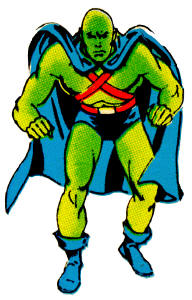
Illustration by Kilian Plunkett.
On the down side, I completely forgot to do a Saturday post, and this was after I barely got Thursday's post in on time. I was working on something late Friday night until I felt the need to tap out, and then was out of the house all day with my closest hu-mans. On the plus side, I feel I've generated some pretty decent commentary to go with these dozens of card posts, to the point where you're maybe backlogged, and who's reading this blog over their weekend anyway? Can you believe I did this more or less daily for years? At this point, I sure can't. So yes, I'll just backdate this one (a term no one under 40 can comprehend today. We used to sign pieces of special paper from a little booklet promising that we had money in the bank to buy things. With a ballpoint pen. By hand. While people waited impatiently in a line for us to write and tear out said note.)
Something you might not know about J'Onn J'Onzz? He likes vanilla cream filled chocolate sandwich cookies of the type invented by Hydrox and monopolized by Oreo. Last week, I read an article on the history Hydrox that took some very conspiratorial turns, particularly regarding a faltering revival attempt in recent years. I'm not absolutely certain that I've eaten an original Hydrox, but the fact that I was familiar with them when referenced in books like American Secrets makes me figure that I have. I'm sure that there were particular differences, like the way every other diet cola paled to me against Pepsi Max/Zero when it had the ginseng in the receipe, but was ruined when that was replaced by just another saccharine chemical sludge.* But at the end of the day, every major grocery chain has their own cheap knock-off of the basic model, and I don't recall any Hydrox riots in my time upon this Earth.
Likewise, when the premise was introduced, J'Onn explicitly favored Oreos to a maximalist, man-sized shipping crate excess, but some lawyers eventually made him switch to Chocos. Maybe Chocos are just that much better, or maybe Oreo changed their formula in some infinitesimal manner only perceptible to Martian Taste Buds. Regardless of the fact that the Oreo bit was one of the finest in a comic so funny and humanizing that it turned me on to all the rest of my Alien Atlas and JLI reading, I only sign or groan at their mention today. Every Martian Manhunter thing has to reference it, and then everybody points at the screen becaise he did the thing! It's like those guys who made their entire personality "bacon." There's a half-dozen flavors of Oreos taking up serious shelf space in every grocery store in America. And? Trust that other people like sandwich cookies. Have you tried the limited edition banana cream ones? The chicken and waffle "test" run is better than you'd expect, mostly because they're just pancake syrup flavored. Not like those disgusting Coca-Cola ones from last year, that were the worst version of exactly that "promise"...
*I will point out that non-U.S. markets didn't seem to ever get the ginseng version, but I also think those countries had better consumer protections against the saccharine chemical sludge. I find foreign Pepsi Max to be more palatable than pretty much any other diet soda that I've been exposed to, but it's still methadone to the heroin that was the domestic ginseng version that I drank almost exclusively for a decades. I see you, Hydrox people, even if I don't feel you.
Showing posts with label Justice League International. Show all posts
Saturday, September 26, 2026
Friday, September 25, 2026
2005 Upper Deck Justice League of America VS System CCG Card DJL-152: Justice League Signal Device
Illustration by Arthur Suydam.
Following up on a comment, considering how iconic and oft-replicated the cover to 1987's Justice League #1 was, how transitory it all was. For instance, the mini-series that preceded it, Legends, clearly set up Changeling being on the team. Considering how I was never wild for Gar Logan as a Teen Titan, he would have maybe been my least favorite press gang into even the JLI. Could you imagine how insufferable the Blue and the Green would have been? I could always half-ignore Booster Gold as a marginally powered also-ran, but ol' Beast Boy would have been prioritized to capitalize on the (already waning) New Teen Titans heat. Plus, I figure he'd have been a bizarro Year One Black Canary, constantly comparing the JLI disparagingly to the Junior JLA. I'm not sure the creative team were in a position to refuse him, either, so I bet Marv clawed him back. Near miss.
Dr. Light is a big "ew," because you figure that was an editorial mandate to take advantage of Kimiyo Hoshi's visibility from Crisis on Infinite Earths. Her whole point was to take a hero's journey from ill-tempered narcissist to noble self-sacrifice, as exemplified for her by Supergirl. It would have been an interesting reset to have her reject that template-- to decide "I didn't spend my entire life earning a doctorate to become a world-class scientist so that I could die on a mudball in the Anti-Matter Universe, just because I stumbled into metahumanity. That's a role for one of these other super-goofs that punch first and think never." Given the intention for Crisis to erase itself, there was never a Kara Zor-El to offer that lesson. Dr. Light could have been a magnificent foil for Guy Gardner, whose self-importance and insubordinance could have also rankled Batman and J'Onn J'Onzz. Plus, the JLI desperately needed women, as evidenced by the later inclusion of Green Flame and Ice Maiden from the Global Guardians. But Fire and Ice were "hey-- sexxxy laaaadies" who could play traditional female types and a typical extrovert/introvert dynamic. Dr. Light demanded more nuance, but Giffen couldn't be bothered, and she was totally reject-able even by a book as desperate for leads as JLI. Her later, limp rotation through a problematic weak sister spin-off book in it's lesser days was no great victory for either female or Asian representation. Nobody has ever seen enough value in Dr. Light to do anything worthwhile with her.
Given that there was no longer an Earth-2, the Justice Society was in (literal) limbo, and that we had moved on to a new incarnation (if not outward presentation) of Dr. Fate for the eighties, it's a shame he was a one-arc chump. I guess Nabu and Linda Strauss dipped in a few times, but they moved Dr. Fate into a solo role at a time when team association could have given the concept a firmer standing. That said, Fate was never really a draw, and you've got a Spectre situation of constantly having to explain why he even needs a team to back such a powerful figure. This was an exit that I agreed with, because Dr. Fate had too much going on in their lives, and I don't think the humor that works for that property is the same flavor the JLI traded in.
Given the five minutes Captain Marvel was in the group, it's disheartening how much damage that small exposure did to the character. As a Wonder Woman fan, I've long decried the tendency for characters with a smaller but devoted fandom to be defined by their usage in higher visibility team over their solo vehicle. It's a form of Flanderization, where a character is warped by the needs and biases of the creative force behind an ensemble into a caricature that sticks for those with no broader awareness of the hero. And boy, did Captain Marvel get walloped with the goober stick. Roy Thomas was wise to pull the Big Red Cheese out as quickly as he did, and a fool for not immediately placing him elsewhere to manifest a counter-narrative. Legends had traded heavily on the boyish innocence of Billy Batson, but when DC's surprise hit of the year turned him into a simpleton, that stuck with him in perpetuity. That's the buffoon a loathsome Zachary Levi played in those wretched feature films, so now that's what Shazam is to a modern global audience. Given that the JSA had been 86'd, I always felt like Roy blew it with Infinity Incorporated, which had already dismally failed to ride the coattails of X-Men and New Teen Titans to such a degree that I think even the Detroit League bettered them. If only Roy had the vision to rework the property more fully into a contemporary Justice Society, he could have brought Captain Marvel and Dr. Fate into that team, preempting that approach on the more successful 2000s JSA revival. And it would have spared us all that Silver Scarab melodrama.
I still have affection for the Justice League that we got, but it's interesting to consider how we didn't really get the one that we were promised.
Wednesday, September 23, 2026
2005 Upper Deck Justice League of America VS System CCG Card DJL-075: UN Recognition
Illustration by Gus Vazquez.
I tried to cover Justice League International in earlier days of the internet, with much slimmer wiki availability, so I cross/sub-referenced my interest to death and tapped out. The book was definitely the second leg of my outsized interest in Martian Manhunter, following my much favored Super Powers figure. I do recall flipping through the first issue at a mall bookstore, and being put off by the Guy Gardner of it all. Some weird off-brand Green Lantern was plotting to lord over his leadership credentials to a Justice League lacking a Superman, Wonder Woman, Flash, Aquaman, Atom, or Hawkman? I don't think I knew the bird-lady in the black and blue costume with a headband. I definitely had the barest exposure to Mister Miracle, in that garish red, yellow, and green get-up with the giant collar. Shazam was all over old Treasury Edition ads, and I caught his cartoon on the rare occasions I was up early enough on Saturday mornings, but he was still an off-brand Superman. Blue Beetle I saw in Chartlton Action Hero house ads when I'd catch a cheap Thunderbolt or Judomaster back issue at the flea market. I had the Manhunter and Dr. Fate action figures, but that alone wouldn't cinch a sale, or else I'd have picked up one of those Detroit issues I'd also tossed through at the mall. Batman was the only draw, but I knew him from The Brave and the Bold, so he was a team-up slut. His joining a group was no sign of quality, or else I'd have bothered with The Outsiders.
I got JLI #8, "Moving Day," at a dinged copy discount at a comic shop shortly after release. It was one of the rare funny books that was legitimately funny, especially J'Onn J'Onzz's endorsement of Oreo cookies by the caseload. He was a standout in one of my favorite single issues to that date. Shortly thereafter, I moved to Nevada, where the convenience store comic rack was way more open to DC Comics than Houston's. Heck, they even had spinner racks, which were scarce here, and that expanded the selection in general from what would fit from a small shelving area near the register. I still picked up JLI irregularly, as I was much less interested in any issues without Kevin Maguire artwork, or that seemed to be telling a serious story. I was there for the comedy. That was not what I got in Martian Manhunter #1, the only book I got at my only trip to a comic shop anywhere near Vegas. I hated everything about it, especially the wasted opportunity and elevated cover price. Put me off Martian Manhunter as a soloist for years afterward. Instead, I gravitated toward that Guy Gardner guy as the best part of that ensemble, because he was never played straight.
Outside of annuals, I lost interest in JLI around the time Ty Templeton left, and Adam Hughes was coming on. I hadn't been into the book for a while, so it wasn't te fault of the art change, but rather the tonal shift. They kept insisting that I needed to take these b/c-listers seriously, and I just couldn't. It was like when Moonlighting got mired in all that soapy relationship stuff when I just wanted snappy mysteries with wry, knowing humor.
Thursday, September 17, 2026
2005 Upper Deck Justice League of America VS System CCG Card DJL-154: World's Greatest Heroes - Team-Up
Illustration by Joe Phillips.
The Legends period was such an important time for J'Onn J'Onzz. I was not very interested in DC Comics Pre-Crisis, and that only started to change when Marvel's top artist took over Superman. I had some exposure to George Perez, and in fact New Teen Titans was one of the few DC titles I occasionally sampled, but John Byrne was a staple. Not only had I loved his X-Men work, but I was always up to toss through one of his (very DCish) Fantastic Four issues, and I bought reprints of his Spider-Man work in Marvel Tales (though I barely gave Alpha Flight a Titans-level sniff.) Where I only bought a single issue of Who's Who, I got a late start on the first volume of Official Handbook of the Marvel Universe, I continued to buy it routinely in the second, "Deluxe Edition." Byrne art was on most covers and a great many entries. He wasn't just Marvel to me-- he was "comics," and with Legends he was at DC Comics. I did buy an issue of Perez's Crisis on Infinite Earths, and I would soon enough sample his Wonder Woman, but I got there through the door Byrne was holding open.
I didn't actually buy a single issue of Legends new, as I had ten consecutive issues of Secret Wars, but I did catch a bunch of tie-ins in first run or through recent-ish three packs. As with Secret Wars, I could feel the events in Legends reverberate through other titles. It felt fresh, and important, even without the context that the public being turned against their super-heroes by a demagogue was echoing the anti-comics crusade of the 1950s. But I could feel that tension, from creators who lived through it, reflecting on it through their work. I finally got to read some of the core mini-series through a friend's copies in 1988, by which point I'd graduated from only knowing the Alien Atlas through the Super Powers Collection into proper monthly comics. But seeing that Post-Crisis DC coming together here, with the Manhunter from Mars near the fore, it felt like a coronation. Suddenly, DC Comics mattered to me, and more shockingly, J'Onn J'Onzz finally meant something to DC Comics.
That having been said, I don't remember Captain Atom being involved with Legends at all. DC largely recreated that character after purchasing him from Charlton Comics, and getting in somewhat on the ground floor with a character I had only the slightest prior awareness of was, at the time, even more intriguing to me than some Jolly Green Giant in a cape. I bought a number of issues of Captain Atom's solo titles in the period before I reached Legends. Seeing the Charlton Action Heroes fully and effectively integrated into the New(er) DC was exciting, and I've long associated J'Onn J'Onzz with their "welcome wagon." It reminds me of how I waxed rhapsodic over that same possibility being afforded the Wildstorm integration early into the New 52. I loved seeing the Sleuth from Outer Space making a new welcome wagon out of Stormwatch. So less than a year in, he quit that team and mindwiped everyone to never remember that he'd ever been a member. A bitter disappointment, but an excellent metaphor for the New 52 and that abortive Wildstorm integration. What integration? What Wildstorm? Who are you people?!?
Saturday, September 12, 2026
2005 Upper Deck Justice League of America VS System CCG Card DJL-055: Maxwell Lord - Financier
Illustration by Cully Hamner.
This is just a cameo appearance by J'Onn, so I thought twice about featuring it, but hey-- I got dates to fill. Max was still a good(ish) guy around 2005, but this was the same year as Countdown to Infinite Crisis, so the heel may already have been turning. My main cause for pause to reconsider this was that it seems like Cully Hamner may have drawn influence from the likeness of another wealthy New York elite that turned into a global super-villain, and that semblance is more repugnant to me than a bullet to Ted Kord's brain.
Monday, September 7, 2026
2005 Upper Deck Justice League of America VS System CCG Card DJL-188: Rallying Cry!
Illustration by Duncan Fegredo.
Both the sportscard and comic book markets started heating up in the 1980s, feeding off one another, so that your average comic shop carried sports cards and vice versa. A lot of this was Mom & Pop stuff, so everybody was learning how each business type worked as they went along, and you tended to value every investment. In the case of cards, you'd typically open up at least one box of a desirable set to see which chase cards you could score to display in a case, and to have common singles to sell or trade to help customers put together sets. Even when you weren't actively making money on those loose cards directly, you provided a service, and by being a resource brought people into the store. Even as the trading card market took a downturn, the rise of collectible card games heightened the value of singles. Game players needed multiple copies of the same useful cards in customizing decks for play, or even just to have enough duplicate cards to maintain multiple active decks for various strategies of gameplay. Just as your Beckett was cooling down, your Scrye was heating up, and games like Magic: The Gathering and Pokémon kept the lights on when other hobby businesses were closing down.
I myself played Overpower and Star Wars, and usually kept my decks in sleeves. Since I was a DC guy, the only box of Overpower that I ever bought for myself was the JLA expansion. Aside from starter packs (basic pre-built decks of first editions,) everything else I got from loose individual packs, or by buying/trading single cards through other players and shops. As was typical, I usually carried my cards in a prefab folded cardboard box that held a single row of cards on their side, and was about 10 inches long with a built-in lid. At the shops I ran and frequented, single cards were usually kept in a variant of these boxes, which I'd guesstimate were something like a foot & a half wide and maybe two feet long. These were more complicated to build, because they would hold multiple rows of cards with separate cardboard slats that were folded into the larger pre-cut template. Cards in these boxes were stood up, and you had a separate folding lid template that could be used to keep dust and debris out of the boxes, or to secure them for transport. That's how you could safely get them to shows/conventions, though being cardboard, you wouldn't want them to be hit with anything more than the lightest of rain sprinkles. At least here in Texas, we'd have stacks of these boxes in our shops, usually supported by wooden shelving behind the counter or in the back room. If you had the right build, you could also get comic book short boxes on those shelves, and because you valued all that stock that you'd put money into, there were often a lot of each type of box around. Of course, in the '90s, after the bottom started to fall out, everybody had overstock to liquidate. You didn't want to pay property taxes on product that wasn't moving. You had to cut your losses at some point, or drown in them.
Monday, July 21, 2025
2023 Fan Expo New Orleans Martian Manhunter figure sketch inks by Tony Kordos
At 2½ years in waiting, this piece's presentation is far from my worst patron offense. I bought a Martian Manhunter figure sketch off eBay a good quarter-century ago, maybe more. I got it cheap and was never 100% sure of its legitimacy, but to quote Sean Connery's character in The Untouchables, "Who would claim to be that who was not?" If you were going to forge a Kevin Maguire drawing, surely you'd pick a more commercial character than J'Onn J'Onzz? Anyway, when I got a Professor Arnold Hugo head sketch from Maguire at Comicpalooza 2014, I asked him about it. He barely looked up from his current drawing to dismissively note words to the effect of "looks like me." Good enough, I figure.
Anyway, I pumped up the contrast on the drawing at a Xerox machine located in a gas station across the street from the comic shop I ran at the time, and used those copies as templates for dozens of Martian Manhunter redesign attempts, none as good as Jim Lee's. Yeah, I don't think that phrasing gets used much, either.
The drawing was so faint, not helped by the cheap acidic paper that it was draw on steadily browning, that I was always afraid of "losing" the image to the elements. Inking in comics is a lost art, and I have much respect for it. That said, I've had some... let's say "misadventures" in my previous inking attempts. One specific piece has been referred to as my personal "Monkey Christ". I've had lousy experiences with seasoned veterans, awesome ones with unknowns, and vice versa. I was precious with my Maguire Manhunter, but I've had opportunities to get the image immortalized by folks who had inked Maguire on Justice League International. For various reasons, I never pulled the trigger.
Finally, I tumbled upon Tony Kordos in NOLA, and I really liked his stuff. Unbeknownst to me, he's a pro who did a fair amount of work at DC during the New 52. He seems to be Paul Pelletier's inker of choice, working over him on such titles as Batman & Robin Eternal, Cyborg, and the Skybound continuation of G.I. Joe: A Real American Hero. I told Kordos that he was free to embellish, rather than slavishly reproduced, and I truly loved the modern flourishes that he added to the '80s style original linework. It gives the piece a pop that it didn't have before, and I'd hope Maguire would be as happy with the collaboration as I was. I haven't caught Kordos at any other shows, but I picked up a real inker's showcase since that I hope he'll take a hand in...
Tony Kordos
Labels:
2020s,
Justice League International,
Martian Manhunter,
Pin-Up
Wednesday, July 9, 2025
History of the DC Universe (1987)
The first thing that you have to remember here is that Mars does not matter in the grand scheme of DC Comics continuity. Krypton does. Gotham City does. To a much lesser extent, Themyscira does. Casting a net more broadly, as has been mentioned in a couple of my podcasts, Atlantis matters to both Marvel and DC Comics. But Mars? I don't think rates all that highly anywhere, outside of Topps Comics. The 20th Century made a lot of dismissive mention of the Red Planet, and like the moon, the popular consciousness read it as a generic location of dubious value to fantastical comic book stories.
And so, the first half of the Post-Crisis on Infinite Earths revisionist history of DC published in 1986 is mighty concerned about Oa, prehistoric Earth, World War II... all those other places I mentioned. Without a comprehensive reread though, no mention of the planet Mars, or any of its denizens. Moving into the second half, they still devote a lot of pages to WWII, and a little bit of the post-war years. The one true Earth was still a cooling mass, however, so from there we leap to Task Force X and the conception of Aquaman. That famed rocket from a doomed planet had been launched in the first volume, and finally landed in a corn field near Smallville. A nigh-adolescent Bruce Wayne saw his parents gunned down, which gets a bit hinky with the relative ages of the DC Trinity. Phantom Stranger, Captain Comet, and the creation of Princess Diana arrive next. Well, one figure does fall between Comet and clay baby Wonder Woman...
In another short-lived stand for this continuity, the entire World's Finest trio launches the modern heroic age, placing Robin ahead of the latest version of Flash, Green Lantern, the Atom, the Hawks, Aquaman, Captain Atom, Green Arrow, and Blue Beetle. We see Starfire as a child, Cave Carson, the Challengers of the Unknown, Adam Strange, the Sea Devils, and Dolphin. Curious chronology ahead of their key super-team revival...
And so, the first half of the Post-Crisis on Infinite Earths revisionist history of DC published in 1986 is mighty concerned about Oa, prehistoric Earth, World War II... all those other places I mentioned. Without a comprehensive reread though, no mention of the planet Mars, or any of its denizens. Moving into the second half, they still devote a lot of pages to WWII, and a little bit of the post-war years. The one true Earth was still a cooling mass, however, so from there we leap to Task Force X and the conception of Aquaman. That famed rocket from a doomed planet had been launched in the first volume, and finally landed in a corn field near Smallville. A nigh-adolescent Bruce Wayne saw his parents gunned down, which gets a bit hinky with the relative ages of the DC Trinity. Phantom Stranger, Captain Comet, and the creation of Princess Diana arrive next. Well, one figure does fall between Comet and clay baby Wonder Woman...
Warrior J'onn J'onzz, exiled into the parched Martian desert, was teleported accidentally to planet Earth by the famous Professor Erdel. This Manhunter from Mars knew the time of heroes had not yet come, and so remained in hiding, disguising himself as a police detective until, at last, he could allow the world to know of his existence.There's a lot to consider there. Firstly, that was two sentences. I choose to offer long, sometimes tortured sentences as part of my personal expression, so you might call me hypocritical for pointing that out-- but dang! Next, the fact that in a rare instance of DC offering mixed caps in a canon story, only the Js are capitalized. Okay, I might be "considering" too pedantically. How about how the late Silver/early Bronze status quo begun with"...And So My World Ends!" seems to still be in place, with that "warrior" bit in particular pushed back against by the 1988 retcon? We're also in a vague pre-heroic age, with the best marker being the conception of Raven on the next page. The creative team on this book had come up with that character to be a member of the New Teen Titans, and the book's artist was presumably working out how his Wonder Woman would also debut in her late teens/early 20s in her new history. Therefore, at the time of publication, it would be fair to assume Detective John Jones was around in the late 1960s. Couldn't be much further back than that, if we want to keep Superman and Batman around 28-30 years old. While a handful of stories alluded to a further period setting, it would be another eight years before parity with his initial date of publication was established in Zero Hour: Crisis in Time #0.
In another short-lived stand for this continuity, the entire World's Finest trio launches the modern heroic age, placing Robin ahead of the latest version of Flash, Green Lantern, the Atom, the Hawks, Aquaman, Captain Atom, Green Arrow, and Blue Beetle. We see Starfire as a child, Cave Carson, the Challengers of the Unknown, Adam Strange, the Sea Devils, and Dolphin. Curious chronology ahead of their key super-team revival...
This was now the Silver Age of heroes, and some of the greatest who ever lived banded together to fight evil on Earth and throughout the stars. Inspired by the wartime exploits of the famed All-Stars and the Justice Society, these young heroes took the name the Justice League of America.Because John Byrne's Man of Steel had already rolled out, we knew that Superman would be excluded. Pictured as the core line-up were J'onn J'onzz, Aquaman, Barry Allen, Batman, and Hal Jordan. A scale Ray Palmer Atom was placed just outside the framing of this team inside the old badge logo of the JLA, with the floating heads of Oliver Queen and Katar Hol on either side. Not a bad guess, but this line-up was never properly executed in the comics. The Caped Crusader was eventually excluded, at least as a founder, though he inevitably engaged with the JLA early and often in this retcon. DC eventually settled on a quintet in 1988, capped by Black Canary. Jemm, Son of Saturn got a mention as a contemporary of Firestorm, Firehawk, and the Warlord Travis Morgan, oddly predating the retroactive continuity armored Gardner Grayle Atomic Knight, as well as Baron Winters of Night Force. These were mostly continuity charity cases, only getting a nod here by proximity to publication date. Jemm was originally a Son of Mars, who played heavily in the fields of post-apocalyptic Bronze Age New Mars stories, and his Saturnians were eventually retconned into literal Martian clones by Ostrander/Mandrake. It's nice for us, since none of the solo Manhunter from Mars adventures rated a mention, nor his predecessor, Roh Kar. Instead, as ever, and another gift of the zeitgeist, the Alien Atlas is solely represented in this period through his affiliation with the mid-80s Justice League (generally appended with "Detroit" to define the line-up of Batman, Elongated Man, Zatanna, Steel, Gypsy, Vibe, Vixen, and Aquaman. From there, we get into the weeds of para-Crisis on Infinite Earths material, with a heavy emphasis on developments during and spinning out of Legends, including the line-up of the first six months or so of the Justice League relaunch (soon-to-be-International.) So that's Dr. Light II, Captains Atom and Marvel, Mr. Miracle, Guy Gardner, Black Canary, Blue Beetle, and Dr. Fate. They're followed by the Suicide Squad and, ugh, Post-Crisis Wonder Woman. It makes my skin itch when people rave about the female leg of the DC Trinity arriving after freakin' EVERYBODY, just so Perez could treat his Simonson Thor retread as though it were a brand new shiny thing. And then from there is a toboggan ride through the potential futures, most especially the Legion of Super-Heroes 30th Century, that will be ripped to pieces to wipe the butt of every reboot from here through the next five decades and counting.
Monday, October 7, 2024
2015-2017 Martian Manhunter Comrades Jam
Another funny one where all the individual parts have been posted online since 2019, but I waited a half decade to offer the combined piece as a whole. My explanation is that I intended this to be the "front cover" for the second volume of Who's Who in Martian Manhunter, with 2014-2016 JLI, Saturnians, & Other Friends Artist Jam on the back, but that's simply never going to happen. It's been eight years. I'm calling the time of death. Anyway, it's also amusing because this jam only took two years to complete, a short turnaround for such a long delay. It spanned an awful lot of conventions though, including a HeroesCon and a couple of Comicpaloozas, but the majority was done at just one of two years' worth of the now defunct Amazing Houston. Here's another cute thing: in the years between efforts, I had the same artist do two different Green Lanterns on as many jams without realizing it. On the plus side, the colors on the original FedEx Xerox were all washed out, but the direct scan from tonight improves on it. In the no laughing matter department, contributing artists Allen Bellman (a Golden Age great) and Adrian Nelson (one of my favorites and most oft-requested over the years) have passed away in the interim.
2015-2017 Martian Manhunter Comrades Jam
- 2015 The Atom (Ray Palmer) Amazing Houston Comic Con Jam Sketch Detail by Atom Todd
- 2015 Bloodwynd Amazing Houston Comic Con Jam Sketch Detail by Oliver Banks
- 2017 Elongated Man Jam Sketch Detail by Isaiah Broussard
- 2015 Glenn Gammeron Amazing Houston Comic Con Jam Sketch Detail by Adrian Nelson
- 2016 Green Lantern John Stewart Amazing Houston Comic Con Jam Sketch Detail by Eddie Nuñez
- 2015 Gypsy Amazing Houston Comic Con Jam Sketch Detail by Brent Peeples
- 2015 L-Ron Amazing Houston Comic Con Jam Sketch Detail by Ali Morgainne
- 2015 Miss Martian Amazing Houston Comic Con Jam Sketch by Mark Bagley
- 2015 Oberon Amazing Houston Comic Con Jam Sketch Detail by Johnny J. Segura III
- 2017 The Ray Comicpalooza convention Jam Sketch Detail by Jason Scholte
- 2017 Roh Kar Jam Sketch Detail by Allen Bellman
- 2016 Steel (Hank Heywood III) Amazing Houston Comic Con Jam Sketch Detail by Allen Adams III
- 2015 Vibe Amazing Houston Comic Con Jam Sketch Detail by Brian Salinas
- 2015 The Vixen Amazing Houston Comic Con Jam Sketch Detail by Brad Garneau
- 2016 Zatanna Comicpalooza convention Jam Sketch Detail by Garrett Gainey
Monday, July 29, 2024
Action Comics #595 (December, 1987)
Silver Banshee walked the streets of Metropolis, killing men indiscriminately as she searched a series of local bookstores. After one policeman under Maggie Sawyer's command was killed, and another nearly so, Superman finally showed up... only to die himself. Various parties, including members of Justice League International, mourned his loss. Black Canary and the Batman believed that someone should address the situation, while the Manhunter from Mars insisted, "Something must be done!"
Lying in state, Superman's ghost lifted from his glass encased body, stating "I have been cut down before my work was done! I must finish what I set out to do. Only then can I rest. Beware, Silver Banshee! Your time of judgment is at hand!" Jimmy Olsen had trailed the villainess to another bookstore, and nearly doomed himself when Spectral Superman showed. Once her powers failed to effect his immaterial form, she blew herself up trying to destroy him with her Banshee cry. Only after did a living Superman reveal himself, while his "ghost" resumed his nat-- er-- typical Martian form.
The Sleuth from Outer Space had deduced that there was a visual component to the Silver Banshee's powers that prevented her from killing someone that she couldn't accurately identify. The Kryptonian form held up better than human victims, but Superman was still placed in a deathlike coma state until the Aien Atlas jumpstarted his brain with undefined "mental powers." It's a huge stretch that doesn't stand up to scrutiny, since she'd killed multiple unidentified dudes, but Perry White lampshades it with "Well, I guess that's a satisfactory explanation... at least it'll have to do if that's all we're going to get." Still, they played fair by announcing J'Onn J'Onzz's presence earlier in the story, and allowing him a showcase for his detective skills.
"The Ghost of Superman" was by John Byrne, with Keith Williams. Crisis on Infinite Earths had ended with 1985, but it took until June of the following year for "Whatever Happened to the Man of Tomorrow?" to wipe the board clean of Pre-Crisis Superman. Then another four months later, John Byrne used the oldest but "spare" of his two Man of Steel titles to continue the team-up format of the recently canceled DC Comics Presents, beginning with #584. I'm fuzzy on when I started picking the title up, but most probably it was with this issue, so it would have been nice to already be familiar with Martian Manhunter for the reveal. It was apparently the first appearance of Silver Banshee as well, though I could have sworn she'd made an earlier one. Obviously she was super cool, and a fairly strong addition to the rogues gallery, so it's disappointing that she's been more or less relegated to a second hand Supergirl foil. Kal-El's so powerful and so visible that he really can't spare someone so formidable, just because neither Banshee or his cousin possess a y-chromosome.
Monday, July 22, 2024
Booster Gold #22 (November, 1987)
Michelle Carter, the sister of Booster Gold, was tooling around in the Goldstar super suit when she was blasted out of the sky by aliens. These were invaders from Dimension X, who had tangled several times with the Teen Titans in their early days. The aliens and would-be heroine had only happened upon one another, but the aliens saw an opportunity to drain her suit as a power source to help them transport their armies to Earth. Booster Gold soon set about tracking her down, but while getting the lowdown from Wonder Girl, refused the help Titans to hog any glory for himself. However, once he encountered the aliens, he was faced with the choice of either saving his sister, or 38,000 spectators at a Minneapolis baseball stadium (Google tells me... Twins?)
Booster Gold sent his flying robot companion Skeets to free Michelle, then called on his new teammates in the Justice League International to stop the giant gray horned monster in Minnesota. Booster griped about how long it took for the JLI to arrive, and they countered with basically "what part of International did you not understand?" Plus, y'know, the Titans could have already gotten there, y'feeb. The giant is an artificial construct made out of a doughy, energy-resistant substance, so direct attacks were fairly useless. At one point, the team is saved by Booster's force field, and another time Mister Miracle helps them escape. It's very weird to see Miracle carrying Martian Manhunter to safety, and in fact this whole debacle relies on tying the JLI's hands behind their backs to make the hoary aliens and Booster look better. Green Lantern Guy Gardner's recent brain trauma is used to keep him out of the action entirely, while Captain Atom's quantum powers are unusually limp against Dimension X, conveniently. The Alien Atlas is reduced to strength, eye beams, and flight (when not being held by Aero-Discs?) and generic teamwork lines. As least as leader, J'Onn J'Onzz comes up with the decisive play: Captain Atom burns a small tunnel, Manhunter holds it open with his regular, non-elongated hands, and Booster Gold flies into the cavity. Once inside, Gold expands his force field until the creature bursts into goo sprayed all over town.
It feels like word came down while the issue was being worked on that the title had been cancelled. For reasons, the JLI vacate the story, Booster Gold returns to his sister, and those pesky reasons also meant that Michelle Carter's very life force had also been drained with the independently powered super suit. The siblings have to team-up to stop the alien invaders, but a stray power line hits Goldstar and disintegrates her. Then the JLI attend her cliff side funeral, and Doctor Fate sends her tombstone to a dimension where it will be untouched by time. That was... abrupt. "Tortured Options" was by Dan Jurgens & Ty Templeton. I bought the first issue of this book because an ad promised me a free button with purchase, not realizing that the offer wouldn't be honored at a Circle K. He had an okay costume, and it was nice to get in on the ground floor with a new hero, but I basically hated the guy from jump. Materialistic narcissist showboat is a good mixer for a shared universe or super-team, but I don't want to read a whole book about that guy. I didn't realize it then, because the whole package was so bland an unappealing, but that issue would be the start of my long time disdain for Dan Jurgens. He's done good work, I won't deny, but on average I find reading his stuff to be a tedious chore. This story was a perfect example, strongly recalling his own mostly miserable run on Justice League America, as a bunch of characters he has no feel for make too many utterances in a chaotic fashion that is supposed to have some sense of humor or characterization that is absent. Just overeager placeholder balloons that never got needed revisions. I needed to skim through a few issues around this one to get a better sense of what was going, but planned to read this one cover to cover, and just couldn't. I quit trying partway through page 14, when the JLI exits for some contrived reason, and I couldn't tolerate the lame dialogue anymore.
Tuesday, July 16, 2024
Doctor Fate #1-4 (July-October, 1987)
Doctor Fate is sort of like if you combined Merlin with Lancelot for the super-hero set, as the wizard/knight battles the forces of capitol-c Chaos from the Golden Age to the present. However, the toll has prematurely aged the human host of the Lord of Order, Nabu. Kent Nelson is dying, his wife Inza is already dead, and the other Lords of Order have decided to write-off the current existence to speed up the cycle of waxing darkness eventually turning back to light. Nabu refuses to comply, and has already picked his next host. As with Kent Nelson, Nabu has prepped a preternaturally mature and mystically adept 10-year-old boy for the role. Things debatably go awry for Eric Strauss, who is insta-grown into an adult, but captured and institutionalized by bad guy Typhon and his own human host, Doctor Benjamin Stoner. It does serve his stepmother Linda well though, as she'd felt "demented" over her romantic feelings toward the boy-turned-man, and that had led her to team-up with Kent Nelson to rescue the now strapping young lad. The experience also made Eric finally ready to embrace his new role (though not yet his-- er-- mama? In the '70s jive sense?)

The connection to Justice League International is modest, and takes place in the third issue. The Helm of Fate was compromised, and donned by Stoner as he created barely elaborated upon global havoc in service to Chaos. The Phantom Stranger aims to address the matter of this "Anti-Fate," using JLI members Batman, Green Lantern Guy Gardner, Mister Miracle, and Martian Manhunter as pawns against the new, evil Dr. Fate. The front half of that line-up appeared to die violently in the attempt, but Martian telepathy knew otherwise, and urged Mr. Miracle to relent in further pursuing the matter. Before being teleported away, the Sleuth from Outer Space assured, "We haven't failed. We're doing what we're supposed to do." Spoken like a career jobber. The Phantom Stranger served similarly, seeming to perish while biding time for Eric, Linda, Kent, and especially Nabu to get their acts together. Eventually, a gestalt entity of the Strausses is required to form a new Doctor Fate, who reclaims their mantle, and exorcises Typhon from Stoner. Kent Nelson moves on to the afterlife, but Nabu retains use of the body, to mentor the Strausses.
Without doing any research, my guess is that Doctor Fate was given a mini-series mostly as a "bold new direction" spin-off from Legends, with a side benefit of supporting and expounding upon the Justice League relaunch (arriving between #'s 3-4.) My first significant exposure to both Fate and Keith Giffen was in a back-up from The Flash #308, the only issue of that volume that I bought new, owing heavily to the novel parallel narrative of the lead feature (with wildly enhancing inks of the little-remembered Dennis Jensen over the usually repellent Carmine Infantino.) My uncle was a big Doctor Strange fan who'd left me dozens of his non-Brunner/BWS issues, so it was kind of neat seeing that type of metaphysical action rendered in a style owing more to Kirby than Ditko. Not enough to get me back for more, but I did buy the Super Powers Collection action figure with its own mini-comic. Doctor Fate is one of those characters that DC sees no inherent appeal in, despite the original version having a lot going for it, so they've spent most of my life selling me lesser variations on the basic premise. I certainly count this incarnation under that heading, despite a very different incarnation of Giffen's involvement-- more or less my favorite version of Keith. David Hunt's inks are fine for the most part, but leave something to be desired at times. J.M. DeMatteis would continue solo into an ongoing series, ditching the more ominous quality here to be a quirky companion title to JLI. I'm glad to have finally knocked this one out after all these years of putting it off, and it was quite easy compared to The Weird, but neither are staying in my collection now. I did like Giffen's visual take on the Alien Atlas, though.
Sunday, June 30, 2024
The Weird #4 (July, 1988)
The Weird was aroused by Batman, who was looking for a way to stop Superman; who was laughing off being double-teamed by Martian Manhunter and Doctor Fate; and Nuklon; who was taking on everyone else (including Guy Gardner, whose head will apparently be wrapped in gauze for 75% of this mini-series.) As one would expect in a Starlin book, The Weird recaps the prior issues of the mini-series, which offers the Dark Knight no clues as to how to defeat the Macrolatts that have possessed his super friend, and also Nuklon. So that's 7 pages of 38 down. The duo of possessed metahumans defeated the rest of the present heroes and lay waste to just enough of Metropolis to look like something out of Akira, but somehow not enough to rate any future mention or leave any trace that won't be cleaned up by the next Superman comic. Also, The Weird had a big speech about how the only way to save this reality was to prevent the Macrolatts from ever reaching it, so The Weird won't waste the remainder of his existence (measurable in hours) on a futile gesture. The Caped Crusader chided, "You may look like a man, Weird. But you've got a lot to learn about actually being one."
Page 16. The Weird kneels before the Macrolatts, speaking to the error of his ways and promising to tell his masters of potential threats to them in this realm. If there were any actual threats, they weren't shared with Batman, so we'll give him the benefit of the doubt that he played indignant before being slapped down by the Weird to help sell the lie. The Macrolatts are so arrogant as to be offended by the idea that anything could threaten them, and smack the Weird around before he fully surrenders, ostensibly to allow them to drain him of all his knowledge and power, ending on a twelve panel page of the possessed heroes slowly reaching toward Weird. Pages 22-24: The Weird reaches into Superman and Nuklon's chests with his variable density powers, pulls out a Macrolatt in each hand, and destroys them both. Well... that was a swift and convenient reversal of the story as told.
Oh, there's still 16 pages to fill? Super studies show that nothing can be done to save The Weird. He spends three pages building a small island as a monument to himself. Superman flies Billy Langley to the island across one page, and it's revealed in the opposing splash. Kind of looks like a sailing ship. Walter Langley's son is somehow meant to make it to this small personal island to play on a mostly barren rock whenever he feels lonely. The proposed logistics of that are the weirdest thing in The Weird. They hug, and then Martian Manhunter is stuck with the thankless task of flying this sobbing child back home to the mother that refused to visit, but was totally cool with allowing her son to fly off with Superman to parts unknown. I do wonder if there was some symbolism in the roles, but most probably J'Onn just got the **** detail, so Superman and Guy Gardner could fly off to unpopulated space to watch The Weird explode. I'd like to say Guy was the only Green Lantern dumb enough to risk it, but they're all so "confident" in their power rings, aren't they? The Weird does blow up a significant distance away, so I guess that explains why an energy bubble wouldn't have contained it. Superman, the Kevin Smith of super-heroes, sheds a tear at his passing. Even Guy looks a bit choked up, or maybe it's like how someone puking makes you want to puke, and Guy is just worried for his tear ducts. The final page is a somber distance shot of the island at sunset.
"...Armageddon" was by Jim Starlin, Berni Wrightson, & Dan Green. Well... that sucked. I liked Batman: The Cult when I got it a few years later, and almost ordered the new edition that's coming out, but I didn't like the production work on display. I mention that because I'm a lifelong Starlin fan, and I'm glad that he produced a script worthy of collaborating with Wrightson at some point, but this wasn't it. All the stuff with the father and son was unearned, because instead of developing that relationship to have any independent weight, they Zarolatted and punch-faced us. I can't remember if they bothered to name the wife/mother, but obviously the story didn't care any more about her than we did once it was done. This feels more like an outline than a complete narrative, and at least twice as many pages of art were produced than were needed to tell this basic of a story. Frankly, it was too obvious and unadorned to even earn its given name. The Lame would have been more honest. At least I got to see Wrightson draw the Alien Atlas, I guess?
Monday, June 24, 2024
The Weird #2-3 (May-June, 1988)
Smarmy TV news reporter undermines heroes and wonders aloud about The Weird. The remains of Walter Langley show off "his" powers for "his" son, then explains the basic cosmology of the story. Macrolatts are oppressive energy vampires who seek to expand their empire to our reality. Zarolatts are passive beings who are fed upon unto nonexistence by Macrolatts. Going straight from one reality to another means destruction, so the Macrolatts seduced homicidal narcissist loser Jason Morgan into transforming into a being capable of creating a bridge that would allow them safe passage. The Weird's proximity to these events while being fed upon gave it access to these events and a means of escape through the initial bridge, and its growing power is in service to its conviction toward the newly learned concept of freedom. Returned home, Billy Langley keeps all this from his mother.
"The Jason" found his failed businessman father's body hanging when he was four. His mother turned to the bottle and maybe prostitution before Jason found her body in bed after one of her gentleman callers took a razor to her. Despite being an impoverished orphan who was academically lax and had no prospects, Jason's belief that he was better than everyone else held fast despite his poor social skills, being an incel, living on the streets, doing a stint in prison for the violent assault of a woman, and eventually ending up a garbageman. He was primed to turn on humanity, ready to believe anything the Macrolatts told him if it meant power, and using it to take murderous advantage of at least one woman victim. Although held captive for a time, The Weird eventually freed himself, and at great personal distress, determined that the only way to stop The Jason was to snap his neck.
The Weird played hide & seek with Superman for fourteen continuous pages in one issue. The Justice League looked on throughout a couple of issues as The Weird had entanglements with other, more powerful beings. "Unbelievable! Not even J'Onn J'Onzz's incredible strength seems able to put a dent in that barrier." Nor Captain Atom's quantum energies, not Green Lantern Guy Gardner's power ring, nor Doctor Fate's mysticism, et cetera. Even after witnessing The Jason's execution, they mostly offer disapproving glares. Well-- that and an order from the Dark Knight to the green one. "It was just as you predicted, Batman. My powers of invisibility caught him completely by surprise." Unable to adapt in time, The Weird took two blows and a hard tumble. Unfortunately, two Macrolatts had escaped to possess Superman and... Nuklon? I guess for his variable density abilities, but yeah, not the guy you'd expect when you have all these powerhouses in Metropolis and Infinity Incorporated is all the way on the West Coast. Also, there was a whole bit about how The Weird had taken over a corpse rather than displace the life energy of a host, so by the rules laid out in the story, both these guys should have died.
"Questions" & "Confrontation" were by Jim Starlin, Berni Wrightson, & Dan Green. These single word narrative direction story titles speak to the reductive nature of the mini-series. Each issue has a few points to check off on a predictable agenda, and the rest is just vamping to fill out space. The art has its moments, but I think everyone involved would have benefited from the space being cut in half. It reminds me of when George Pérez quit Infinity Gauntlet midway through because he was sick of drawing fight scenes where a bunch of people gang up on Thanos and lose. So much of this series involves powerhouse DC heroes floating impotently outside energy fields or getting slapped around by what ultimately prove to be nothing characters, for clout more than narrative necessity. It's all so cheap, pointless, and passionless-- a purely commercial venture that nonetheless can't conceal its distaste toward its own existence. Anyway, I got through the second issue after coming home from HeroesCon, realized the Alien Atlas wasn't in that one, and decided we'd just double up on issues for the following week. This would keep, especially since I have to do my own scans on this thing.
Tuesday, June 11, 2024
The Weird #1 (April, 1988)
A fit blond white man with roughly half his physical form replaced by a jagged green crystalline substance sat cross-legged on the bathroom floor in his apartment and conjured an atomic energy form. This was an intended "bridge" for his "friends." A red gem of similar coarseness to his own body began to form in midair, but then an energy escaped it, leaving the gem to crumble away. The man, Jason Morgan, was shocked and dismayed.
The small energy ribbon hovered in the sky above Metropolis, and Superman investigated. The energy had no atomic structure-- no mass-- but when the Man of Steel passed his hand through it, he was knocked back three miles. By the time he flew back, J'Onn J'Onzz and Captain Atom had arrived to observe the energy. An hour later, there was a military cordon and a No Fly Zone, then the new Justice League were on the scene. Examinations through varied disciplines were attempted, including a science team on The Bug aircraft consisting of Blue Beetle, Batman, Black Canary, and more. When Doctor Fate's mystics were stymied, Green Lantern Guy Gardner attempted to probe deeper with his Oan Power Ring. An energy surged knocked out Gardner and blacked out the Bug and city as a whole.
Two probes were fired off by the energy ribbon in opposite directions. One was pursued by Superman, as it passed immaterially through a genetics lab's fluid beakers and into its complex computers. The other was followed by Manhunter to a funeral parlor, where the Martian met repeated resistance in contrast to the immediate aid and trust conferred upon the Kryptonian. The energy went into a service in progress, and caused the body of Walter Langley to vanish as mourners looked on in shock and horror. The probes reunited with the core energy, and the gathered heroes watched as the borrowed elements slowly coalesced into a new physical body of a lanky adult male in a queer red and black garb. Super senses detected that this being was not quite right, a sort of cosmic Frankenstein made up of misfit parts that were not quite human. The being collapsed into unconsciousness from the effort, and was taken to S.T.A.R. Labs for testing. Super senses determined that the Weird being, as dubbed by Blue Beetle, was molecularly unstable to a degree that its energies threatened a detonation that could destroy the Earth.
The Weird awakened and assisted upon attending to tasks that "he" refused to take the time to explain to the super-heroes, who attempted by failed to detain him/it by force. The Weird had its vibratory patterns thrown off by the proximity of the super-beings during its maturation period, which had altered the form in unexpected ways. This allowed The Weird to unintentionally push the Alien Atlas across a room, although the Manhunter fared better in a follow-up physical altercation than most of the rest of the League with their varied abilities. Regardless, the Weird at least briefly laid low everyone but Batman, while Superman had left prior to the fight to correct a compromised passenger jet's flight elsewhere.
The Weird sought out "The Jason," the half-crystal man that had been conjuring earlier, but found only his empty apartment. It/he declared the Jason to have a "dark and twisted nature" that would see him pursue world domination. However, a misalignment of the harmonic vibrations in the apartment would prevent Jason Morgan from attempting another inter-dimensional bridge for 18 hours, so the former Walt Langley had some time to kill, The Weird retained some of Langley's memories and motivations, causing him to visit Walt's former home. His widow, Eva, bemoaned his fatal mugging and the scene at the funeral parlor. "I don't care what the police say, I'm sure it's all the doing of that terrible green man." Meanwhile, in the back yard, young Billy Langley recognized his visiting father, even in this altered form...
"Conception" was by Jim Starlin, Berni Wrightson, & Dan Green. Following by introduction to Justice League International with their eighth issue, my reintroduction to the Man of Tomorrow via John Byrne, and a broader exploration of the Post-Crisis landscape moving out from the Millennium event series, I was a target audience member for The Weird house ads. However, I don't know when I had access to individual issues, and do know that I only read the first issue at some point after the final one. Neither experience was satisfying, and I won't know if I ever bothered with the meat of that story sandwich until I move on to covering the second installment. One quarter of "The Studio" and the crown prince of cosmic comics were long time friends who would prove a formidable pairing... on Batman: The Cult. This excessively long warm-up session noodles for 38 pages of heroes impotently watching stuff, then getting trashed by the second in a series of very powerful but rather boring sci-fi/magical Mister Spocks based on the visual template of Syzygy Darklock. I do like though that both Starlin and Wrightson are clearly a more comfortable fit on the Sleuth from Outer Space over Superman. Wrightson seems to relish his dark, exaggerated features over an off-model Man of Steel, with a broad flat nose and thick lips suggesting a less Caucasoid interpretation of the Manhunter, with the strongly implied prejudice that goes with it. I do wonder if Grant Morrison was influenced in his views of J'Onn J'Onzz here (and I think that's the only name he's been referred to in the issue.) Also, Wrightson's horror background gives the takedown of the heroes a more ominous quality than the story would seem to dictate, a sort of accidental element of interest in what otherwise feels more akin to a Radio Shack rudimentary science edutainment giveaway. The issue is way too long to accomplish so little, and I do wonder if this was initiated as a prestige squarebound mini-series for more niche audiences that was either determined not to rate the expensive ask, or was diverted to take advantage of the JLI's building heat on the newsstand.
Monday, June 3, 2024
Lovens Vogtere Nr. 4 / Med Super-Klubben Nr. 32 (1988)
"But you know what the funniest thing about Europe is? It's the little differences. I mean, they got the same stuff over there they got here, but, it's just, just, there it's a little different. You know what they call a Justice League in Copenhagen? Lovens Vogtere." I may be paraphrasing. Run through Google Translate, that yields "Guardians of the Law," which I guess is in the ballpark? Based on my experience while visiting comic shops, the League didn't quite catch on in Denmark like it did here. As best as I can tell from internet searches and observed back issues, the League only ever received a couple of very brief runs under the publisher Interpresse: five issues in 1968 (sharing space with Supergirl & Grønne Lygte Hal Jordan,) and four issues in 1988 that collected more or less the contents of Justice League: A New Beginning (JL International #1-8.)
Faraos Cigarer was easily the friendliest, most elaborate and well stocked comic shop that I visited in Copenhagen, and they had much of the first run. Had I known that there were only five total, I may have considered springing 1500DKK ($224.27) for Nr. 1 when I saw it locked in a glass case behind the front door. I did get the Ill Mac the Kr. 60.00 Super-Helte Alliancen Klassiker Nr. 4 / Med Marvel-Klubben Nr. 51 (1984) with the black & white reprint of Avengers #100 and Thanos' debut in Iron Man #55 (don't tell Mr. Fixit!) If you can believe it, Avengers comics were even less in demand than Justice League ones, and I only found two total, one existing only because it reprinted a two-part Spider-Man guest appearance.
Both the DC and Marvel comics were published by Interpresse, at least until about 1990. That's where the Super-Klubben / Marvel-Klubben comes in, because most any DC reprint had a Superman shield on it, and the Marvel ones had a Spider-Man web. While the indicia indicates Lovens Vogtere as the title, a second title/number on the cover seems to indicate that a lot of these series were like Dell Four-Color, essentially a revolving reprint anthology with its own overarching numbering system. The four "Lovens Vogtere" issues weren't even consecutive, cover-noted as Med Super-Klubben Nr. 20, 24, 28, & 32. I'm guessing it was a weekly release that made the Lovens Vogtere installments a de facto monthly. Based on my research, these four issues (or 7 U.S. comics) may be the only Danish-language versions of this series.
Clearly, the final cover of the single issue I found was derived from the comedy classic "Moving Day," though the colors are much less vibrant and more peachy. Justice League International #7 was an extra-length 38 page story, involving an 8-page coda to the Gray Man story arc. That part is not included here, picking up with page 9 and titling the rest "Forberedelser" with new Lappan-esque lettering credited to John Lysmand.
There are no ads anywhere inside the comic, but at the center-spread the story pauses briefly for a Captain Atom Who's Who entry, and then a blurry, slightly-overblown reprint of the U.S. cover to that issue. After the final five pages of the first tale, "Flyttedag" begins at the turn of the page. Both of the inside covers offer black & white letters columns punctuated by S-Shields and a tiny Byrne Superman. The only advertisement is on the back cover, a monochromatic orange Modesty Blaise ad with red lettering on the logo.
I've still got about a foot tall stack of these comics, many bought as gifts that I haven't had the chance to give yet, and a few as "investments" that I couldn't resist (more because it would bug me to leave them behind and less any actual intent to sell.) There will be a few more Martian Manhunter specific ones when we get to the 60th anniversary, but I've been so lousy about posting lately, I wanted to give ya'll something a little special this time. While not the biggest Alien Atlas adventures, this edition does contain "Moving Day," probably the first comic story I read where J'Onn J'Onzz stood out as a character to watch (and laugh with.) An early favorite!
Tuesday, May 7, 2024
Green Lantern Annual #8 (October, 1999)
Like most of his fellow JLAers, Green Lantern Kyle Rayner briefly regressed to being controlled by Gorilla City while in his ape form, but took the problem further than most. Where the other heroes managed to shake both the influence and the form in relatively short order, the neophyte mostly gave in, becoming a proper gorilla soldier against mankind. As noted by the Sleuth from Outer Space in his own forthcoming, conclusive annual, "However, by this time, the orbital morphic resonator array is operational, defended by a force of space marines led by General Zolog-- aided by Green Lantern, who had been subverted to the gorilla cause." Building a close camaraderie with several of his fellow gorilla grunts, the Green Lantern would play an important role in General Zolog's bid to succeed as his contemporaries repeatedly failed. Essentially, as the last ape standing, all the future glory or blame fell on Zolog's fuzzy shoulders.
In a show of (increasingly limited) power, Zolog ordered the ape-ification of Honolulu, but had to deactivate cloaking to do so, allowing their detection by the Sleuth from Outer Space at the JLA Watchtower. I'm not sure who put it together, but the Alien Atlas has an unconventional team ready to go, made up of Golden Age Green Lantern Alan Scott, Warrior, and the Metal Men. J'Onn once worked with Scott in the 1970s, and of course had associated with him via the JLA/JSA crossovers. Guy Gardner of Justice League International was well familiar, and I was well pleased that he was played as his usual crass self, rather than the Beau Smith glow-up. The Metal Men was the curve ball, though they did go back to JLA: Year One.
Just as Gorilla Lantern engaged this force, he was teleported to the Watchtower, where he was greeted by a gorilla claiming to be part of a force that now occupied the facility. However, this ape slipped up in calling the Lantern "Kyle," rather than his ape name, and his power ring set tentacles upon the disguised Martian. However, J'Onn continued using Kyle's name, and helping him to remember who he truly was. The ring did the rest. "Thanks to my rather duplicitous efforts, Green Lantern was restored to normal, as have been the rest of the JLA." Kyle had initially been concerned for his ape comrades, and now for all of his friends, and rushed back into combat. Unfortunately, General Zolog was something of a simian Kissinger, willing and able to sacrifice many of his own men in a last bid for overall victory. Green Lantern helped mitigate the fallout, but still lost some of his former men, wounding hearts on both sides of this gorilla warfare.
"Grunts" was by Keith Giffen, Octavio J. Cariello, Jr., John Nadeau, Marcelo Campos, & Jordi Ensign. J'Onn's synopsis was written by Len Kaminski. Obviously, my coverage of "JLApril" is late and entirely prompted by the podcasting event that I linked to last week, but I wish I'd run even later, so that I could take advantage of the sharp digital scans in the newly released collection of these comics. The 1999 version were printed on lousy paper that gave everything a gray tinge and made the colors a drab mess. I don't always love the glossy sheen of modern printing, but trust that it's an improvement. Anyway, this was a nice read, my favorite of the satellite solo annuals (obviously not counting the bookends with our favorite Martian.) Giffen on his own doesn't sing like he did with his better collaborators, but his weary, cranky voice suits this material. Unfortunately, there's several instances of the editor blowing it, allowing dialogue balloons intended for one character to come out of the "mouth" of another. Thankfully, the dialogue is distinct enough for the reader to tell where the fault lies. Despite often being thought of as a funny guy, Giffen plays this one fairly straight, lending an unexpected poignancy. But also, he brings in JLI favorite Guy, who naturally plays well with our boy. Star Wars artist Nadeau leans into the grit, so that it's jarring when the style switches to more clean cut super-heroics mid-sequence. Further, Cariello demonstrated his own moody chops on Deathstroke, so maybe there was a heavy-handed inker? It all looks good, just different. Oddly enough, both pencillers moved out of comics and into painting after this. Man, it was so nice to see J'Onn working with people with whom he had a history, instead of whichever team-up tickled Ostrander's fancy on a given month.
Tuesday, February 27, 2024
DC Power 2024 (March, 2024)
If you haven't been following the story so far, Raphael Arce gained empathic powers during the Lazarus Planet event, which led him to a confrontation between Martian Manhunter and the psychic ghost of Doomsday that caused his corpse to be pressurized into a blood gem of sorts. Later, around the same time Supergirl and the Alien Atlas were dragged to the metaphysical Hell to again deal with Doomsday, we learned the infernal realm also hosted the lost soul of Raphael Arce. However, in the afterlife Arce had taken on the identity of Bloodwynd, with a new array of abilities. He was at this point in the Fifth Circle of Hell, and had to use a demon in each circle as a "passport" into the next. He was apparently working his way through the circles in pursuit of The Devil himself, and had randomly been assigned the role of "A Superman for Hell," whatever that means. Bloodwynd was sidetracked by an adventure outside Hell alongside the actual Superman and Etrigan the Demon. He then returned to Hell, where we rejoin him in the Eighth Circle: Fraud.
Raphael was meant to be tormented by "his" personal Hell, invoking the Arce surname and images from the career of the original Bloodwynd. But also, Raphael learned the history of the actual Blood Gem, crafted by antebellum slaves to slay their cruel master and gain infernal power from the act. The Blood Gem had been handed down through the ages, and passed through the hands of Raphael's mother. Returning to Bloodwynd, even Raphael was surprised to learn that he was a distinct entity from J'Onn J'Onzz, rather than an assumed identity of the Martian. Felix Faust eventually consigned Bloodwynd to the pit, which I wasn't aware of, and may be an invention of this story.
The demon assigned to torture Bloodwynd confirmed that he was a blood relative of Raphael, and that any who die while wearing the family's Blood Gem are immediately damned to Hell. Raphael claimed Bloodwynd was a hero who saved lives and served with the Justice League, and so fought the demon to liberate his soul. Bloodwynd finally declared himself Quintus Arce, the brother of Raphael's mother, who together faked his death so that her son might be spared the curse of the Blood Gem. Instead, they were both temporarily incarnations of Bloodwynd, until Raphael drained all vestiges of the mantle to allow Quintus access to Paradise. Quintus made Raphael promise to be a better Bloodwynd than he had managed, and to tell his sister that he loved her before vanishing. Finally, the new, sole Bloodwynd grabbed his uncle's demonic tormentor to grant him access to the Ninth Circle, to confront The Devil...
"Pit Stop" was by Lamar Giles, Sean Damien Hill, & Anthony Fowler Jr. I think the 8-pager is the best of the new Bloodwynd stories, which admittedly isn't saying much, but it did make sense, engaged me, and sorted out necessary details. It doesn't make it any less misguided, though. In the early days of the internet, Bloodwynd got picked up by African-American comics catalogers and touted as a high level powerhouse deserving of more exposure. However, in all my years of following the character as peripheral to Martian Manhunter and as a Black super-hero, I never heard of anybody who had a legitimate affection for him. It was all utility-- the abilities, the visibility, not being a "street-level" stereotype. But fans? Not really.
The main reason Bloodwynd is still a recognized quantity is that he was high profile during the Death of Superman, and strong enough to be one of the only Leaguers still standing after trading blows with Doomsday. Bloodwynd was created by Dan Jurgens, for his League book that was a key tie-in to the Doomsday arc, who got a splash page with Ice in Superman #75. It was by design, but Jurgens never actually put the character over, and abandoned him in the rushed wrap-up of said Justice League America run. Sure, he's on the big funeral for Superman poster, with the foul play red herring of J'Onn J'Onzz also appearing separately, but he's sort of like Dan Ackroyd at the "We Are The World" recording session. Bloodwynd is a Where's Waldo-- a "who is that and what was he doing there" geek drink night trivial pursuit answer. No matter what else you try to do with him, the very name of Bloodwynd in disqualifying. Bloodwynd isn't an heroic identity, but a gastrointestinal disorder. What do you call two Bloodwynds? A pair of Arces. A Bloodynd is when you fart so hard that you explosively rupture a hemorrhoid. A Bloodwynd is like racing stripes in your underwear, but it gets up the crack and looks like spray paint splatter from being kissed directly by the pucker. Bloodwynd is when you queef while on the rag. No good comes from a Bloodwynd.
And despite all this lip service, if DC cared so much, why have they passed Raphael Arce around from book to book and across multiple creative teams? Why saddle him with such a lame sub-New Bloods/gene bomb/"so you just got powers from an event book" origin story? Now that DC barely publishes anything not directly related to their Trinity, do they really have room to explore a multi-hero Bloodwynd dynasty, especially when the mysterious and slightly sinister old Bloodwynd has given way to a plain Jane goody-two-shoes model? There are ten stories in this book, most spotlighting a single hero or villain of African descent. There are three different variant covers spotlighting different groupings of these characters. The main cover offers eight characters, a variant has seven, and then there's a Far Sector one with about a dozen. Bloodwynd made none of these covers. He's not one of the five who got a Who's Who bio page, either. Nobody actual cares. This is trademark management personified, that will get killed off in a different crossover event down the line, until we get a third case of Bloodwynd... like Montezuma's Revenge.
Labels:
2020s,
Batman,
Bloodwynd,
Justice League International,
Martian Manhunter,
Rebirth,
Superman
Subscribe to:
Posts (Atom)