Tuesday, July 29, 2025
New History of the DC Universe #2 (September, 2025)
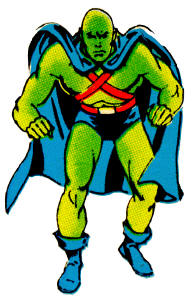
Hypertime 2025 tries to squeeze as much of the Pre-Crisis material that the writer grew up on back into the continuities of the biggest DC icons, particularly with regard to Superman and Batman. Wonder Woman suffers under the attempt, referencing a "new" Barbara Minerva version of Cheetah without having Priscilla Rich appear in the Golden Age book, making the Valerie Beaudry Silver Swan share space with green jumpsuit Angle Man, offering some sort of dapper Tony Stark x Dr. Psycho from no time ever, and squeezing it all into a quarter page to save space for Bizarro, Sinestro, and '60s Batman rogues-- obviously of equal importance to the majority of Amazing Amazon history. So basically, the same five DC characters that always get to feast get that much more to chew on, while the ones the basic boys were never as into get the leftovers. I like the Mark Waid as a person and a professional, but he's basically a war criminal on Paradise Island. All this to say, it's not just the Alien Atlas getting crumbs, but that's where I'll pour the rest of the salt today.
Here's where we get very New 52/Snyder Murderverse. The Martian Marvel remains in hiding, or at least of the public board, even as the Challengers, Adam Strange, and the boy sidekicks that would form the Teen Titans maker the scene. Next, a proto-Justice League forms around the initial incursion of Darkseid/the Fourth World, during which Victor Stone suffers crippling injuries and becomes a proto-Cyborg. After that initial encounter, Stone is placed in some sort of suspended animation "for further healing" until he's released to show a lot more skin as a New Teen Titan. DC wants the credit in foregrounding an African-American super-hero as an original Justice Leaguer, but they don't actually want to integrate him into their broader history. You might say that he's separate but equal. Sure, Jan.
That leaves Martian Manhunter and the second generation Black Canary to formally found the Justice League during the Appellaxian Invasion. So they're technically co-founders after a previous grouping was retconned in, just as happened to Hal Jordan, Wonder Woman, Superman, and Batman. Plus, this time we're leaving out the "of America," so maybe there's another formality where the "JLA" was a separate team altogether?
From there, the continuity is largely classical and chronological. J'Onn's part of the first Earth-2 seanace with the DC Trinity, though this edition is very coy about the existence of a Multiverse, so we're probably talking more about being trapped in a different vibrational plane here. The campaign against the scourge of boy sidekicks in short pants continues to be fought with retconned full leggings. Another deeply annoying choice is to have Plastic Man treated as a crappy mid-'60s DC hero only worthy of a caption box instead of one of the greatest Golden Age heroes featured in WWII-era Quality Comics publications. I guess Jack Cole fans are relieved to not have to associate his creation with decades of DC mishandling their version.
There's no mention of Martian Manhunter as the book vaguely touches on key developments of the 1970s and early '80s. To be fair, very little solo material of any heroes are offered, so I should be pleased that the mod Diana Prince and Aquaman's reign/marriage/heir/infanticide got the attention that they did. It was mostly just rattling heroic debuts in partial page pin-up shots. It's... let's go with "amusing," that all of Black peopledom go on ice with Cyborg. Until suddenly, oh my stars, there's John Stewart, Nubia, Bronze Tiger, and a little on Black Lightning is one long rip. Hey, another WW nod, too. In this context, and with a sense of perspective, Martian Manhunter's existence being solely defined by League incarnations fits. The Satellite era is bundled up into the Red Tornado blurb, but the Detroit League rate half a page. Sorta. They left out a visual of Vixen since she already had a debut blurb (representation!) plus we had a top hat & tails Zatanna, New 52 Vibe, and second suit Steel (did we even see Commander Steel in the first issue?) For all the clean up and inclusion, the ethnic slur Gypsy remains, though she looks more like her early JLTF self.
The final three pages covers a thin gruel take on Crisis on Infinite Earths. Asian female Dr. Lights will live. Supergirls will die. And can we squeeze an Infinity Incorporated profile into this? By the way, Power Girl and the Huntress still don't exist yet? The art this time was by Mike Allred, who I love and is perfect for covering this era, and Brad Walker, whose style is jarringly incompatible. I enjoyed Walker's style back when he was going to do a Martian Manhunter mini-series, but this more cartoony style is an awkward compromise.
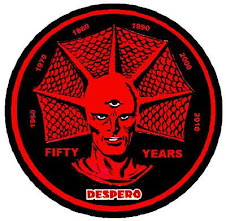
The backmatter co-written by Dave Wielgosz offers an insane amount of retcon review from the Post-Crisis period. The 2018 Martian Manhunter maxi-series that I gave up on a few issues in, with the latest already forgotten killer of all the Martians (second or third for that decade alone?) is the only J'Onn J'Onzz one given credence. Of course Mark Waid's own JLA: Year One is wedged in there, but that's a book people actually read and loved. Things start to settle into the actual Silver Age six pages in, but it's still pretty much just a list of character debuts. It occurs to me now that Iris Allen doesn't seem to die anymore? Oh, but Sue Dibny still gets assaulted by Dr. Light, at least in the liner notes? Mongul gets a brief nod, with a Starlin panel. The Despero erasure, tho. And don't get me started on Captain Atom.
Wednesday, July 9, 2025
History of the DC Universe (1987)
And so, the first half of the Post-Crisis on Infinite Earths revisionist history of DC published in 1986 is mighty concerned about Oa, prehistoric Earth, World War II... all those other places I mentioned. Without a comprehensive reread though, no mention of the planet Mars, or any of its denizens. Moving into the second half, they still devote a lot of pages to WWII, and a little bit of the post-war years. The one true Earth was still a cooling mass, however, so from there we leap to Task Force X and the conception of Aquaman. That famed rocket from a doomed planet had been launched in the first volume, and finally landed in a corn field near Smallville. A nigh-adolescent Bruce Wayne saw his parents gunned down, which gets a bit hinky with the relative ages of the DC Trinity. Phantom Stranger, Captain Comet, and the creation of Princess Diana arrive next. Well, one figure does fall between Comet and clay baby Wonder Woman...
Warrior J'onn J'onzz, exiled into the parched Martian desert, was teleported accidentally to planet Earth by the famous Professor Erdel. This Manhunter from Mars knew the time of heroes had not yet come, and so remained in hiding, disguising himself as a police detective until, at last, he could allow the world to know of his existence.There's a lot to consider there. Firstly, that was two sentences. I choose to offer long, sometimes tortured sentences as part of my personal expression, so you might call me hypocritical for pointing that out-- but dang! Next, the fact that in a rare instance of DC offering mixed caps in a canon story, only the Js are capitalized. Okay, I might be "considering" too pedantically. How about how the late Silver/early Bronze status quo begun with"...And So My World Ends!" seems to still be in place, with that "warrior" bit in particular pushed back against by the 1988 retcon? We're also in a vague pre-heroic age, with the best marker being the conception of Raven on the next page. The creative team on this book had come up with that character to be a member of the New Teen Titans, and the book's artist was presumably working out how his Wonder Woman would also debut in her late teens/early 20s in her new history. Therefore, at the time of publication, it would be fair to assume Detective John Jones was around in the late 1960s. Couldn't be much further back than that, if we want to keep Superman and Batman around 28-30 years old. While a handful of stories alluded to a further period setting, it would be another eight years before parity with his initial date of publication was established in Zero Hour: Crisis in Time #0.
In another short-lived stand for this continuity, the entire World's Finest trio launches the modern heroic age, placing Robin ahead of the latest version of Flash, Green Lantern, the Atom, the Hawks, Aquaman, Captain Atom, Green Arrow, and Blue Beetle. We see Starfire as a child, Cave Carson, the Challengers of the Unknown, Adam Strange, the Sea Devils, and Dolphin. Curious chronology ahead of their key super-team revival...
This was now the Silver Age of heroes, and some of the greatest who ever lived banded together to fight evil on Earth and throughout the stars. Inspired by the wartime exploits of the famed All-Stars and the Justice Society, these young heroes took the name the Justice League of America.Because John Byrne's Man of Steel had already rolled out, we knew that Superman would be excluded. Pictured as the core line-up were J'onn J'onzz, Aquaman, Barry Allen, Batman, and Hal Jordan. A scale Ray Palmer Atom was placed just outside the framing of this team inside the old badge logo of the JLA, with the floating heads of Oliver Queen and Katar Hol on either side. Not a bad guess, but this line-up was never properly executed in the comics. The Caped Crusader was eventually excluded, at least as a founder, though he inevitably engaged with the JLA early and often in this retcon. DC eventually settled on a quintet in 1988, capped by Black Canary. Jemm, Son of Saturn got a mention as a contemporary of Firestorm, Firehawk, and the Warlord Travis Morgan, oddly predating the retroactive continuity armored Gardner Grayle Atomic Knight, as well as Baron Winters of Night Force. These were mostly continuity charity cases, only getting a nod here by proximity to publication date. Jemm was originally a Son of Mars, who played heavily in the fields of post-apocalyptic Bronze Age New Mars stories, and his Saturnians were eventually retconned into literal Martian clones by Ostrander/Mandrake. It's nice for us, since none of the solo Manhunter from Mars adventures rated a mention, nor his predecessor, Roh Kar. Instead, as ever, and another gift of the zeitgeist, the Alien Atlas is solely represented in this period through his affiliation with the mid-80s Justice League (generally appended with "Detroit" to define the line-up of Batman, Elongated Man, Zatanna, Steel, Gypsy, Vibe, Vixen, and Aquaman. From there, we get into the weeds of para-Crisis on Infinite Earths material, with a heavy emphasis on developments during and spinning out of Legends, including the line-up of the first six months or so of the Justice League relaunch (soon-to-be-International.) So that's Dr. Light II, Captains Atom and Marvel, Mr. Miracle, Guy Gardner, Black Canary, Blue Beetle, and Dr. Fate. They're followed by the Suicide Squad and, ugh, Post-Crisis Wonder Woman. It makes my skin itch when people rave about the female leg of the DC Trinity arriving after freakin' EVERYBODY, just so Perez could treat his Simonson Thor retread as though it were a brand new shiny thing. And then from there is a toboggan ride through the potential futures, most especially the Legion of Super-Heroes 30th Century, that will be ripped to pieces to wipe the butt of every reboot from here through the next five decades and counting.
Wednesday, July 2, 2025
New History of the DC Universe #1 (August, 2025)
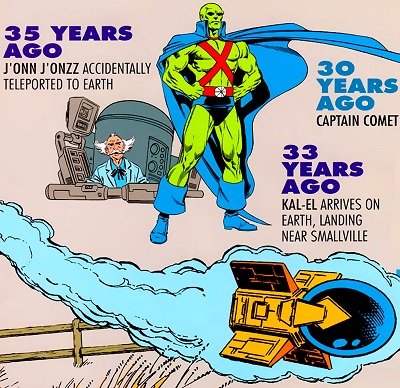
In a key divergence, the writer incorporates elements of the mini-series Doomsday Clock, which to my horror is from nearly eight years ago (though the maxi-series took two years to complete, so its latest reveals are closer to a half-decade-plus old.) Actually, the writer is surprisingly deferential to Geoff Johns' work in general, so maybe he still has sway as the former CCO, or it's just an acknowledgement of his impact at the company. Anyway, the reference is to a government think tank meant to replace the super-heroes lost after the forced retirement on the Justice Society in the early 1950s. Dr. Niles Caulder, Will Magnus, Professor Martin Stein, and Simon Stagg are named and credentialed, so unless one of their projects involved the study of Ian Karkull, these guys would be a minimum of about 30 years old at the time. They would soon reference baby Kal-El's rocket from Krypton, and human frailty suggests these guys would be 60+ today at most, so we're talking a setting of about the same time as 1994's Zero Hour: Crisis in Time that gave us the Martian Manhunter's 35 Years Ago time frame, then meaning 1959.
J'onn J'onzz's use as an historical benchmark is almost exactly the same in execution between the "1987" and 2025 editions of History, but with wildly different relative contexts. Timeline-wise, Martian Manhunter anchors the same gap between "heroic ages" from Justices Society to League that he once did sharing a page with Captain Comet. Except now, the presumably 1950s-set Comet forms a short-lived "Justice Alliance" with other characters published (but not previously canonically set) in that decade: Prince Ra-Man, Automan, Tiger-Man, and Congorilla. What used to be about a four year difference in age between Comet and Manhunter is probably now more like forty years. It makes me wonder where and if the Justice Experience has standing in this sliding timeline, since they were a late 60s/early '70s set team, but Cameron Chase is likely not meant to be in her sixties after seeing her father murdered by Dr. Trap as a child.
With all that having been said, at the end of the day, the image yet comes down to the Alien Atlas manifesting before Erdel, now formally mashing up pre-and-post-Crisis incarnations by name and title...
"In a small laboratory in Colorado, Dr. Mark Saul Erdel tested his teleportation ray for the first time. Inadvertently, he wrenched through space and time a Martian named J'Onn J'Onzz--Note the mixed caps, which will come up again later/earlier. This book was by writer Mark Waid and artists Todd Nauck and Jerry Ordway. I'd initially assumed that one was inking the other to various degrees, but once I actually read the book, it was clear each was providing full art on their individual pages, with Nauck drawing the Manhunter one. Dave Wielgosz is credited with researching the project with Waid, and offers copious end notes to the issue. The 1998 volume of Martian Manhunter is referenced a few times, including some Tom Mandrake art. Specifically, Ma'aleca'andra's colonization of the solar system. There's also a weirdly worded reference to Kelly/Mahnke JLA about how White Martians "arise" around the time of the Crusades on Earth. The prior Ostrander reference was from Earth's pre-history, with White Martians already competing with greens in the expansion. Even if you excuse it as a reference to the phenomenon of "Burning Martians," one of those was killed by Vandal Savage in the caveman days, so it's still needlessly anachronous. Ma'alefa'ak's plague is unleashed between the times of the Earl of Strethmere and Captain Fear in the early 18th Century of Earth. J'Onn's teleportation is listed between the inital I-Spy activities of King Faraday, and Slam Bradley's arrival in Gotham City.

Monday, October 14, 2024
Jack Reed
"In my secret identity of John Jones, I'm an accomplished detective with the Middleton police force-- but Jack Reed set the standard there. He was as brave and skilled an officer as I've ever known. If only that had been enough to keep him safe. Jack made plenty of enemies. Vengeful mobsters murdered Jack and his wife. Their son Robby was barely two-- not old enough to realize what had happened-- only old enough to feel a great and inexplicable sense of loss. Not long after, Robby's maternal grandfather moved the boy to nearby Littleville. I can see now that I should have stayed in touch-- since i can't fathom what could have turned the boy into a-- super-hero?"See Also: Silver Age: Dial H for Hero #1 (July, 2000)
Monday, July 24, 2023
Brightest Day #3 (Early August, 2010)
In Pearl River, New York, at Rockland County Morgue, J'Onn J'Onzz observed the flayed bodies of the massacred family. Finding a dog hair on their clothes, he tracked their absent family dog to the Rockland County Animal Shelter. In its memory, J'Onn saw a corrupted Martian figure stripping off the skins of the family members. He then took the dog to keep Melissa Erdel company, having wiped its memory of the trauma.
"Revelations" was by writers Peter J. Tomasi & Geoff Johns, with art by Patrick Gleason & company.
Monday, July 17, 2023
Brightest Day #2 (Late July, 2010)
The exact same scenario had played out in the previous issue, where a Black man working at a fish market was triggered by news of Aquaman's return, and murdered everyone at the shop with a knife. For a moment, especially with the TV shot of Aquaman, I thought the writers might have been playing at some sort of mass hysteria event related to Blackest Night that obfuscated the exact triggers/targets. But then I remembered that the man was revealed as Black Manta at the end of the issue, and the woman hissed J'Onzz's name after her homicidal episode, so their individual obsessions were never in doubt. They were just repeating the exact same gory, exploitative plot element in unrelated circumstances. Or put simply, writing poorly, which can happen with fatigue toward the end of a biweekly group collaborative maxi-series, but a severe warning sign on the third issue out of 25+. The exact murder weapons were an electric slicer, drum sticks, and a toy guitar/game accessory, in case you were curious.
In Denver, Colorado, J'Onn visited the grave of his "old friend," Saul Erdel, whose headstone read "TEACHER AND EXPLORER." In Post-Crisis continuity, the nature of J'Onn's relationship with Erdel has remained contradictory and unclear, though generally Erdel still dies almost immediately after encountering the Martian. Manhunter ghosts his way though the ground into Saul's coffin. Erdel's emaciated, near-skeletal hands were laid across his chest, left clutching photographs of Saul and the unidentified woman from the vision, dressed for the lab. The back of one read, "Me and Dad at the lake." So was it a lab at a lake, or a lettering error? The Sleuth from Outer Space swiftly located the now elderly woman at Mount Hope Senior Home. The blue-eyed woman identified as Melissa was in a wheelchair, where she liked to stare out her window toward the stars, and she had a large outwardly branching scar at her right temple. J'Onzz took the form of her father, whom she still remembered, even though she now routinely forgot a great many important things.
On a moonlit flight, Melissa was willing to tell her story, if "Dad" could just help her remember. "I remember when you first showed me the stone tablet you found in the ancient ruins of that Aztec temple when you were a boy... I can still hear the wonder in your voice when you told me the same bedtime story every night of how space travelers from the red star once visited our planet and helped an ancient people survive and thrive. Once you had it translated it became your life-- our life-- and I was glad Mom left-- She never understood what we were trying to do-- All she saw was an obsession-- and all we saw was the future... but the future was pain... and horror. We should have run, Dad. We should have run as fast as we could. But we didn't. Because intertwined in all our fear was hope... Hope that somehow peace and understanding would win that terrible night. But it didn't. All our dreams of reaching out to a new world... only put our in jeopardy."
Oh-- I thought we were introducing a mystery that would play out over the course of the series, not creating a brand new character to insert into Martian Manhunhter's origin so that she could give an exposition dump in issue #2. Gee, I hope that doesn't mean that with all that extra space, the story won't devolve into a bunch of meaningless screaming and violence where the mystery could have gone. Also, mom was right, actually. Let me break down that mess of run-on sentences and misused dashes. Saul Erdel was apparently such a privileged white boy that he was able to steal a square foot of stone artifact from a Latin country that seemed to confirm the existence of aliens via a crude rendition of a cone-headed Martian wearing the classic Manhunter costume. After somehow translating the language of a presumed millennia-dead people from a planet away via mid-20th Century science, it was determined that this alien played into debunked racist theories of non-White civilizations being reliant on extraterrestrials for their noted achievements. Father and daughter wasted their lives trying to make contact with an alien race not recorded since at least 1521 A.D., and their "success" was to unleash a body horror creature onto their world that was all twisted limbs and jagged teeth. Despite presumably being the same alien that massacred their own "family," this first contact involving elongated and grotesquely enlarged appendages applying throat chokes and tossing the Erdels around like rag dolls, but they survive intact and barely bloodied. Maybe they'd also made a scientific breakthrough in the field of plot armor? Worst of all-- Saul brainwashed his little girl with Chariots of the Gods fanfic on nightly repeat? Mom should have called CPS on the way out.
"So you had a new mission, Dad. A new obsession. And I hated you for making me hide in the shadows and not allowing me to be part of it. I remember when I asked you why in the world you would try something like this again after everything that happened. A sad smile crossed your lips, Dad, and all you said was: I'm a scientist, Melissa, and science is built on the foundation of failure. How could I not try to right a wrong? And then one night, there he was. Standing before you-- before us-- the same type of being we saw etched into the ancient stone tablet. The one I would learn years later is called J'Onn J'Onzz, the Martian Manhunter. He was going to be our savior-- deliver us from the evil we had unleashed. I didn't see the cyclonic power generator arcing from behind the door... but you did. I still hear your scream every night, Dad, just as I can see the flash of the explosion that blinded me for weeks... along with a piece of the transporter console that left it's mark on me forever."
Albert Einstein was also a scientist, often attributed the quote "The definition of insanity is doing the same thing over and over again and expecting a different result." For instance, unleashing an alien xenomorph, shrugging, then tapping on another egg in hopes you'll get lucky and find a Kryptonian instead of a facehugger in that one. Writ large, it would also apply to revising Martian Manhunter's origin as a way in for new readers instead of telling, I dunno, an actual new story? We're not all Melissa Erdel over here. Also, notice how I put those little two-finger wave things on either side of phrases in which I'm directly quoting someone? Might want to try it sometime. One of my particular writing quirks is overly long sentences, arguably in need of better structure or truncation, but it's a conscious stylistic choice on my part. This reads like a child all sugared-up on Pixie Stix whose every sentence is a paragraph of nonsense. How exactly was Erdel "protecting" his daughter by having her in the same house where he's trying to manifest an opposite number against SIL from Species, in line of vision so that she could be blinded, and less than a stone's throw distance because an actual chunk of debris flew into her brain? Saul tackled J'Onn to "save" him from the explosion, but forgets to tell the Martian in a lab ablaze, "Oh hey, can you do me a solid and make sure my adult daughter gets out of here safely?" I assume that her childlike recollection is from the brain damage, and that she was not in fact a teenager imperiled and disabled as a result of her father's negligence.
Even here, Melissa was still entirely concerned about the comfort of her dying father, left to wonder what his final words were. The reader is not so deprived. "... forgive me... for taking you from your home... needed someone to save us... save us from my arrogance... my recklessness..." Not "my baby-- she's still in the fire! Save her!" Not "I brought you here to fight a horrible creature that I accidentally ripped from your planet, if you don't mind looking into that, once you get settled." Not even, "so, like, what can you tell me about those Aztecs." At least he didn't specify that he wanted the Leonard Cohen and not Jeff Buckley version of "Hallelujah" played at his funeral service. That would have been selfish, and also, not the broad preference of any potential mourners of this nutjob shut-in. Anyway, Melissa still expressed gratitude that her father "protected" her from his experiments, rather than plainly ruin her life like what we saw, and she was proud that he'd delivered the Martian hero that would presumably confront their mistake (after a decades long unchecked and undetected rampage of uncounted carnage,) hopefully before she died of old age?
"Nuclear Options" was by writers Peter J. Tomasi & Geoff Johns, with art by Patrick Gleason & company. Yeah, nuclear options are indeed looking good at this stage. "Stop me before I retcon again." The art was much better this time, more in line withn his excellent, undervalued Aquaman run.
Monday, July 10, 2023
Brightest Day #1 (Early July, 2010)
"Second Chances" was by writers Peter J. Tomasi & Geoff Johns, with art by Patrick Gleason & company. While I was pleased that J'Onn had made a swift return from his stunt death, as he settled into his narrative within the quasi-anthology, I found the direction wanting. I had really enjoyed Fernando Pasarin art in the initial shared section with the Green Lanterns in #1, only to be succeeded by Pat Gleason delivering some of his worst art to this date. I guess someone felt the need to reenforce J'Onn's ties to Earth after the Coneheadhunter offered a brief and mostly overlooked reembrace of his Martian identity, but I don't think the fandom needed this. Given the state of Earth even then, wasting vital resources on Martian nostalgia just made J'Onn look foolish, and spun his narrative wheels at a point where he desperately needed traction.
Monday, March 7, 2022
35 Years Ago
I don't believe I owned or read "The Origin of the Justice League-- Minus One!" until after I started this blog, but it swiftly became one of my favorite Martian Manhunter related stories. That statement is thick with disclaimers, among them being that the Manhunter is at best a supporting player in the overall narrative, and I'm not all that enamored with the actual script. It's down to the conceit. Retroactive continuity grounded firmly in established lore, supplying an untold story of how most of the original Justice Leaguers first met, researched to the month of proposed publication, referencing exactly where the players in DC hero comics would have been at that exact moment in time. Obscure characters and continuity minutia are my kink, so a story working in the little seen original Robotman (All-Star Squadron wasn't even a twinkle in Roy's eye yet) and contextualizing where vanguard teams like the Challengers and Blackhawks would have been relative to one another? *Ecstatic shudder* It was obviously a primary influence on Darwyn Cook's The New Frontier, made rare direct nods to actual Manhunter from Mars strip elements, and grounded John Jones so firmly in one of the most fascinating periods in United States history that he was still acknowledged as a 1950s hero as canon during Zero Hour? The event series designed to euthanize surviving 1940s heroes? It's positively miraculous that this thing still has a toe-hold of relevancy, much less an actual artistic legacy.
That mid-century, postwar, paranoiac, conformist, xenophobic period is such a perfect milieu for the Sleuth from Outer Space. It's also the overlooked middle child between the roaring 20s/Depression/WWII and the revolutionary 60s/Me Decade/80s excess that it speaks to a Gen-Xer like me. Eternally, horrifically tainted creative ped(-o-)gree aside, Martian Manhunter: American Secrets remains a top contender for my actual favorite story that not only unquestionably stars the Alien Atlas, but is also about exploring the same themes as the character himself. In 1994, J'onn J'onzz was explicitly stated as arriving "35 years ago," which supported that 1977 Steve Englehart's setting for only the year Zero Hour #0 was published. I'm sure the intent was Marvel method, where Reed & Ben went from serving in World War II to Korea to... jeez, didn't they end up in the Persian Gulf at some point? And yes, J'onn J'onzz did have a bunch of '60s & '70s set stories published in the '90s & '00s, but he never felt unmoored from the 1950s. The Justice Society exited, and the Manhunter from Mars quietly, covertly entered. I big part of his appeal, certainly to myself and in my experience others, was that he was a rare super-hero "holding the line" before the likes of Clark Kent was (functionally) born, much less "The New Heroic Age" begins. Even when my fandom exploded in the late '90s, it was hard to swallow 40+ years of no one else appearing in the JSA's stead. It was even harder when I finally read "Minus One" another decade (and century) removed. Today, it's too great a logistical hurdle.
It should surprise no one that after decades of writing about the Martian Marvel, I have oodles of stories conceived for the hero swimming around my head. Every comic fan carries some fan fiction within them, whether they express it or not. A lot of mine involve continuity patches. When DC Comics bought Wildstorm, they had a fair amount of continuity set in the '40s and '60s that could have been absorbed by DC to fill those "lost decades" before Batman had his Year One. My feeling was that a lot of DC's properties really only worked for the time period in which they were conceived, so why not just leave the Sea Devils or the Metal Men in the 1960s? DC so radically altered the Charlton heroes when reintroducing them post-Crisis that there could have just as easily been a real "Watchmen" made up of their inspirations who had come and gone in times past. If I wanted to keep some vestige of "Minus One" in continuity, why not recast the Barry Allen Flash as Johnny Quick, or really lean into a want of mine, Superman replaced by Captain Comet for even more fifties team-ups?
The "why not" is pretty obvious. DC's love-hate relationship with the JSA for sure, and those historical ties to the Golden Age are often considered an albatross. All that continuity that I wanted to patch was cast aside in 2011 by Flashpoint and "The New 52." Even after Rebirth and Dark Nights debuted an all-inclusive Hypertime omniverse, there's little editorial appetite for deep dive continuity implants. With 89% of DC's current output being Batman Family titles, where would you even put one? Frankly, dear as the generational legacy aspect is to my heart, World War II was nearly a century ago. Do we really want to be conjuring up Nazis and straight patriarchal Caucasian heroic hegemony into infinity? That's rhetorical. No rando partisan gater comment bombs are being solicited here. You guys are a little too into Kylo Ren, right? "Let the past die. Kill it, if you have to."
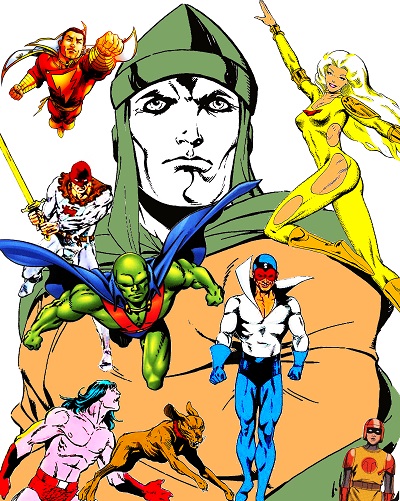
Speaking of solicitations, for two years next month, I've devoted entirely too much time to obsessively crafting fake ad copy for a line of books in an alternate DC Universe as part of Siskoid's Who's Editing. "Why" is an excellent question. I have a number of answers of varying degrees of quality and desperate raving madness that I vaguely allude to in a companion podcast, The DK Encyclopedia Diaries: The Drunken Guide To The Characters Of The DC Universe. Hopefully I can slur out a semblance of a satisfying response before my liver gives out. But one of them is to serve as my personal island of misfit ideas, aborted concepts lost to space and time and lack of ambition... tears in the rain streaking down little seen comments. This entire post was a ploy to fill a week of blogging with a visual aid I roughly threw together of a final alternate draft for the DC You Moi "Minus One." I had Captain Marvel still active in the 1950s in my "DC Comments Challenge," while Captain Comet is otherwise engaged, so he got the Superman spot. Knight & Squire, the Fury, Max Mercury, and Neptune Perkins stand in for the rest of the proto-JLA. Rex the Wonder Dog from the original story is rendered Thor the Thunderdog here, and a non-pictured Tommy Tomorrow takes pre-GL Hal Jordan's place. Variations of this substitute League have swirled in my subconscious for at least three presidencies. It's never to be, and acknowledging it here as a pure fan fiction is cathartic for me. Thanks for indulging my eleven-hundred word blogging therapy session.
Monday, August 2, 2021
JLA: Year One #12 (December, 1998)
The Daily Planet buzzed over Earth's heroes beating back the Appellaxian invaders. Two generations of Green Lanterns & friends saved Metropolis. Black Canary & the Blackhawks had an Iwo Jima moment in DC. Aquaman, the Sea Devils and others were in... um... ocean? Hawkman, Hawkgirl, Shining Knight, and Black Condor fought avians in... air, and Martian Manhunter had to listen to them wonder how the aliens knew all their secret identities. Awkward. Kalar took out his frustrations on Stonehenge, where a teleporting Vandal Savage used the mindwipe device to take out a group of Appellaxians, and also took offense at the insult to his design. On to St. Louis. In a brilliant moment, the Atom shattered a crystal proxy by enlarging slightly in one of its flaws, but the explosion knocked Ray Palmer out, leaving his tiny form to be caught in the palms of Doll Man. In Paris, Molly Mayne reported on the Global Guardians. In Central City, Canary and Flash reunited, as did Barry Allen and Iris West, so Dinah made clear that she wasn't going to be her mother's daughter in a way that would make for two-timing. Also, Green Arrow showed up to flirt. Martian Manhunter helped clear Peking, but even with Metamorpho and the Doom Patrol, the Great Wall was lost. Despite some gains, there were just too many aliens being fought by exhausted heroes. Even the mystical likes of Dr. Fate and the Spectre faltered. Vandal Savage offered a poisoned chalice, delivered by a shapeshifted Clayface in his image. The device, now set to kill all the Appellaxians on Earth with the touch of a button. The League debated. Aquaman and Flash leaned yeh, Canary and Lantern nay. Snapper Carr and Martian Manhunter went a third way, filtering the device's ray's through J'Onn's psyche to render it agonizing rather than lethal. The Alien Atlas head warped and mind verged on shattering. Aquaman whispered, "I'm here, J'Onn, my friend. Open your mind to me... Open your mind... to us." The League lent their own psyches to the filtration. The mystics creating a portal to Appellaxia, and those that didn't walk through it were tossed in. Savage wanted the League complicit in an act of vengeance. Canary insisted, "We're not about vengeance... we're about justice!" Flash noted, "I'll say it again, J'Onn. You never fail to surprise us. That was one incredible risk." J'Onn felt he owed a debt to everyone there for the way he'd compromised them, which Canary assured with a kiss was "--Paid in full. Let it go. We will." Hawkman asserted that the Justice Society was proud to pass the torch, and Superman stated that there could be no greater honor than to serve at their side when needed. Planet headlines announced future victories against Amazo, (an anachronistic) Despero, and Kanjar Ro. Aquaman removed the plague commemorating the Appellaxian casualty of their first missio, and thought the surface dwellers had done a nice job pulling together. There was a very forced moment where Black Canary likened herself to a flower blossoming and a bunch of stuff about hers and Flash secret identities being trains going in different directions, yadda yadda. Green Lantern put forth the notion of expanding the roster, beginning with Green Arrow, to the questioning of Dinah and Barry. They took it to a vote. As it turned out, the identity of the secret financier Simon Carr continued to keep was none other than Oliver Queen. "The Irony is just to wicked." "Justice for All" was by storytellers Mark Waid / Brian Augustyn / Barry Kitson with inker Michael Bair. This extra-length finale didn't take so long to read or to write up, but I put it off because of all the expected listing of names and locations and this happened and that happened. All the toys got set up in their displays and the good guys won. I appreciated that this series made a point of spotlighting the original Blue Beetle, often overlooked in DC history as one of the earliest published super-heroes (thanks to his originating at another publisher and not moving to DC until after Gerry Conway and Roy Thomas were heading out the door.) Still, fanboy here, so can't quite forget that the Seven Soldiers of Victory should have still been separated and lost in time. Overall, the story is nice and pleasant, with no small amount of nostalgia both for Silver Age comics and even then-contemporary ones. There are some great bits and classic character moments. The whole premise of a super-alien with total recall keeping filing cabinets full of excruciatingly sensitive data about masked heroes on paper in filing cabinets behind a false wall is about the dopiest I could point to off the top of my head. It worked way better as encrypted files on the Bat-computer in "Tower of Babel." All the Appellaxian stuff goes on for too long, and I wish we'd had more single issue spotlights and attention to period detail. Then again, they tried that with the quasi-sequel Incarnations, and maybe not so much. This is probably my second or third pass reading the material, and my second write-up, so I'm probably done revisiting it unbidden by outside factors. I like it fine, but prefer to skim rather than fully invest as a whole, which is probably why it never got a proper adaptation.